Category
page 1Logic symbols

exclamation mark
punctuation mark (!) to show strong feelings

tilde
The tilde (, also ) is a grapheme or with a number of uses. The name of the character came into English from Spanish , which, in turn, came from the Latin , meaning 'title' or 'superscription'. Its primary use is as a diacritic in combination with a base letter. Its freestanding form is used in modern texts mainly to indicate approximation.

&
The ampersand, also known as the and sign, is the logogram , representing the conjunction "and". It originated as a ligature of the word (Latin for ).
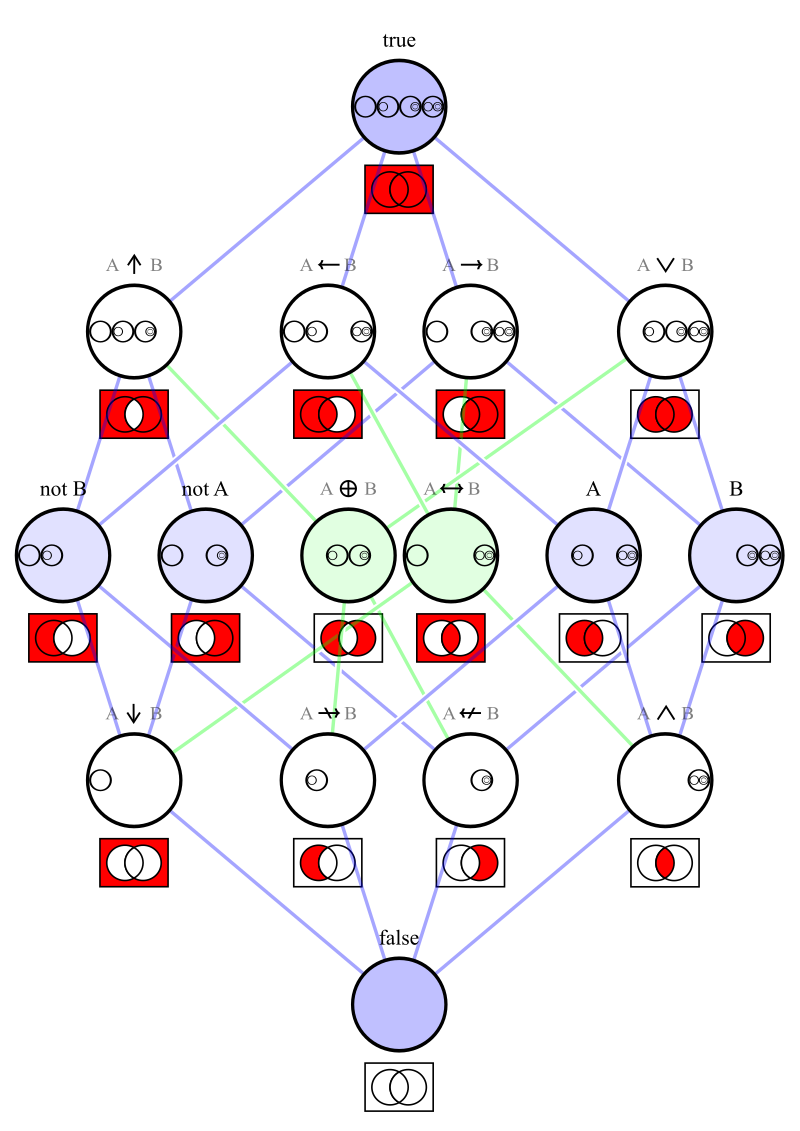
logical operator
symbol or word which can be applied to statements (of either a formal or a natural language) to produce a new statement
vertical bar
a glyph with various uses in mathematics, computing, and typography
universal quantification
logical quantification stating that a statement holds for all objects
existential quantification
logical quantification stating that a statement holds for at least one object
arrow
direction symbol
Sheffer stroke
logical operation that asserts that at least one of its operands is false
Ɐ
Latin letter turned A
list of logic symbols
Wikimedia list article
logical constant
term in logic
propositional variable
mathematical representation of truth or falsehood
literal
in logic, atomic formula (atom) or its negation
free and bound variables
classification of variables in a logic formula based on whether or not they are inside the scope of a quantifier
therefore sign
mathematical logical symbol
◊
form of rhombus
symbol
basic element of strings in a formal language
triple bar
mathematical symbol "≡" with multiple meanings
turnstile
mathematical symbol
double turnstile
mathematical symbol
→
→ or -> may refer to: