Category
page 1Love and lust gods

Krishna
Krishna (; Sanskrit: कृष्ण, ) is a major deity in Hinduism. He is worshipped as the eighth avatar of Vishnu and also as the Supreme God in his own right. He is the god of protection, compassion, tenderness, and love; and is widely revered among Hindu divinities. Krishna's birthday is celebrated every year by Hindus on Krishna Janmashtami according to the lunisolar Hindu calendar, which falls in late August or early September of the Gregorian calendar.

Cupid
In classical mythology, Cupid ( , meaning "passionate desire") is the god of desire, erotic love, attraction and affection. He is often portrayed as the son of the love goddess Venus and the god of war Mars. He is also known as Amor (Latin: '''', "love"). His Greek counterpart is Eros.
Although Eros is generally portrayed as a slender winged youth in Classical Greek art, during the Hellenistic period, he was increasingly portrayed as a chubby boy. During this time, his iconography acquired the bow and arrow that represent his source of power: a person, or even a deity, who is shot by Cupid's a
.jpg)
Bes
Bes (; also spelled as Bisu, , ), together with his feminine counterpart Beset, is an ancient Egyptian deity, of Nubian or C-Group culture origin worshipped as a protector of households and, in particular, of mothers, children, and childbirth. Bes later came to be regarded as the defender of everything good and the enemy of all that is bad. According to Donald Mackenzie in 1907, Bes may have been a Middle Kingdom import from Nubia and his cult did not become widespread until the beginning of the New Kingdom, but more recently several Bes-like figurines have been found in deposits from the Naqa
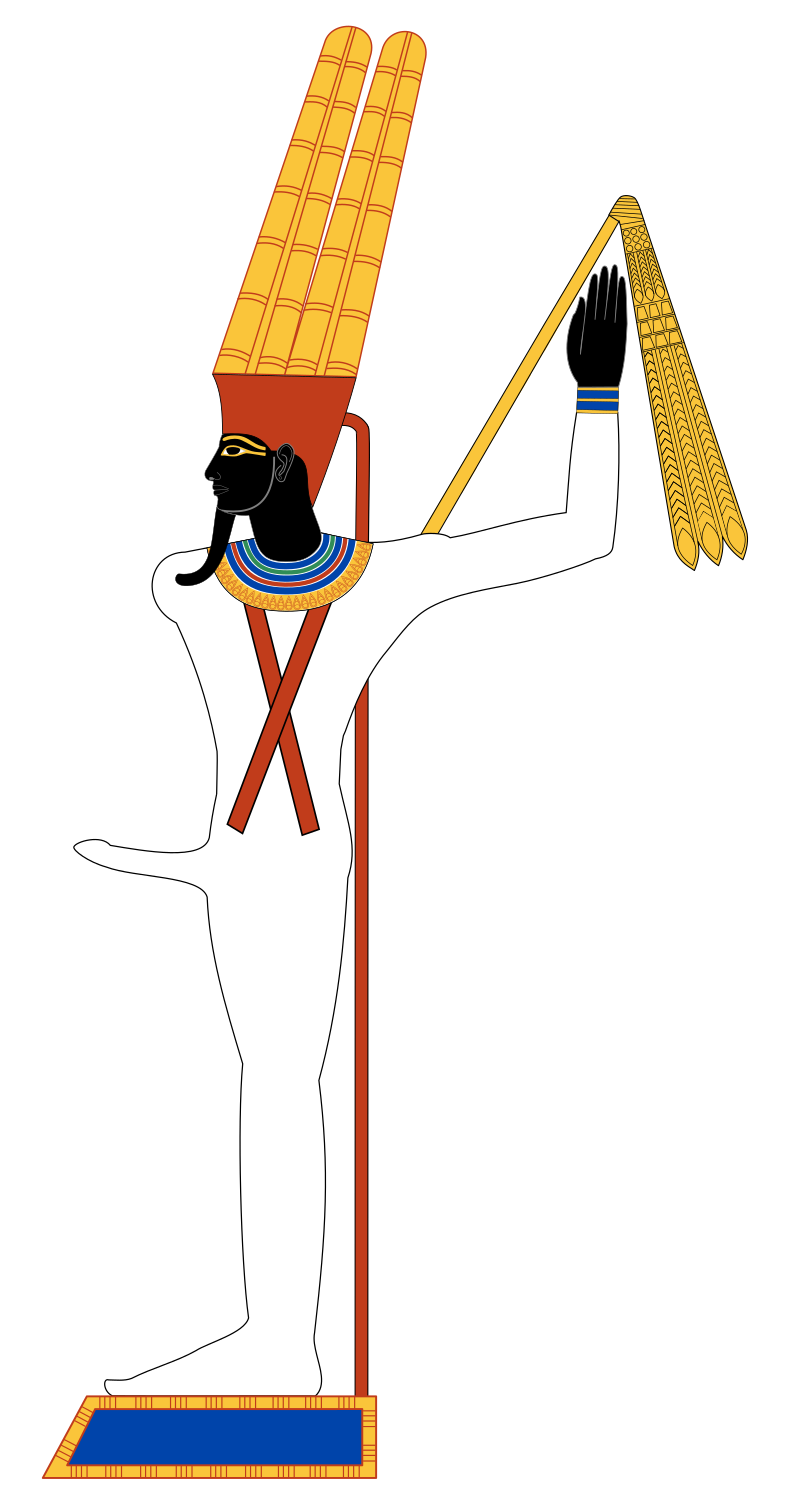
Min
Egyptian deity
%20-%2002.jpg)
Hermaphroditus
thumb|Herculaneum fresco 1–50 AD, [[National Archaeological Museum, Naples]]
In ancient Greek religion and mythology, Hermaphroditus (; , ) is a child of Aphrodite and Hermes. According to Ovid, he was born a remarkably beautiful boy whom the naiad Salmacis attempted to rape and prayed to be united with forever. A god, in answer to her prayer, merged their two forms into one and transformed him into a being of two sexes, both male and female. His name is compounded of his parents' names, Hermes and Aphrodite, and is the origin of the term hermaphrodite.
.jpg)
Kamadeva
Kamadeva (, ), also known as Kama, Manmatha, and Madana is the Hindu god of love, carnal desire, attraction, pleasure and beauty, as well as the personification of the concept of kāma. He is depicted as a handsome young man decked with ornaments and flowers, armed with a bow of sugarcane and shooting arrows of flowers. He often portrayed alongside his consort and female counterpart, Rati.

Susanoo
__FORCETOC__
.jpg)
Antinous
Antinous, also called Antinoös, (; ; – ) was a Greek youth from Bithynia, a favourite and lover of the Roman emperor Hadrian. Following his premature death before his 20th birthday, Antinous was deified on Hadrian's orders, being worshipped in both the Greek East and Latin West, sometimes as a god () and sometimes merely as a hero ().

Xochipilli
'''''' is the god of beauty, youth, love, passion, sex, sexuality, homosexuality, fertility, arts, song, music, dance, painting, writing, games, playfulness, nature, vegetation and flowers in Aztec mythology. His name contains the Nahuatl words ("flower") and (either "prince" or "child") and hence means "flower prince".

Aengus
In Irish mythology, Aengus or Óengus is one of the Tuatha Dé Danann and probably originally a god associated with youth, love, summer and poetic inspiration. The son of The Dagda and Boann, Aengus is also known as Macan Óc ("the young boy" or "young son"), and corresponds to the Welsh mythical figure Mabon and the Celtic god Maponos. He plays a central role in five Irish myths.

Daikokuten
is a syncretic Japanese deity of fortune, luck and wealth. Daikokuten originated from Mahākāla, the Buddhist conflated with the native Shinto god Ōkuninushi. He is a patron of farmers, cooks and jobs related to money such as bankers.
Huehuecoyotl
In Aztec mythology, Huēhuehcoyōtl () (from huēhueh "very old" (literally, "old old") and coyōtl "coyote" in Nahuatl) is the auspicious Pre-Columbian god of music, dance, mischief, and song. He is the patron of uninhibited sexuality — his partners can be female or male of any species — and rules over the day sign in the Aztec calendar named cuetzpallin (lizard) and the fourth trecena Xochitl ("flower" in Nahuatl).
Babi
deity
Baron Samedi
Loa of Haitian Vodou
Tu Er Shen
Chinese deity of homosexual love and sex

Rāgarāja
Rāgarāja () is a deity venerated in the Esoteric and Vajrayana Buddhist traditions. He is especially revered in Chinese Esoteric Buddhism in Chinese communities as well as Shingon and Tendai in Japan.
Yue-Laou
Taoist god of marriage and love in Chinese folk religion

Kurupi
thumb|Statue of Curupi.
Curupi (') or Kurupi' is a figure in Guaraní mythology, known particularly for an elongated penis that can wind once or several turns around the waist or torso, or wrap around its arms, and feared as the abductor and rapist of women.

Maximón
Maximón () is a Maya deity and folk saint, represented in various forms by the Maya peoples of several towns in the Guatemalan Highlands. Oral tradition of his creation and purpose in these communities is complex, diverse, and born of the ancient Maya traditions centuries ago.
Lempo
Lempo () is a demon from Finnish folklore and mythology. Lempo has been connected to the names Lemmes, Lemmas, Lemmätär and Lemmetär (), as well as themes of love and fire. The -tär ending names are feminine, but Lempo has also been understood as a male demon in some instances.
phallic saint
representation of a saint or fertility deity
Thongalen
Thongalen (also, Thongalel, Thongaren or Thongarel) is the god of the dead and the king of the underworld in Meitei mythology and Sanamahism, the indigenous religion of Manipur.
He is the Guardian God of the nadir..
Elbis
Elbis (also Ilvis, Ilbis or Yilbis) is a deity of war and love in Turkic, Yakut, Tuva and Altai mythology. Since "Elbis" shares some devilish characteristics, he became identified with Iblis under Islamic influences. However the name actually derives from the root "Yel" (or El/Al/Yal), which describes evil features.
Khoriphaba
Khoriphaba is a God in Sanamahism, the indigenous religion of Manipur. He is the son of Sky God Salailen and the Goddess Konthoujam Tampha Lairembi. He came down from heaven to earth to search for his mother and then for a bride. He is best known for wrestling with Loyalakpa in the Lai Haraoba festival. He is also a Sagol Kangjei(polo)-playing God.
Loiyalakpa
Loyalakpa is a God in Sanamahism, the indigenous religion of Manipur. He is best known for wrestling with Khoriphaba during the Lai Haraoba festival. He is the consort of goddess Thoudu Nungthel Leima. He is one of the ten kingly gods (or ten divine kings) in Meitei religion.
Korouhanba
Korouhanba is the God of the Sun, the Sky and the Heaven in Sanamahism, the indigenous religion of Manipur. He is also known as Taohuireng and is one of the two sun brothers in the Numit Kappa epic legend. He is also called Ngantureng because of his ability to remove darkness. He is described as "Songbu Chiraitangba" — a physician who is bald headed.
Astrild
Astrild (from Old Norse: "Love-fire") is a relatively late Nordic name for Amor or Cupid. Astrild probably originated in the writings of the 17th-century Swedish poet Georg Stiernhielm, and has since been used in Nordic poetry, mainly during the Baroque and Rococo eras, such as in Carl Michael Bellman's 1790 ''Fredman's Epistles''. Astrild does not appear in Norse mythology, even though the name was used before Stiernhielm as a synonym for the estrildid finches.