Category
page 1Lujanian

Macrauchenia
Macrauchenia ("long llama", based on the now-invalid llama genus, Auchenia, from Greek "big neck") is an extinct genus of large ungulate native to South America from the Pliocene or Middle Pleistocene to the end of the Late Pleistocene. It was one of the last surviving members of the extinct order Litopterna, a group of South American native ungulates distinct from the two orders which contain all living ungulates which had been present in South America since the early Cenozoic, over 60 million years ago, prior to the arrival of living ungulates in South America around 2.5 million years ago as
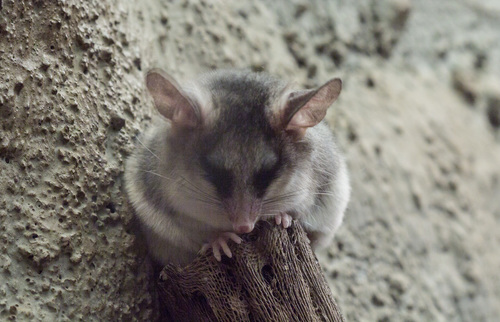
Thylamys
Thylamys is a genus of opossums in the family Didelphidae. The premaxillae are rounded rather than pointed. The females lack a pouch. The females' nipples are arranged in two symmetrical rows on the abdomen. All species but T. macrurus store fat in their tails, although this is not necessarily true for all species in the genus. Fossils belonging to the genus date back to the Miocene, with the oldest specimens being found in the Cerro Azul Formation of Argentina and the Honda Group of Colombia. Genetic studies indicate that the genus may have originated around 14 million years ago.

Toxodon
Toxodon (from Ancient Greek τόξον (tóxon), meaning "bow", and ὀδούς (odoús), meaning "tooth", in reference to the curvature of the teeth) is an extinct genus of large ungulate native to South America from the Pliocene to the end of the Late Pleistocene. Toxodon is a member of Notoungulata, an order of extinct South American native ungulates distinct from the two living ungulate orders that had been indigenous to the continent for over 60 million years since the early Cenozoic, prior to the arrival of living ungulates into South America around 2.5 million years ago during the Great American Int
.jpg)
Arctotherium
Arctotherium ("bear beast") is an extinct genus of short-faced bears endemic to Central and South America from the Late Pliocene to the end of the Late Pleistocene. Arctotherium migrated from North America to South America during the Great American Interchange, following the formation of the Isthmus of Panama during the late Pliocene.

Mylodon
Mylodon is an extinct genus of ground sloth belonging to the family Mylodontidae, known from southern South America. With a total length of 3 to 4 m and a body mass of 1-2 tonnes, it is one of the largest mylodontids (though it was considerably exceeded in size by the mylodontid Lestodon).

Eremotherium
Eremotherium (from Greek for "steppe" or "desert" "beast": ἔρημος "steppe or desert" and θηρίον "beast") is an extinct genus of giant ground sloth in the family Megatheriidae. Eremotherium lived in southern North America, Central America, and northern South America. It was one of the largest sloths, with a body size comparable to elephants, weighing around and measuring about long, slightly larger than its close relative Megatherium.

Cuvieronius
Cuvieronius is an extinct New World genus of gomphothere which ranged from southern North America to northwestern South America during the Pleistocene epoch. Reaching a shoulder height of and a body mass of , it was comparable in size to an Asian elephant. Cuvieronius inhabited subtropical and tropical latitudes in environments ranging from grasslands to tropical rainforest. Among the last gomphotheres along with the South American Notiomastodon, it became extinct as part of the end Pleistocene-extinction event, approximately 12-11,000 years ago, along with most other large mammals in the Amer

Hippidion
Hippidion (meaning "little horse" in Ancient Greek) is an extinct genus of equine that lived in South America from the Late Pliocene to the end of the Late Pleistocene (Lujanian), between 2.5 million and 11,000 years ago. Hippidion arrived in South America along with many other animals of North American origin as part of the Great American Interchange. They were one of two lineages of equines native to South America during the Pleistocene epoch, alongside Equus (Amerhippus) neogeus. Hippidion ranged widely over South America, extending to the far south of Patagonia. Hippidion differs from livi

Doedicurus
Doedicurus, from Ancient Greek δοῖδυξ (doîdux), meaning "pestle" and oυρά (ourá), meaning "tail", is an extinct genus of glyptodont from South America containing one species, D. clavicaudatus. Glyptodonts are a member of the family Chlamyphoridae, which also includes some modern armadillo species, and they are classified in the superorder Xenarthra alongside sloths and anteaters. Being a glyptodont, it was a rotund animal with heavy armor and a carapace. Averaging at an approximate , it was one of the largest glyptodonts to have ever lived. Though glyptodonts were quadrupeds, large ones like D

Holmesina
Holmesina is an extinct genus of pampathere, a group of armadillo-like xenarthrans that were distantly related to extant armadillos. Like armadillos, and unlike the other extinct branch of megafaunal cingulates the glyptodonts, the shell was made up of flexible plates which allowed the animal to move more easily.
thumb|left|Holmesina occidentalis
thumb|left|Life reconstruction of Holmesina floridanus and size comparation
Holmesina individuals were much larger than any modern armadillo: They could reach a length of , and a weight of , while the modern giant armadillo does not attain more than
_(20485352308).jpg)
Glyptotherium
Glyptotherium (from Ancient Greek for 'grooved or carved beast') is a genus of glyptodont (an extinct group of large, herbivorous armadillos) in the family Chlamyphoridae that lived from the Early Pliocene, about 3.9 million years ago, to the Late Pleistocene, around 15,000 years ago. It was widely distributed, living in the United States, Mexico, Guatemala, Costa Rica, Honduras, El Salvador, Panama, Venezuela, Colombia, and Brazil. Fossils that had been found in the Pliocene Blancan Beds in Llano Estacado, Texas were named Glyptotherium texanum by American paleontologist Henry Fairfield Osbor
Desmodus draculae
species of mammal

Glossotherium
Glossotherium is an extinct genus of large mylodontid ground sloths of the subfamily Mylodontinae. It represents one of the best-known members of the family, along with Mylodon and Paramylodon. Reconstructed animals were between long and possibly weighed up to 1,002.6–1,500 kg. The majority of finds of Glossotherium date from the Middle and Upper Pleistocene, around 300,000 to 10,000 years ago, with a few dating older, as far back Pliocene, about 3.3-3 million years ago. The range included large parts of South America, east of the Andes roughly from latitude 20 to 40 degrees south, leavin
Scelidotherium
Scelidotherium is an extinct genus of ground sloth of the family Scelidotheriidae, endemic to South America during the Late Pleistocene epoch. It lived from 780,000 to 11,000 years ago, existing for approximately .
Speothos pacivorus
species of mammal
Protocyon
Protocyon (from Greek for "first dog") is an extinct genus of large canid endemic to South and Central America from the Late Pliocene to the Late Pleistocene.
Dusicyon avus
species of mammal

Mixotoxodon
Mixotoxodon ("mixture Toxodon") is an extinct genus of notoungulate of the family Toxodontidae inhabiting South America, Central America and parts of southern North America during the Pleistocene epoch, from 1,800,000–12,000 years ago.
Pachyarmatherium
Pachyarmatherium is a genus of extinct large armadillo-like cingulates found in North and South America from the Pliocene and Pleistocene epochs, related to the extant armadillos and the extinct pampatheres and glyptodonts. It was present from 4.9 Mya to 11,000 years ago, existing for approximately .
Lestodon
Lestodon is an extinct genus of giant ground sloth native to South America during the Pleistocene epoch. Its fossil remains have primarily been found in the Pampas and adjacent regions. The largest member of the family Mylodontidae, It is estimated to have weighed . It was a herbivore and primarily fed on the grasses and low-growing plants.
Panochthus
Panochthus is an extinct genus of glyptodont, which lived in the Gran Chaco-Pampean region of Argentina (Lujan, Yupoí and Agua Blanca Formations), Brazil (Jandaíra Formation), Bolivia (Tarija and Ñuapua Formations), Paraguay and Uruguay (Sopas and Dolores Formations) during the Pleistocene epoch. The first specimen of Panochthus consisted of two carapace (shell) fragments, now lost, recovered from Buenos Aires. In 1845, the fragments were referred by Sir Richard Owen to the genus Glyptodon. In 1864, working from more complete remains, Karl Hermann Konrad Burmeister erected Panochthus as a subg
Hemiauchenia
Hemiauchenia is an extinct genus of lamine camelids that evolved in North America in the Miocene epoch about 10 million years ago. This genus diversified and entered South America in the Late Pliocene about three to two million years ago, as part of the Great American Biotic Interchange. The genus became extinct at the end of the Pleistocene. The monophyly of the genus has been considered questionable, with phylogenetic analyses finding the genus to paraphyletic or polyphyletic, with some species suggested to be more closely related to living lamines (llamas and relatives) than to other Hemiau
Theriodictis
Theriodictis is an extinct monotypic genus of cerdocyonine canid endemic to South America during the Middle Pleistocene.
Xenorhinotherium bahiense
Xenorhinotherium is an extinct genus of macraucheniine macraucheniids, native to northern South America during the Pleistocene and Holocene epoch, closely related to Macrauchenia of Patagonia. The type species is X. bahiense.
Agathaeromys
Agathaeromys is an extinct genus of oryzomyine rodents from the Pleistocene of Bonaire, Netherlands Antilles. Two species are known, which differ in size and some details of tooth morphology. The larger A. donovani, the type species, is known from hundreds of teeth that are probably 900,000 to 540,000 years old, found in four localities. A. praeuniversitatis, the smaller species, is known from 35 teeth found in a single fossil site, which is probably 540,000 to 230,000 years old.
Eulamaops parallelus
Eulamaops is an extinct genus of camelid belonging to the tribe Lamini, endemic to South America during the Pleistocene (Lujanian, 781,000—12,000 years ago), existing about . Fossil remains of Eulamaops have been found in the Luján Formation in Argentina in areas that would have been open grass and shrub land. It is estimated to have weighed 150 kilograms
Catonyx
Catonyx is an extinct genus of ground sloth of the family Scelidotheriidae, endemic to South America during the Pliocene and Pleistocene epochs. It lived from 2.5 Ma to about 10,000 years ago, existing for approximately . The most recent date obtained is about 9600 B.P.
Antifer
Antifer is an extinct genus of large herbivorous deer belonging to the tribe Odocoileini native to South America during the Pleistocene, becoming extinct around 12,000 years ago. It was one of the largest South American deer genera, with an estimated body mass of up to , comparable to red deer, considerably exceeding the marsh deer, the largest living South American deer species in size. The genus has large antlers that could reach a length of over .
Morenelaphus
Morenelaphus is an extinct genus of capreoline deer that lived in South America during the Pleistocene, ranging from the Pampas to southern Bolivia and Northeast Brazil. There is only a single recognised species, Morenelaphus brachyceros. It was a large deer, with some specimens estimated to exceed 200 kilograms in body mass. The antlers were over 70 cm in length, and are superficially similar those of deer belonging to the subfamily Cervinae, like red deer. Fossils of the genus have been recovered from the Agua Blanca, Fortín Tres Pozos and Luján Formations of Argentina, the Ñuapua Formation
Panthera onca mesembrina
Extinct subspecies of Jaguar
Eutatus
Eutatus is an extinct genus of large armadillos of the family Chlamyphoridae. It was endemic to South America from the Early Miocene to Late Pleistocene, living from 17.5 Ma-11,000 years ago, with possible survival into the early Holocene (~ 7,500 BP) and existing for approximately .
Neosclerocalyptus
Neosclerocalyptus is an extinct genus of glyptodont that lived during the Pliocene, Pleistocene, and Holocene of Southern South America, mostly Argentina. It was small compared to many glyptodonts at only around 2 meters long and either 320 kilograms, or between 383 kg - 598 kg.
Ahytherium
Ahytherium is an extinct genus of megalonychid sloth that lived during the Pleistocene of what is now Brazil. It is a monotypic genus that contains a single species, A. aureum.
== Discovery and taxonomy ==
The almost-complete skeleton of Ahytherium alongside remains of another extinct sloth species, Australonyx, were discovered in Poço Azul, an underwater cave in Chapada Diamantina National Park in 2005. It was described by Castor Cartelle of Pontifícia Universidade Católica de Minas Gerais. The bones, which had a length of about when put together, belong to an animal which presumably was stil
Protopithecus
Protopithecus is an extinct genus of large New World monkey that lived during the Pleistocene. Fossils have been found in the Toca da Boa Vista cave of Brazil, as well as other locales in the country. Fossils of another large, but less robust ateline monkey, Caipora, were also discovered in Toca da Boa Vista.
Neolicaphrium
Neolicaphrium is an extinct genus of ungulate mammal belonging to the extinct order Litopterna. This animal lived from the Late Pliocene (Chapadmalalan) to the Late Pleistocene (Lujanian) in southern South America, being the last survivor of the family Proterotheriidae.
Nothrotherium
Nothrotherium is an extinct genus of medium-sized ground sloth from South America (Bolivia, Brazil and the Ware Formation, La Guajira, Colombia). It differs from Nothrotheriops in smaller size and differences in skull and hind leg bones.
Caiman venezuelensis
species of reptile (fossil)
Megalomys curazensis
species of mammal
Lujanian
The Lujanian age is a South American land mammal age within the Pleistocene and Holocene epochs of the Quaternary, from 0.4–0.011 Ma or 400–11 kya.
Wingegyps cartellei
Wingegyps is an extinct genus of small condor from the Late Pleistocene of South America. The type species W. cartellei was described from cave deposits in the states of Bahia and Minas Gerais, Brazil, with more material having been found in the Mene de Inciarte tar seeps of Venezuela. The material was first discovered in the mid 19th century and eventually described by Danish ornithologist Oluf Winge, for whom it was later named, without initially attributing a new scientific name. While it is regarded as the smallest known New World Vulture, the anatomy of the cranium suggests that it was ac