Category
page 1Lunar science

tide
300px|thumb|upright=1|Simplified schematic of only the lunar portion of Earth's tides, showing (exaggerated) high tides at the sublunar point and its antipodal point|antipode for the hypothetical case of an ocean of constant depth without land, and on the assumption that Earth is not rotating; otherwise there is a lag angle. Solar tides not shown.|alt=
right|thumb|Earth's rotation drags the position of the tidal bulge ahead of the position directly under the Moon showing the lag angle.
thumb|In Maine (U.S.), low tide occurs roughly at moonrise and high tide with a high Moon, corresponding to t
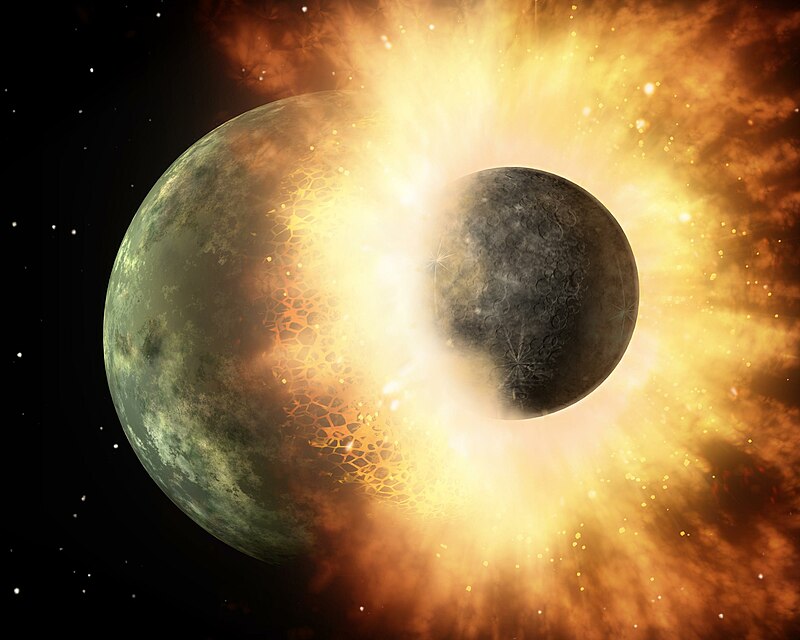
Theia
planet that is hypothesized to have impacted Earth and created the Moon

far side of the Moon
hemisphere of the Moon that always faces away from Earth

terminator
moving line that separates the illuminated day side and the dark night side of a planetary body

geology of the Moon
structure and composition of the Moon

Late Heavy Bombardment
hypothesized event, occurring ca. 4.1–3.8 billion years ago, during which a large number of asteroids collided with the Moon, Mercury, Venus, Earth, and Mars
giant impact hypothesis
theory that the Moon formed out of the debris left over from a collision between Earth and an astronomical body the size of Mars, approximately 4.5 billion years ago

selenography
thumb|right|345px|alt=Topography of the Moon measured from the Lunar Orbiter Laser Altimeter on the mission Lunar Reconnaissance Orbiter, referenced to a sphere of radius 1737.4 km|Topography of the Moon.
thumb|Moon 360 animation in 4K resolution|4K

near side of the Moon
hemisphere of the Moon facing the Earth
619 Triberga
main-belt asteroid

moonbow
A moonbow (also known as a moon rainbow or lunar rainbow) is a rainbow produced by moonlight rather than direct sunlight. Other than the difference in the light source, its formation is the same as for a solar rainbow: It is caused by the refraction of light in many water droplets, such as a rain shower or a waterfall, and is always positioned in the opposite part of the sky from the Moon relative to the observer.
thumbnail|Lunar rainbow over Kihei, Hawaii|Kihei, [[Maui, Hawaii, US]]
Moonbows are much fainter than solar rainbows, due to the smaller amount of light reflected from the surface of
exploration of the Moon
various uncrewed and crewed flights from the Earth to the Moon
atmosphere of the Moon
very scant presence of gases surrounding the Moon
mass concentration
region of a planet or moon's crust that contains a large positive gravitational anomaly
selenographic coordinates
coordinate system
origin of the Moon
how the Earth's moon was formed
opposition surge
brightening of a rough surface, when illuminated from directly behind the observer
space weathering
type of weathering
Earth–Moon–Earth communication
radio communication technique
gravitation of the Moon
Google Moon
magnetic field of the Moon
lunar soil
finely grained regolith on the Moon

solar eclipses on Moon
lunar phenomenon wherein the Sun is obscured by Earth

sodium tail of the Moon
tail or plume of trace amounts of sodium released by the Moon
Selenographia, sive Lunae descriptio
milestone work by Johannes Hevelius
Lunar distance
Angular distance between the Moon and another celestial body
Selenean summit
highest point on the Moon
lunar observation
methods and instruments used to observe the Moon
Lunar limb
edge of the visible surface of the Moon as viewed from Earth