Category
page 1M-type main-sequence stars

Alpha Centauri
triple star system in the constellation Centaurus, where one of the three stars, Proxima Centauri, being the closest star to the Earth

Proxima Centauri
star in Centaurus constellation

Capella
Capella is the brightest star in the northern constellation of Auriga. It has the Bayer designation α Aurigae, which is Latinised to Alpha Aurigae and abbreviated Alpha Aur or α Aur. Capella is the sixth-brightest star in the night sky, and the third-brightest in the northern celestial hemisphere after Arcturus and Vega. A prominent object in the northern sky, it is circumpolar to observers north of 44°N. Its name meaning "little goat" in Latin, Capella depicted the goat Amalthea that suckled Zeus in classical mythology. Capella is relatively close, at . It is one of the brightest X-ray source

Fomalhaut
Fomalhaut (, ) is the brightest star in the southern constellation of Piscis Austrinus, the Southern Fish, and one of the brightest stars in the night sky. It has the Bayer designation Alpha Piscis Austrini, which is an alternative form of α Piscis Austrini, and is abbreviated Alpha PsA or α PsA. This is a class A star on the main sequence approximately from the Sun as measured by the Hipparcos astrometry satellite. Since 1943, the spectrum of this star has served as one of the stable anchor points by which other stars are classified.
TRAPPIST-1
|-
! style="background-color: #FFFFC0; text-align: center;" colspan="2"| Characteristics
|- style="vertical-align:top"
! style="text-align:left" | Evolutionary stage
| Main sequence
|- style="vertical-align:top"
! style="text-align:left" | Spectral type
| M8V
|- style="vertical-align:top"
! style="text-align:left" | Apparent magnitude (R)
|
|- style="vertical-align:top"
! style="text-align:left" | Apparent magnitude (I)
|
|- style="vertical-align:top"
! style="text-align:left" | Apparent magnitude (J)
|
|- style="vertical-align:top"
! style="text-alig

Regulus
Regulus is the brightest object in the constellation Leo and one of the brightest stars in the night sky. It has the Bayer designation designated α Leonis, which is Latinized to Alpha Leonis, and abbreviated Alpha Leo or α Leo. Regulus appears single, but is actually a quadruple star system composed of four stars that are organized into two pairs. The system lies approximately 79 light years from the Solar System.

Barnard's Star
red dwarf star in the constellation of Ophiuchus

Castor
star in the constellation Gemini

Gliese 581
Red dwarf star in the constellation Libra

Nemesis
hypothetical star orbiting the Sun, responsible of extinction events

Wolf 359
red dwarf in the constellation Leo
Kapteyn's Star
subdwarf star in the constellation Pictor
Alcor
star in the constellation of Ursa Major
Lalande 21185
star in the constellation Ursa Major
Luyten 726-8
binary star in the constellation Cetus

Ross 128
small star in the equatorial zodiac constellation of Virgo

Acrux
Acrux is a multiple star system the brightest star in the southern constellation of Crux. It has the Bayer designation α Crucis, which is Latinised to Alpha Crucis and abbreviated Alpha Cru or α Cru. With a combined visual magnitude of +0.76, it is the 13th-brightest star in the night sky. It is the most southerly star of the asterism known as the Southern Cross and is the southernmost first-magnitude star, 2.3 degrees more southerly than Alpha Centauri. This system is located at a distance of from the Sun.
Beta Aurigae
binary star system in the northern constellation of Auriga
Ross 154
star
Ross 248
Variable star in the constellation Andromeda
Gliese 667
triple star system
Upsilon Andromedae
star in the constellation Andromeda
Luyten's Star
star in the constellation Canis minor
Teegarden's star
M-type red dwarf in the constellation Aries
Gamma Cephei
star in the constellation of Cephei
Gliese 876
star in the constellation Aquarius
EZ Aquarii
star in the constellation Aquarius
Omicron2 Eridani
triple star system in the constellation Eridanus
Alpha Librae
star in the constellation Libra
Lacaille 9352
star in the constellation Piscis Austrinus
Gliese 229
binary system in the constellation Lepus
YZ Ceti
star in the constellation Cetus
Noquisi
star in the constellation Leo
Gliese 832
Red dwarf (spectral type M2V) in constellation Grus
K2-18
K2-18, also known as EPIC 201912552, is a red dwarf star with two planetary companions located from Earth, in the constellation of Leo.
Groombridge 34
binary star system in the constellation of Andromeda
Alpha Caeli
star in the constellation Caelum

Kepler-186
Kepler-186 is a main-sequence M1-type dwarf star, located 177.5 parsecs (579 light years) away in the constellation of Cygnus. The star is slightly cooler than the sun, with roughly half its metallicity. It is known to have five planets, including the first Earth-sized world discovered in the habitable zone: Kepler-186f. The star hosts four other planets discovered so far, though they all orbit interior to the habitable zone.
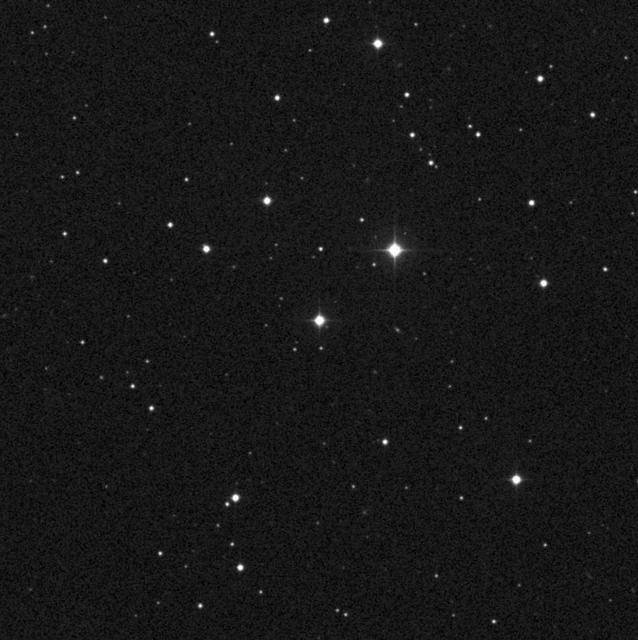
Gliese 1
star in the constellation Sculptor
GJ 1061
star
Lacaille 8760
star in the constellation Microscopium
LHS 292
star in the constellation Sextans
Ross 614
star in the constellation Monoceros
Gliese 687
star in the constellation Draco
Wolf 1061
star
Chi1 Orionis
star in the constellation Orion
Gliese 445
star in the constellation Camelopardalis
Mu Herculis
star in the constellation Hercules
GJ 1002
star in the constellation Cetus
Alpha Reticuli
star in the constellation Reticulum
AB Doradus
star system in the constellation Dorada
Scholz's Star
binary stellar system in the constellation Monoceros
TZ Arietis
nearby flare star in constellation Aries
Gliese 570
star in the constellation Libra
ultra-cool dwarf
type of stellar or sub-stellar object
Gliese 777
binary star in the constellation Cygnus
DX Cancri
red dwarf star in the constellation Cancer
Delta Andromedae
multiple star system in the northern constellation of Andromeda
WDS 20007+2243AB
star in the constellation Vulpecula
Theta Pegasi
star in the constellation Pegasus