Category
page 1Magic gods
.jpg)
Odin
thumb|Odin, in his guise as a wanderer, as imagined by Georg von Rosen (1886)

Helios
In ancient Greek religion and mythology, Helios (; ; Homeric Greek: ) is the god who personifies the Sun. His name is also Latinized as Helius, and he is often given the epithets Hyperion ("the one above") and Phaethon ("the shining"). Helios is often depicted in art with a radiant crown and driving a horse-drawn chariot through the sky. He was a guardian of oaths and also the god of sight. Though Helios was a relatively minor deity in Classical Greece, his worship grew more prominent in late antiquity thanks to his identification with several major solar divinities of the Roman period, partic

Thoth
Thoth (from , borrowed from , , the reflex of "[he] is like the ibis") is an ancient Egyptian deity. In art, he was often depicted as a man with the head of an ibis or a baboon, animals sacred to him. His feminine counterpart is Seshat, and his wife is Ma'at. He is the god of the Moon, wisdom, knowledge, writing, hieroglyphs, science, magic, art, and judgment.

Marduk
Marduk (; cuneiform: dAMAR.UTU; Sumerian: "calf of the sun; solar calf"; ) was a god from ancient Mesopotamia, patron deity of Babylon.
First sparsely attested in the 3rd millenium BC, Marduk slowly rose to prominence before being enshrined as leader of the Mesopotamian pantheon under Nebuchadnezzar I in the 1st millennium BC. In Babylon, Marduk was worshipped in the Esagila temple.

Hermes Trismegistus
purported author of the Hermetic Corpus

Enki
Enki (Sumerian: dEN-KI), also known as Ea (Akkadian: dE₂-A), was the Mesopotamian god of wisdom, crafts, fresh subterranean waters, magic, and incantations. He was believed to rule the Abzû. In Mesopotamian astronomy, he was associated with the stars of the southern band of the sky. Enki's wife was Damgalnuna, and their children included Nanshe, Asalluhi, Marduk and Enbilulu. His sukkal (attendant deity) was Isimud. Servants of the god included lahmu, kulullû, and the Seven Sages.
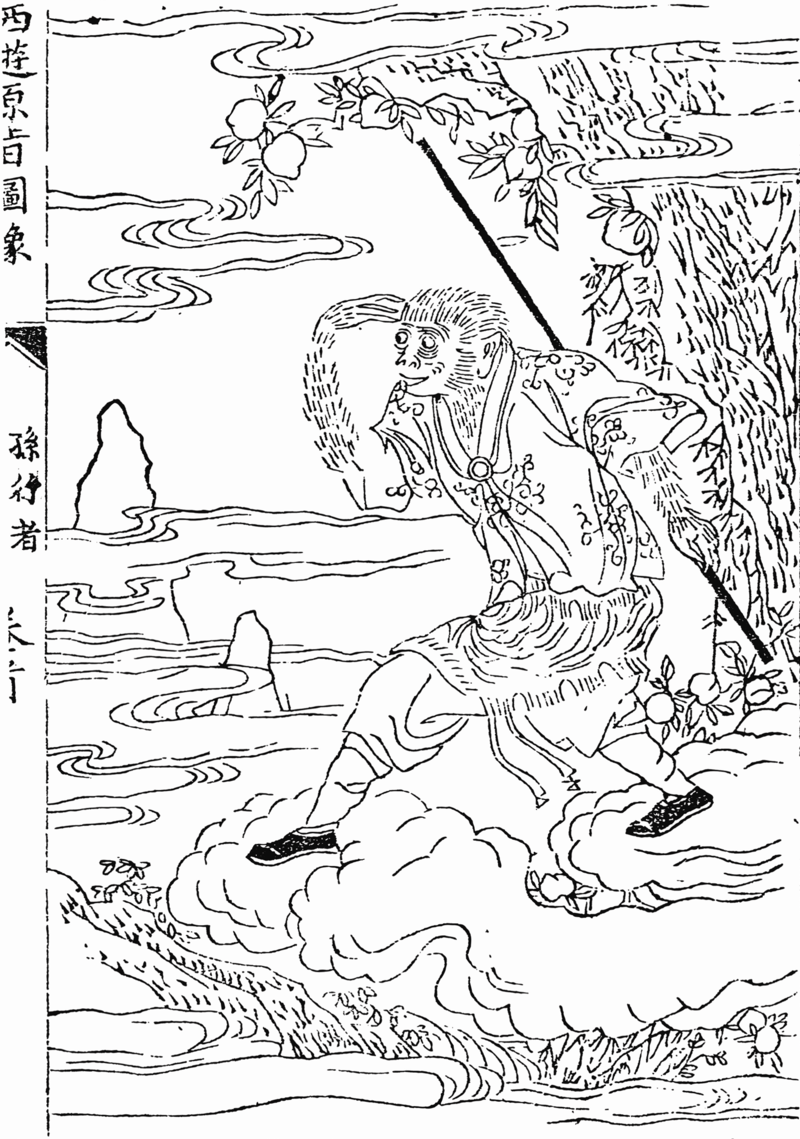
Sun Wukong
mythical character from Journey to the West

Veles
Slavic god of earth, waters and the underworld

Väinämöinen
'''' () is a demigod, hero and the central character in Finnish folklore and the main character in the national epic Kalevala'' by Elias Lönnrot. Väinämöinen was described as an old and wise man, and he possessed a potent, magical singing voice.
Heka
Egyptian deity

Tezcatlipoca
thumb|The jaguar was an animal sacred to Tezcatlipoca.|link=File:Standing_jaguar.jpg
thumb|Mirrors in Mesoamerican culture#Aztecs|Aztec obsidian mirror
The Dagda
deity
Maya Hero Twins
the central figures of the Popol Vuh
Elder Zhang Guo
Chinese mythological figure

Sukunabikona
thumb|Yuzen shrine at Atami|Atami onsen enshrines Sukunabikona
Sukunabikona or Sukuna bikona (少彦名神, also known as Sukuna-biko, Sukuna-biko-na, Sukuna hikona) is the Shinto kami of the onsen (hot springs), agriculture, healing, magic, brewing sake and knowledge. His name means "the small lord of renown." He is often described as being a dwarf and is frequently paired with Ōkuninushi.
Kothar-wa-Khasis
Kothar-wa-Khasis (), also known as Kothar or Hayyānu, was an Ugaritic god regarded as a divine artisan. He could variously play the roles of an architect, smith, musician or magician. Some scholars believe that this name represents two gods, Kothar and Khasis, combined into one.

Hauron
Hauron, Horon, Haurun or Hawran (from Egyptian ḥwrwnꜣ) was an ancient Egyptian god worshiped in Giza. He was closely associated with Harmachis, with the names in some cases used interchangeably, and his name as a result could be used as a designation of the Great Sphinx of Giza. While Egyptologists were familiar with Hauron since the nineteenth century, his origin was initially unknown, and only in the 1930s it was established that he originated outside Egypt. Today it is agreed that he was the Egyptian form of a god worshiped in Canaan and further north in the city of Ugarit, conventionally r
Asaruludu
thumb | right | alt=Clay tablet with a Sumerian spell against demons, calling on Asalluhi, god of magic. Old Babylonian Period (2000-1600 BC). | Clay tablet with a Sumerian spell against demons, calling on Asalluhi, god of magic. Old Babylonian Period (2000-1600 BC).
Asalluhi, also spelled as Asarluhi or Asalluhe, also known as Asaralimnuna, Asaralim, Asalim or Asarnuna was a Mesopotamian god primarily associated with the sphere of incantations and exorcism, commonly operating together with his father Enki. He is likely the same deity as Asar, who was attested starting from the third millenni
Kanaloa
In the traditions of ancient Hawaii, Kanaloa is a god symbolized by the squid or by the octopus, and is typically associated with Kāne. It is also an alternative name for the island of Kahoolawe.
Wangpulen
Wangpulen is the god of water, rain, flood, disease and sickness in Meitei mythology and Sanamahism.
He is the ruler of the underwater world. He is the Lord of the rivers. The guardianship of the south eastern direction is alluded to Wangbren and the other directions to Koupalu (north west), Marjing (north east) and Thangjing (south west). He is one of the Umang Lais.
Thongalen
Thongalen (also, Thongalel, Thongaren or Thongarel) is the god of the dead and the king of the underworld in Meitei mythology and Sanamahism, the indigenous religion of Manipur.
He is the Guardian God of the nadir..
Loiyalakpa
Loyalakpa is a God in Sanamahism, the indigenous religion of Manipur. He is best known for wrestling with Khoriphaba during the Lai Haraoba festival. He is the consort of goddess Thoudu Nungthel Leima. He is one of the ten kingly gods (or ten divine kings) in Meitei religion.
Khamlangba
Khamlangba is a deity in Sanamahism, the indigenous religion of Manipur. He is the God of iron, mining, metallurgy, steel manufacturing, hunting and war. His occupation is the extraction of the iron ores and the manufacture of steel. The Khamlangba Thenlon text mentions about his skills of iron metallurgy and blacksmith in ancient Kakching kingdom.
Mongba Hanba
forest god in Meitei mythology and religion
Anulap
Anulap is a sky god in the mythology of the island of Truk in Micronesia.