Category
page 1Mahatma Gandhi
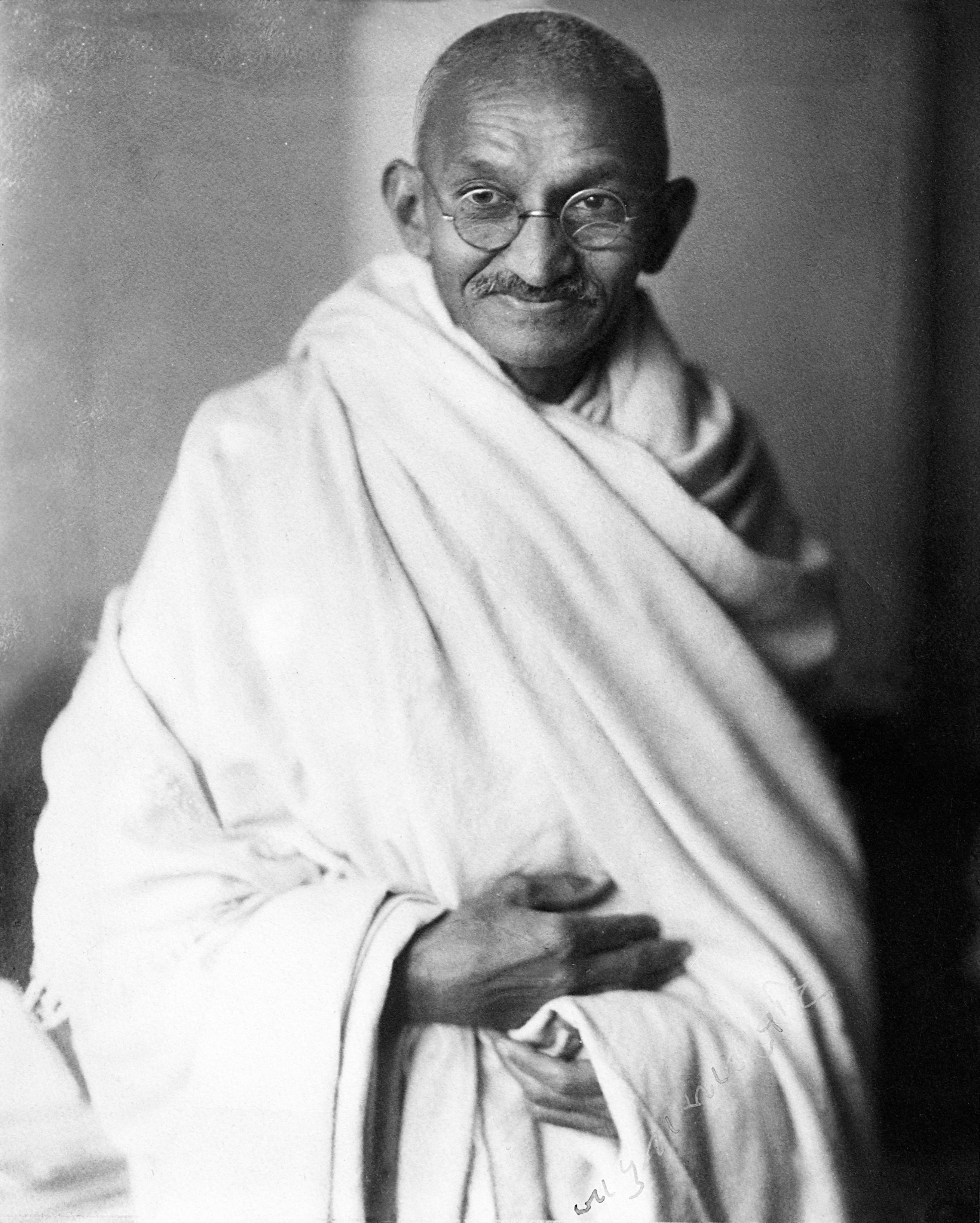
Mahatma Gandhi
Mohandas Karamchand Gandhi was an Indian lawyer, anti-colonial nationalist and political ethicist who employed nonviolent resistance to lead the successful campaign for India's independence from British rule, and to later inspire movements for civil rights and freedom across the world. The honorific Mahātmā, first applied to him in 1914 in South Africa, is now used throughout the world.

International Day of Non-Violence
observed on 2 October, the birthday of Mohandas Gandhi

three wise monkeys
pictorial maxim, embodying the proverbial principle “see/hear/speak no evil”, depicted as three monkeys

Mahatma
Mahatma (English pronunciation: , , , ) is an honorific used in India. The term is commonly used for Mohandas Karamchand Gandhi, who is often referred to simply as "Mahatma Gandhi" (). Albeit less frequently, this epithet has also been used with regard to such people as Basava (1131–1167), Swami Shraddhanand (1856–1926), Lalon Shah (1772–1890), Ayyankali (1863–1941), and Jyotirao Phule (1827–1890).
assassination of Mahatma Gandhi
1948 murder in New Delhi, India
Mahadev Desai
Indian independence activist, writer and Mahatma Gandhi's personal secretary (1892–1942)

The Kingdom of God Is Within You
philosophical treatise by Leo Tolstoy
Gandhi–Irwin Pact
the 11 demands
Young India
weekly paper or journal in English published by Mahatma Gandhi from 1919 to 1931
Gandhi cap
white coloured sidecap, pointed in front and back and having a wide band, worn in India

Sevagram
Sevagram (meaning "A town for/of service") is a town in the state of Maharashtra, India. It was the place of Mahatma Gandhi's ashram and his residence from 1936 to his death in 1948. After Sabarmati, Sevagram Ashram holds immense importance due to the residence of Mahatma Gandhi.
Satyagraha House
historical house in Johannesburg - previous residence of Mahatma Gandhi
Shrimad Rajchandra
Jain poet, philosopher and scholar (1867-1901)
Poona Pact
Agreement between Dr. Babasaheb Ambedkar and Mahatma Gandhi
Narsinh Mehta
poet-saint of Gujarat
Natal Indian Congress
political organisation in South Africa

Hind Swaraj
1909 book by Mohandas Gandhi

Seven Blunders of the World
Mohandas Gandhi's list of negative qualities

Tolstoy Farm
first ashram initiated and organized by Mohandas Gandhi

Indian Opinion
weekly newspaper, first established and produced by Mohandas Gandhi ("Mahatma"), M.H. Nazar and Madanjit Viyavaharik in 1903 in the Natal Province
Dandi Beach
Monument of Mahatma Gandhi at Dandi Beach is one of the prominent beaches located in Dandi village, Gujarat.
Narayan Hemchandra
Indian writer
Kochrab Ashram
first ashram in India organized by Mahatma Gandhi
Harijan Sevak Sangh
Creative organization established in 1932 by Mahatma Gandhi
Navajivan Trust
publishing house
list of fasts undertaken by Mahatma Gandhi
Wikimedia list article
afoxê
The term afoxé refers to a Carnival group originating from Salvador da Bahia, Brazil, in the 1920s, and the music it plays deriving from the Afro-Brazilian Candomblé religion. It came to indicate a musical rhythm, named ijexá derived from the ijexá nation within Candomblé. Cultural performances of the afoxés, typically at Brazilian Carnival, incorporate choreography, song, ritual language and ceremonies deriving from the Candomblé religion. In Brazil, afoxé is generally performed by blocos, afros-groups of mostly black or mulatto musicians who are familiar with African Brazilian music. Afoxés
Mangal Prabhat
book by Mohandas Karamchand Gandhi
Harijan
magazine by Mahatma Gandhi, 1933 to 1948
V Kalyanam
Indian freedom fighter
Sarva Dharma Sama Bhava
hindu concept
Eleven vows
part of the ethical system prescribed by Mahatma Gandhi
Bernhard Mann
German sociologist and Professor of Health Sciences
Kapur Commission
commission of inquiry into the conspiracy to murder Mohandas Karamchand Gandhi
Kaba Gandhi No Delo
House where Mohandas K Gandhi's father, Karamchand Uttanchand Gandhi (Kaba Gandhi) resided at Rajkot,
Indian Ambulance Corps
created by Mahatma Gandhi for use by the British