Category
page 1Market (economics)
market
mechanisms whereby supply and demand confront each other and deals are made, involving places, processes and institutions in which exchanges occur (for physical venues, use Q132510 or Q330284)

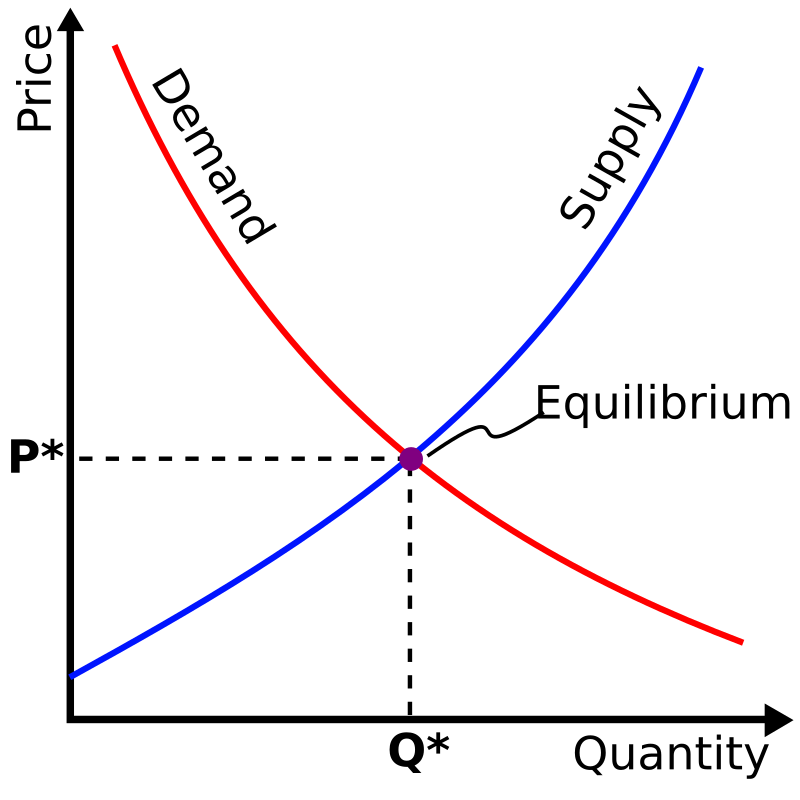
supply and demand
economic model of price determination in microeconomics

market economy
type of economic system

free market
form of market-based economy
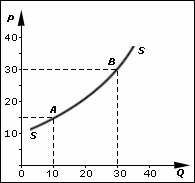
supply
in economics, the amount of a good that sellers are willing to provide in the market
economic equilibrium
state where economic forces such as supply and demand are balanced and the values of economic variables will not change
economic interventionism
economic policy perspective favoring government intervention in the market process
industrial organization
branch of economics
grey market
trade of goods outside the original producer's authorized distribution channel

excess demand
thumb|Supply and demand, with market-clearing price shown
250px|thumbnail|right|Unemployed men queue outside a depression soup kitchen in United States during the Great Depression.
250px|thumbnail|right|A 2014 image of product shortages in Venezuela

prosumer
A prosumer is an individual who both consumes and produces. The term is a portmanteau of the words producer and consumer. Research has identified six types of prosumers: DIY prosumers, self-service prosumers, customizing prosumers, collaborative prosumers, monetised prosumers, and economic prosumers.
prediction market
exchange where participants trade contracts based on the outcome of real-world events, with prices reflecting implied probabilities
shortages related to the COVID-19 pandemic
medical material and other goods shortages occurring as a result of the COVID-19 pandemic
two-sided market
market having two distinct user groups that provide each other with network benefits
contestable market
market served by a small number of firms that are nevertheless characterized by competitive equilibrium (and therefore provides desirable welfare outcomes) because of the existence of potential short-term entrants
slave market
place where slaves are bought and sold
transparency
economic concept
regulated market
market over which government bodies or, less commonly, industry or labor groups, exert a level of oversight and control
market penetration
in marketing, a parameter to show the rate of circulation of a product in its market
buyer decision processes
decision-making process used by consumers before, during, and after the purchase of a good or service
market mechanism
economic phenomenon
exchange economy
mass market
market for goods produced on a large scale for a significant number of end consumers
pork cycle
phenomenon of fluctuations of supply and prices in livestock markets
vertical market
market of vendors selling goods or services specific to an industry or trade
relative price
ratio of two prices
Quasi-market
Quasi-markets are markets which can be supervised and organisationally designed that are intended to create greater desire and more efficiency in comparison to conventional delivery systems, while supporting more accessibility, stability and impartiality than traditional markets. Quasi-markets also can be referred to as internal or planned markets.
marketization
Marketisation or marketization is a restructuring process that enables state enterprises to operate as market-oriented firms by changing the legal environment in which they operate.
media market
geographic area with mostly the same set of media outlets
market system
Process enabling agents to offer and demand goods
knowledge market
mechanism for distributing knowledge resources