Category
page 1Market structure

monopoly
A monopoly (from Greek and ) is a market in which one person or company is the only supplier of a particular good or service. A monopoly is characterized by a lack of economic competition to produce a particular thing, a lack of viable substitute goods, and the possibility of a high monopoly price well above the seller's marginal cost that leads to a high monopoly profit. The verb monopolise or monopolize refers to the process by which a company gains the ability to raise prices or exclude competitors. In economics, a monopoly is a single seller. In law, a monopoly is a business entity that ha

privatization
Privatization (rendered privatisation in British English) can mean several different things, most commonly referring to transitioning something from the public sector into the private sector. It is also sometimes used as a synonym for deregulation when a heavily regulated private company or industry becomes less regulated. Government functions and services may also be privatised (which may also be known as "franchising" or "out-sourcing"); in this case, private entities are tasked with the implementation of government programs or performance of government services that had previously been the

economic competition
rivalry between firms; ability of companies to take each others' market share in a given market

oligopoly
An oligopoly () is a market in which pricing control lies in the hands of a few sellers.
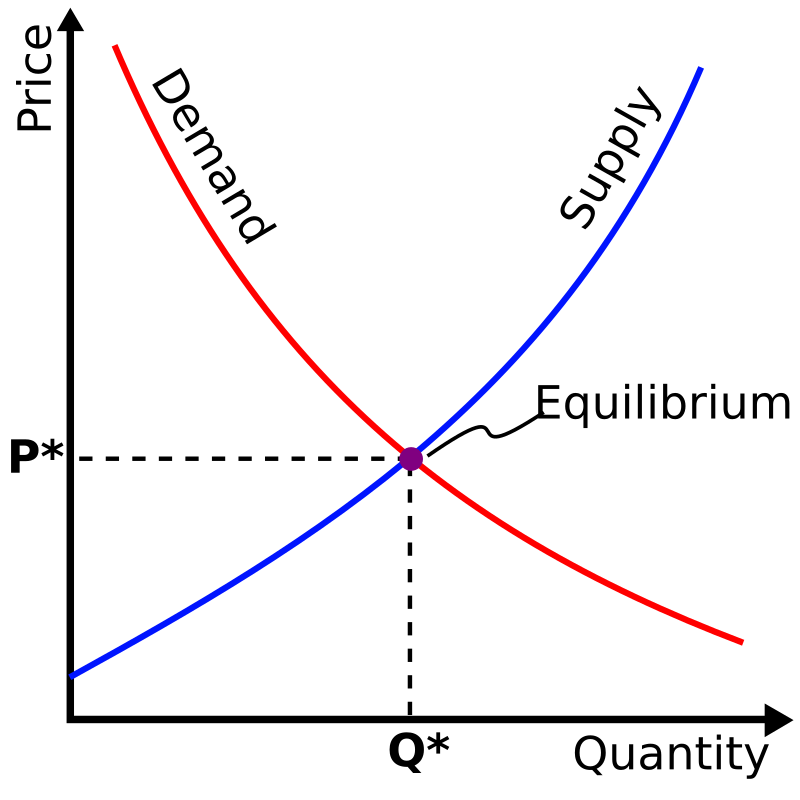
perfect competition
market structure in which firms are price takers for a homogenous product
economic equilibrium
state where economic forces such as supply and demand are balanced and the values of economic variables will not change
duopoly
A duopoly (from Greek , ; and , ) is a type of oligopoly where two firms have dominant or exclusive control over a market, and most (if not all) of the competition within that market occurs directly between them.
liberalization
Liberalization (American English) or liberalisation (British English) is a broad term that refers to the practice of making laws, systems, or opinions less severe, usually in the sense of eliminating certain government regulations or restrictions. The term is used most often in relation to economics, where it refers to economic liberalization, the removal or reduction of restrictions placed upon (a particular sphere of) economic activity. However, liberalization can also be used as a synonym for decriminalization or legalization (the act of making something legal after it used to be illegal),
vertical integration
business arrangement in which the supply chain of a company is owned by that company

deregulation
thumb|250px|As a result of deregulation of telecommunications in New Zealand, France Télécom (now Orange S.A.|Orange) operated phone booths in [[Wellington and across New Zealand in the 2000s.]]
Deregulation is the process of removing or reducing state regulations, typically in the economic sphere. It is the repeal of governmental regulation of the economy. It became common in advanced industrial economies in the 1970s and 1980s, as a result of new trends in economic thinking about the inefficiencies of government regulation, and the risk that regulatory agencies would be controlled by the reg
market share
relative market adoption
market structure
meeting point of supply and demand for a product
horizontal integration
increasing production of at the same level of the supply chain through acquisition, merger or internal expansion
oligopsony
An oligopsony (from Greek ὀλίγοι (oligoi) "few" and ὀψωνία (opsōnia) "purchase") is a market form in which the number of buyers is small while the number of sellers in theory could be large. This typically happens in a market for inputs where numerous suppliers are competing to sell their product to a small number of (often large and powerful) buyers. It contrasts with an oligopoly, where there are many buyers but few sellers. An oligopsony is a form of imperfect competition.
Herfindahl index
measure of the size of firms in relation to the industry and an indicator of the amount of competition among them
regulatory economics
economics of regulation, in the sense of the application of law by government
Cornering the market
commerce phenomenon
open source
freely available source code, design documents or content source for possible modification and redistribution to the public
market concentration
function of the number of firms and their respective shares of the total production in a market
swing producer
supplier of commodity controlling its global deposits and possessing large spare production capacity
ideal firm size
company size which results in the lowest production cost per unit of output