Category
page 1Mathematical linguistics
computational linguistics
interdisciplinary field
formal language
set of strings of symbols that may be constrained by rules that are specific to it; words whose letters are taken from an alphabet and are well-formed according to a specific set of rules
generative grammar
theory in linguistics
formal grammar
structure of a formal language
phonotactics
Phonotactics (from Ancient Greek and ) is a branch of phonology that deals with restrictions in a language on the permissible combinations of phonemes. Phonotactics defines permissible syllable structure, consonant clusters and vowel sequences by means of phonotactic constraints.
parse tree
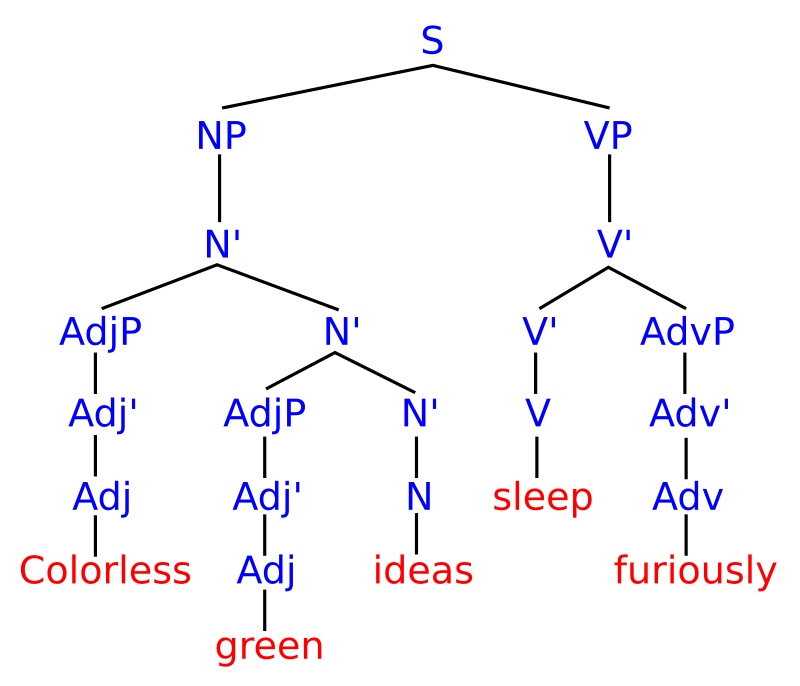
ordered, rooted tree that represents the syntactic structure of a string according to some context-free grammar
quantitative linguistics
subdiscipline of mathematical linguistics that investigates languages using statistical methods to formulate language laws
optimality theory
linguistic model proposing that the observed forms of language arise from the optimal satisfaction of conflicting constraints
lexicostatistics
Lexicostatistics is a method of comparative linguistics that involves comparing the percentage of lexical cognates between languages to determine their relationship. Lexicostatistics is related to the comparative method but does not reconstruct a proto-language. It is to be distinguished from glottochronology, which attempts to use lexicostatistical methods to estimate the length of time since two or more languages diverged from a common earlier proto-language. This is merely one application of lexicostatistics, however; other applications of it may not share the assumption of a constant rate
mathematical linguistics
branch of applied mathematics
phonological rule
systematic formalization of a phonological process
formal semantics
study of meaning in natural languages
categorial grammar
family of formalisms in natural language syntax motivated by the principle of compositionality and organized according to the view that syntactic constituents should generally combine as functions or according to a function-argument relationship