Category
page 1Mathematics education

multiplication table
mathematical table
science, technology, engineering, and mathematics
group of academic disciplines

dyscalculia
Dyscalculia is a learning disability resulting in difficulty learning or comprehending arithmetic, such as difficulty in understanding numbers, numeracy, learning how to manipulate numbers, performing mathematical calculations, and learning facts in mathematics. It is sometimes colloquially referred to as "math dyslexia", though this analogy can be misleading as they are distinct syndromes.
Wolfram Alpha
WolframAlpha is an online knowledge engine developed by Wolfram Research that has been around since 2009. It is offered as an online service that answers queries by computing answers from externally sourced data.
elementary arithmetic
collective term for the four mathematical operations of addition, subtraction, multiplication and division
mathematics education
mathematics teaching, learning and scholarly research
Trends in International Mathematics and Science Study
series of international assessments of the mathematics and science knowledge of students around the world
advanced mathematics
certain type of mathematics from secondary school onwards
mathematical problem
problem that can be possibly solved via mathematics
data literacy
ability to collect, manage, evaluate and apply data with critical thinking skills
New Math
style of teaching mathematics in the 1960s

numeracy
thumb|Children in Laos have fun as they improve numeracy with "Number Bingo". They roll three dice, construct an equation from the numbers to produce a new number, then cover that number on the board, trying to get four in a row.
thumb|Number bingo improves math skills. LPB Laos.
Numeracy is the ability to understand, reason with, and apply simple numerical concepts; it is the numerical counterpart of literacy. The charity National Numeracy states: "Numeracy means understanding how mathematics is used in the real world and being able to apply it to make the best possible decisions...It's as mu
mathematical anxiety
anxiety about one's ability to do mathematics
ethnomathematics
In mathematics education, ethnomathematics is the study of the relationship between mathematics and culture. Often associated with "cultures without written expression", it may also be defined as "the mathematics which is practised among identifiable cultural groups". It refers to a broad cluster of ideas ranging from distinct numerical and mathematical systems to multicultural mathematics education. The goal of ethnomathematics is to contribute both to the understanding of culture and the understanding of mathematics, and mainly to lead to an appreciation of the connections between the two.
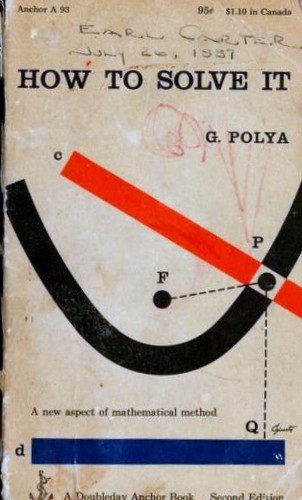
How to Solve It
book about problem solving
STEAM education
science, technology, engineering, art and mathematics in educational programs

precalculus
thumb|Diagram for the deriving the power-reducing formula for the sine function|260x260px

clock angle problem
Mathematical question

Female education in STEM
child and adult female represented in the fields of science, technology, engineering, and mathematics (STEM)

worksheet
A worksheet, in the word's original meaning, is a sheet of paper on which one performs work. They come in many forms, most commonly associated with children's school work assignments, tax forms, and accounting or other business environments. Software is increasingly taking over the paper-based worksheet.
Wolfram Demonstrations Project
Organized and open-source collection of interactive programs representing ideas from a range of fields
word problem
mathematical exercise presented in ordinary language
International Commission on Mathematical Instruction
international Mathematics Union subgroup (1908 –)
Singapore Math
teaching method for mathematics
Conrad Wolfram
information technologist and businessman
toy problem
simplified example problem used for research or exposition
Numberphile
Numberphile is an educational YouTube channel featuring videos that explore topics from a variety of fields of mathematics. In the early days of the channel, each video focused on a specific number, but the channel has since expanded its scope, featuring videos on more advanced mathematical concepts such as Fermat's Last Theorem, the Riemann hypothesis and Kruskal's tree theorem. The videos are produced by Brady Haran, a former BBC video journalist and creator of Periodic Videos, Sixty Symbols, and several other YouTube channels. Videos on the channel feature several university professors, mat
relationship between mathematics and physics
relationship
exercise
training unit in mathematics
business mathematics
practical mathematics used in business