Category
page 1Mecoptera

Mecoptera
Mecoptera (from Ancient Greek μῆκος (mêkos), meaning 'length', and πτερόν (pterón), meaning 'wing') is an order of insects in the superorder Holometabola with about six hundred species in nine families worldwide. Mecopterans are sometimes called scorpionflies after their largest family, Panorpidae, in which the males have enlarged genitals raised over the body that look similar to the stingers of scorpions, and long beaklike rostra. The Bittacidae, or hangingflies, are another prominent family and are known for their elaborate mating rituals, in which females choose mates based on the quality

Panorpa communis
species of insect
Boreidae
family of scorpionflies

Hangingfly
Bittacidae is a family of scorpionflies commonly called hangingflies or hanging scorpionflies.
Meropeidae
Meropeidae is a family of tiny scorpionflies within the order Mecoptera with only three known living species, commonly referred to as "earwigflies" (or sometimes "forcepflies"), based on the earwig-like forceps-shaped male genitalia. The living species are the North American Merope tuber, the Western Australian Austromerope poultoni, and the recently discovered South American A. brasiliensis. The biology of these species is essentially unknown, and their larvae have never been seen. The adults have been suggested to probably be saprophagous, though they have never been observed feeding. The fo
Choristidae
The Choristidae are a small (only eight species in three genera) family of scorpionflies known only from Australia. Their larvae are found in moss mats.
==Species==
This list is adapted from the World Checklist of extant Mecoptera species: Choristidae (unless cited otherwise) and is complete as of 1997.
Nannochoristidae
Nannochoristidae is a family of scorpionflies with many unusual traits. It is a tiny, relict family with a single extant genus, Nannochorista, with eight species occurring in New Zealand, southeastern Australia, Tasmania, Argentina and Chile. Due to the group's distinctiveness from other scorpionflies, it is sometimes placed in its own order, the Nannomecoptera. Some studies have placed them as the closest living relatives of fleas. Most mecopteran larvae are eruciform, or shaped like caterpillars. Nannochoristid larvae, however, are elateriform, and have elongated and slender bodies. The larv

Panorpodidae
The Panorpodidae are a small family of scorpionflies. Of the two genera, Brachypanorpa occurs only in the United States, and Panorpodes occurs in East Asia, with a single species in California. Unlike their sister group Panorpidae, the family generally has short jaws, amongst the shortest of all mecopterans. Brachypanorpa is thought to be phytophagous, consuming the epidermis of soft leaves, and a similar diet is suggested for Panorpodes.

Panorpa cognata
species of insect
Eomeropidae
Eomeropidae is a family of aberrant, flattened scorpionflies represented today by only a single living species, Notiothauma reedi, known from the Nothofagus forests in southern Chile, while all other recognized genera in the family are known only as fossils, with the earliest definitive fossil known from Liassic-aged strata, and the youngest from Paleogene-aged strata.
Apteropanorpidae
Apteropanorpidae is a family of wingless scorpionflies containing a single genus, Apteropanorpa, with four named species, which are all endemic to the Australian island of Tasmania. Of the four known species, three occupy alpine habitats while A. warra occupies lower elevations.
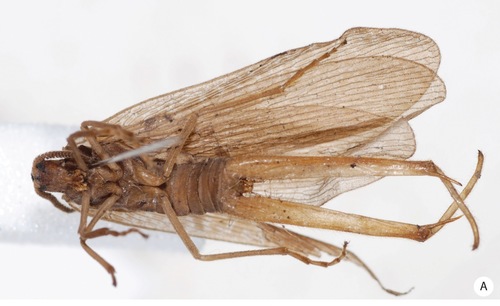
Austromerope poultoni
species of insect
Apteropanorpa tasmanica
species of scorpionflies

Merope tuber
species of insect
Brachypanorpa carolinensis
species of insect
Brachypanorpa oregonensis
species of insect
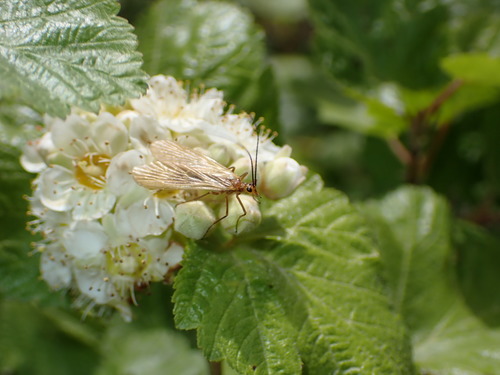
Brachypanorpa sacajawea
species of insect
Panorpa flexa
species of insect
Panorpodes
Panorpodes is a genus of scorpionflies in the family Panorpodidae, containing the following species:
Austromerope brasiliensis
species of forcepfly
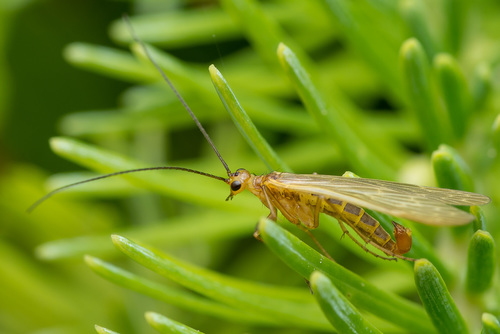
Brachypanorpa
Brachypanorpa is a genus of scorpionflies in the family Panorpodidae. There are about five described species in Brachypanorpa.

Pseudopolycentropodidae
Pseudopolycentropodidae is an extinct family of scorpionflies known from the Mesozoic. Fossils are known from the Middle Triassic (Anisian) to the early Late Cretaceous (Cenomanian). It is part of Mesopsychoidea, a group of scorpionflies with siphonate proboscis. They are suggested to have been nectarivores, feeding off the liquid pollination drops and acting as pollinators for now extinct insect pollinated gymnosperms such as Bennettitales.
Cimbrophlebia
Cimbrophlebia is an extinct genus of Mecoptera which existed from the Jurassic to the Eocene period.
Juracimbrophlebia
Juracimbrophlebia is an extinct genus of hangingflies that lived during the Middle Jurassic Period about 165 million years ago, containing only its type species, Juracimbrophlebia ginkgofolia; it was discovered in deposits from Daohugou in northeastern China’s Inner Mongolia.
Aneuretopsychidae
Aneuretopsychidae is an extinct family of scorpionflies known from the Mesozoic. Fossils are known from the Jurassic (Callovian-Oxfordian) to the early Late Cretaceous (Cenomanian). It is part of Mesopsychoidea, a group of scorpionflies with siphonate proboscis. They are suggested to have been nectarivores, feeding off the liquid pollination drops of and acting as pollinators for now extinct insect pollinated gymnosperms such as Bennettitales.
Austromerope
left|thumb|A. brasiliensis lateral view
Dinopanorpidae
thumb|right|upright|Dinopanorpa megarche holotype
Dinopanorpidae is a small family of extinct insects in the order Mecoptera (scorpionflies) that contains two genera and seven species.