Category
page 1Megalithic monuments

moai
thumb|330px|Moai facing inland at Ahu Tongariki, restored by Chilean archaeologist Claudio Cristino in the 1990s

menhir
upright=1.5|thumb|Large menhir located between Millstreet and [[Ballinagree, County Cork, Ireland]]
thumb|The Caramujeira Menhir, currently preserved at the Silves Municipal Archeology Museum, in [[Portugal]]
thumb|Cwm Rhaeadr Fawr maen hir (menhir) near Aber Falls, [[Gwynedd, Wales]]
thumb|Dry Tree menhir – a standing stone at [[Goonhilly Downs, Cornwall]]

dolmen
thumb|Poulnabrone dolmen, [[the Burren, County Clare, Ireland]]
thumb|Dolmens in Amudalavalasa|Amadalavalasa, [[Andhra Pradesh, India]]

megalith
thumb|Dolmen at [[Ganghwa Island, South Korea (c. 300 BC)]]
thumb|Megalithic Batu Brak, Lampung Province, Indonesia (c. 2100 BC)
thumb|Megalithic grave Harhoog in [[Keitum, Sylt, Germany (c. 3000 BC)]]

Nan Madol
ruined city of Federated States of Micronesesia
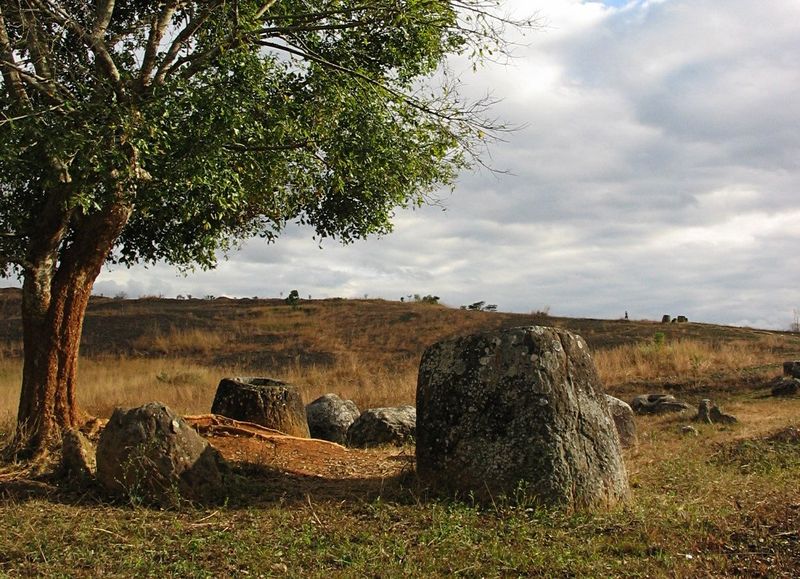
Plain of Jars
megalithic archaeological landscape in Laos, consisting of thousands of stone jars scattered around the upland valleys and the lower foothills of the central plain of the Xiangkhoang Plateau
Stone spheres of Costa Rica
Assortment of over three hundred precolumbian petrospheres in Costa Rica
deer stone
ancient megalith carved with symbols in Siberia and Mongolia
stone circle
monument of standing stones arranged in a circle
Rano Raraku
volcanic crater on Easter Island
stone ship
type of megalithic monument

trilithon
thumb|upright|Trilithon at Stonehenge
Gunung Padang Megalithic Site
Sundanese archaeological site

vishap
thumb|200px|right|A vishap
A vishapakar () also known as vishap stones, vishap stelae, "serpent-stones", "dragon stones", are characteristic monoliths found in large numbers in the Armenian Highlands, in natural and artificial ponds, and other sources of water. They are commonly carved from one piece of stone, into cigar-like shapes with fish heads or serpents. Supposedly they are images of vishaps, a water dragon of Armenian folklore.
There are about 150 known extant vishap stelae, of which 90 are found in Armenia.
Rujm el-Hiri
monument in the Golan Heights
Roknia
Roknia is a necropolis in the Guelma region of north-east Algeria consisting of more than 7000 dolmens spread over an area of 2 km.
Kurgan stelae
anthropomorphic stone stelae within the perimeter of a tumulus
Tiya archaeological site
archaeological site
Gate of the Sun
megalithic solid stone arch or gateway constructed by the ancient Tiwanaku culture of Peru and Bolivia

Anakena
thumb|right|250px|Ahu Ature on Anakena Beach.
Anakena is a white coral sand beach in Rapa Nui National Park on Rapa Nui (Easter Island), a Chilean island in the Pacific Ocean. Anakena has two ahus; Ahu-Ature has a single moai and Ahu Nao-Nao has seven, two of which have deteriorated. It also has a palm grove and a car park.
sieidi
Sieidis (, , , ) are Sami cultural items, usually a rock with unusual shape. Sieidis are found in nature in certain sacred places, for example at the sea or river beaches or on the mountain. The word sieidi has also been used for holy rocks or wooden figures that have undergone some processing. The victory was a symbol of the divine power ruling over the natural resources that humans needed for their survival. Samis sacrificed parts of their catch at sea to get a successful hunting or fishing in the future.
stone row
linear arrangement of upright, parallel megalithic standing stones
chamber tomb
communal burial places, cut into rock or hillslopes or constructed of masonry, whose chamber may or may not have an entry passage, usually covered by a mound

verraco
thumb|The Bulls of Guisando, in [[El Tiemblo, Castile and León, Spain.]]
thumb|The Sow of Murça, in Murça, Portugal.
rocking stone
large precariously balanced stones
Steppe Geoglyph
prehistoric earthworks in Kazakhstan
Ahu Akivi
ahu on Easter Island
Blythe Intaglios
group of gigantic figures incised on the ground in the Colorado Desert, United States
Latte stone
Historical building supports
gallery grave
type of megalithic tomb, subtype of a dolmen
Khirgisüür
Khirigsuur (kheregsüür, khirgisuur, kereksur, khereksur) is a type of Bronze Age burial, encountered in the Mongolic-speaking regions such as the Republic of Mongolia, Inner Mongolia, Buryatia and Tuva. It is composed of a central stone mound with a stone burial chamber generally beneath it, a stone enclosure, and external mounds and circles on the periphery. The etymology of the word is uncertain, though some groups of Mongols connect it with the Kyrgyz people.
Bada Valley
valley
Parque Arqueológico do Solstício
archaeological park in Brazil

Leluh
ruined city in Kosrae, Federated States of Micronesia
Ha'amonga 'a Maui
a stone trilithon located in Tonga
Dragon houses
ancient stone structures in Euboea
Mount Livadiyskaya
mountain in Russia
Msoura Stone Circle
Msoura (also Mzoura, Mezora, Mçora, ''M'Zorah, M'Sora or Mzora) is an archaeological site of a stone circle in northern Morocco. It is located near Chouahed village, 15 kilometers southeast of Asilah, and consists of 167 monoliths surrounding a tumulus 58 m long, 54 m wide, with a height of 6 m. One of the monoliths, known as El Uted'' (the peg) measures more than 5 m, with the average height of the monoliths being 1.5 m. Legend claims it is the tomb of the giant Antaeus. Dated to the 4th or 3rd century BC, the site probably hints to the beginnings of the Kingdom of Mauretania.thumb|Mzoura sto
Urpek
Urpek is a village in Amangeldi District of Kostanay Region, northern Kazakhstan.
Ikom monoliths
series of volcanic-stone monoliths from the area of Ikom, Cross River State, Nigeria.
Pukara de La Compañia
archaeological site containing the remains of a promaucae fortress, later used by the Incas, located on the large hill overlooking the village of La Compañia, Graneros, Chile, It is the southernmost building which remains of the Inca Empire
Tet el Bad Stone Coffin
Tentative World Heritage Site in Palau
Ishi-no-Hōden
archaeological site in Takasago, Japan
Wartberg culture
archaeological culture
wedge tomb
type of neolithic gallery grave in Ireland
Anakalang
Anakalang is a village area (desa) and a small kingdom in the western part of Sumba island, in eastern Indonesia. It is noted for numerous megalithic tombs and its quadrangular adzes.
recumbent stone circle
stone circle incorporating a large monolith, known as a recumbent, lying on its side
Relocation of moai objects
list of largest monoliths
Wikimedia list article
Nobbin
thumb|Riesenberg barrow near Nobbin
thumb|Riesenberg barrow from the east
Cotswold-Severn group
type of long barrows found in southwestern Britain