Category
page 1Mental states

sleep
Sleep is a state of reduced mental and physical activity in which consciousness is altered and certain sensory activity is inhibited. During sleep, there is a marked decrease in muscle activity and interactions with the surrounding environment. While sleep differs from wakefulness in terms of the ability to react to stimuli, it still involves active brain patterns, making it more reactive than a coma or disorders of consciousness.
.jpg)
emotion
thumb|Sixteen faces expressing the human passions – colored engraving by J. Pass, 1821, after [[Charles Le Brun|371x371px]]

depression
state of low mood and aversion to activity
hypnosis
thumb|right|Hypnotic Séance (1887) by Richard Bergh
thumb|thumbtime=7|Photographic Studies in Hypnosis, Abnormal Psychology (1938)
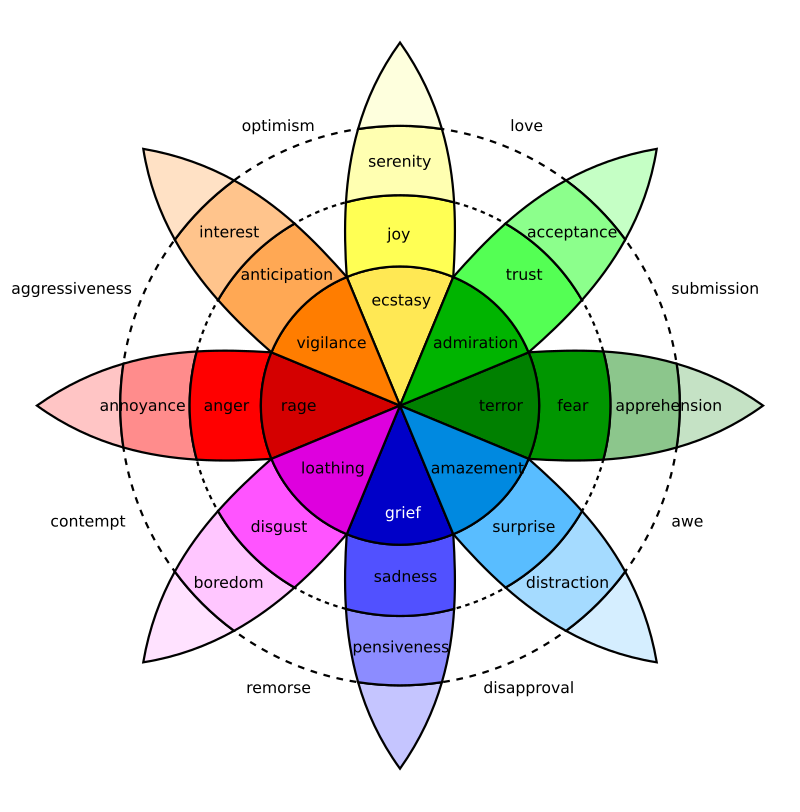
mood
relatively long lasting emotional, internal and subjective state

ecstasy
advanced emotion, subjective experience of total involvement of the subject, with an object of their awareness
mental confusion
In psychology, confusion is the quality or emotional state of being bewildered or unclear. The term acute mental confusion is often used interchangeably with delirium in the International Statistical Classification of Diseases and Related Health Problems and the Medical Subject Headings publications to describe the pathology. These refer to the loss of orientation, or the ability to place oneself correctly in the world by time, location and personal identity. Mental confusion is sometimes accompanied by disordered consciousness (the loss of linear thinking) and memory loss (the inability to co

Ikigai
is a Japanese concept of an individual's definition of the meaning of their life.
sublimation
type of defense mechanism where socially unacceptable impulses or idealizations are unconsciously transformed into socially acceptable actions or behavior
aporia
In philosophy, an aporia () is a conundrum or state of puzzlement. In rhetoric, it is a declaration of doubt, made for rhetorical purpose and often feigned. The notion of an aporia is principally found in ancient Greek philosophy, but it also plays a role in modern post-structuralist philosophy, as in the writings of Jacques Derrida and Luce Irigaray, and it has also served as an instrument of investigation in analytic philosophy.
dysphoria
Dysphoria (; ) is a profound state of unease or dissatisfaction. It is the semantic opposite of euphoria. In a psychiatric context, dysphoria may accompany depression, anxiety, or agitation.

hygge
thumb|Illustration of a hygge situation, with Meik Wiking's The Little Book of Hygge
thumb|"Hygge" sign in a restaurant in Nørrebro
superiority complex
the psychological state of being superior, where one looks down on those deemed inferiors
defeatism
Defeatism is the acceptance of defeat without struggle, often with negative connotations. It can be linked to pessimism in psychology, and may sometimes be used synonymously with fatalism or determinism.
wakefulness
Wakefulness is a daily recurring brain state and state of consciousness in which an individual is conscious and engages in coherent cognitive and behavioral responses to the external world.
altered state of consciousness
any condition which is significantly different from a normal waking state
mental state
state of mind of a person
relaxation
emotional state of low tension and an absence of arousal from sources such as anger, anxiety, or fear

psychonautics
thumb|right|upright|Illustration from The Secret of the Golden Flower, a Chinese book of alchemy and meditation.
distress
difficult state in which a person is unable to completely adapt to stressors and their resulting stress and shows maladaptive behaviors
terminal lucidity
cognitive phenomenon
repetition compulsion
psychological phenomenon in which a person repeats an event or its circumstances over and over again

Thumos
thumb | right | alt=Homer, Marble bust in the British Museum, London. | Homer. Marble bust in the British Museum, London.
Thumos, also spelled thymos (), is the Ancient Greek concept of (as in "a spirited stallion" or "spirited debate"). The word indicates a physical association with breath or blood and is also used to express the human desire for recognition. It is not a somatic feeling, as nausea and dizziness are.
open-mindedness
Open-mindedness is receptiveness to new ideas. Open-mindedness relates to the way in which people approach the views and knowledge of others. Jason Baehr defines an open-minded person as one who "characteristically moves beyond or temporarily sets aside his own doxastic commitments in order to give a fair and impartial hearing to the intellectual opposition". Jack Kwong's definition sees open-mindedness as the "willingness to take a novel viewpoint seriously".

alertness
Alertness is a state of active attention characterized by high sensory awareness. Someone who is alert is vigilant and promptly meets danger or emergency, or is quick to perceive and act. Alertness is a psychological and physiological state.
pronoia
phenomenon akin to the opposite of paranoia
cosiness
thumb|Beim Heurigen in [[Grinzing is a typical scene of Gemütlichkeit, painting by Rudolf Alfred Höger (1900).]]
thumb|Interior of the Café Hawelka with [[plush furniture and muted colours, serving cake and coffee, is a typical example of Gemütlichkeit.]]
thumb|A cosy Stube normally has many wooden elements, giving a feeling of warmth and comfort (inside of Schreiberhaus in [[Neustift am Walde, Vienna).]]
thumb|Hofbräukeller garden in Munich, a typical German beergarden scene, permeated by Gemütlichkeit
silliness
thumb|Official senatorial candidate portrait of Komeng with a silly face
Silliness is defined as engaging in "a ludicrous folly", showing a "lack of good sense or judgment", or "the condition of being frivolous, trivial, or superficial". In television, film, and the circus, portrayals of silliness such as exaggerated, funny behavior are used to amuse audiences. Portrayals of silliness, provided by clowns and jesters, are also used to lift the spirits of people in hospitals.
solipsism syndrome
psychological condition
peak experience
altered state of consciousness characterized by euphoria
insignificance
thumb|right|250px|In modern society, people may feel insignificant for a number of reasons, including from living in a huge, impersonal city (pictured is Chang'an Avenue in [[Beijing).]]
People may face feelings of insignificance due to a number of causes, including having low self-esteem, being depressed, living in a huge, impersonal city, comparing themselves to wealthy celebrity success stories, working in a huge bureaucracy, or being in awe of a natural wonder.
Double-mindedness
Double-mindedness is a concept used in theology and philosophy. In Christian theology, the term comes from the Bible in the Epistle of James, where the author exhorts the reader to avoid the self-deception that comes from being halfhearted in one's commitment to God. The Danish philosopher Søren Kierkegaard used the same term but made it refer to insincerity, egoism, or fear of punishment. The term was to help him develop his own systematic way to try to detect double-mindedness in himself.
Repressive desublimation
concept of commodification of art