Category
page 1Mesozoic amphibians
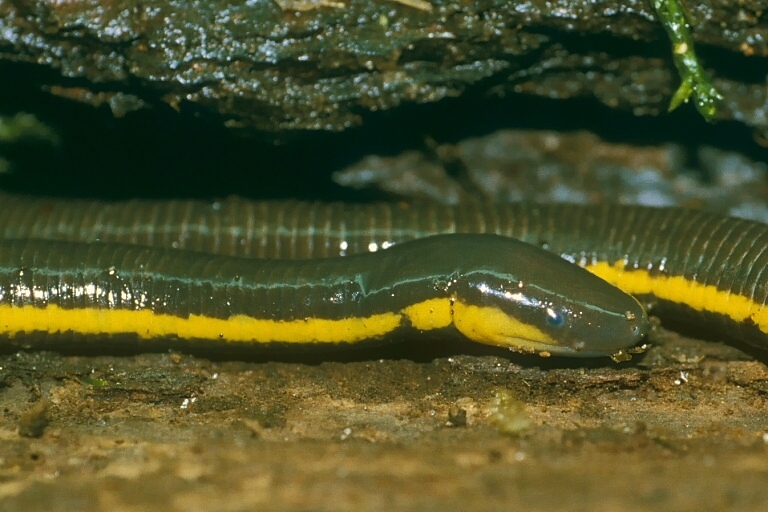
Caecilian
Caecilians (; ) are a group of limbless, worm-shaped or snake-shaped amphibians, with either small eyes or no eyes, comprising the order Gymnophiona. They mostly live hidden in soil or in streambeds, making them some of the least familiar amphibians. Modern caecilians live in the tropics of South and Central America, Africa, and southern Asia. Caecilians feed on small subterranean creatures, such as earthworms. The body is noodle-like and often dark in colour, and the skull is bullet-shaped and strongly built. Caecilian heads have several unique adaptations, such as fused skull and jaw bones,

Labyrinthodontia
"Labyrinthodontia" (Greek, 'maze-toothed') is an informal grouping of extinct predatory amphibians which were major components of ecosystems in the late Paleozoic and early Mesozoic eras (about 390 to 150 million years ago). Traditionally considered a subclass of the class Amphibia, modern classification systems recognize that labyrinthodonts are not a formal natural group (clade) exclusive of other tetrapods. Instead, they consistute an evolutionary grade (a paraphyletic group), ancestral to living tetrapods such as lissamphibians (modern amphibians) and amniotes (reptiles, mammals, and kin).