Category
page 1Metalworking

screw
thumb|An assortment of screws, and a Quarter (United States coin)|US quarter for size comparison
thumb|upright|A wood screw: a) head; b) non-threaded shank; c) threaded shank; d) tip

cast iron
group of iron-carbon alloys

etching
thumb|upright|The Soldier and his Wife. Etching by Daniel Hopfer, who is believed to have been the first to apply the technique to printmaking.

cage
right|thumb|Spherical cage containing watermelons in Russia
A cage is an enclosure often made of mesh, bars, or wires, used to confine, contain or protect something or someone. A cage can serve many purposes, including keeping an animal or person in captivity, capturing an animal or person, displaying an animal at a zoo, or protecting an object from external threats (i.e. theft, damage).

soldering or brazing
thumb|upright=1.5|Using a soldering iron to desolder a contact from a wire

engraving process
thumb|Saint Jerome in His Study (Dürer)|St. Jerome in His Study (1514), engraving by [[Northern Renaissance master Albrecht Dürer]]
Engraving is the practice of incising a design on a hard, usually flat surface by cutting grooves into it with a burin. The result may be a decorated object in itself, as when silver, gold, steel, or glass are engraved, or may provide an intaglio printing plate, of copper or another metal, for printing images on paper as prints or illustrations; these images are also called "engravings". Engraving is one of the oldest and most important techniques in printmaking.

rivet
right|thumb|220px|Solid rivets
right|thumb|upright=1.6|Sophisticated riveted joint on a railway bridge
thumb|upright=1.6|Riveting team working on the cockpit shell of a C-47 transport at the plant of [[North American Aviation. The woman on the left operates an air hammer, while the man on the right holds a bucking bar.]]
thumb|upright=1|Women rivet heaters, with their tongs and catching buckets, Puget Sound Navy Yard, May 1919

smithy
thumb|The inside of a typical smithy in Finland
thumb|Wooden smithy built in 1726 in Opole, Upper Silesia, Poland
thumb|A smithy built around 1880 in Mērsrags, [[Courland, Latvia currently located at The Ethnographic Open-Air Museum of Latvia]]

metalworking
thumb|A fireman turning a bar of metal on a lathe on the USS Harry S. Truman in 2004
Metalworking is the process of shaping and reshaping metals in order to create useful objects, parts, assemblies, and large scale structures. As a term, it covers a wide and diverse range of processes, skills, and tools for producing objects on every scale: from huge ships, buildings, and bridges, down to precise engine parts and delicate jewellery.

abrasive
An abrasive is a material, often a mineral, that is used to shape or finish a workpiece through rubbing which leads to part of the workpiece being worn away by friction. While finishing a material often means polishing it to gain a smooth, reflective surface, the process can also involve roughening as in satin, matte or beaded finishes. In short, the ceramics which are used to cut, grind and polish other softer materials are known as abrasives.

Damascus steel
type of steel used in Middle Eastern swordmaking

pig iron
iron alloy with a high carbon content

wrought iron
iron alloy with a very low carbon content and with fibrous slag inclusions, worked with hammers or dies
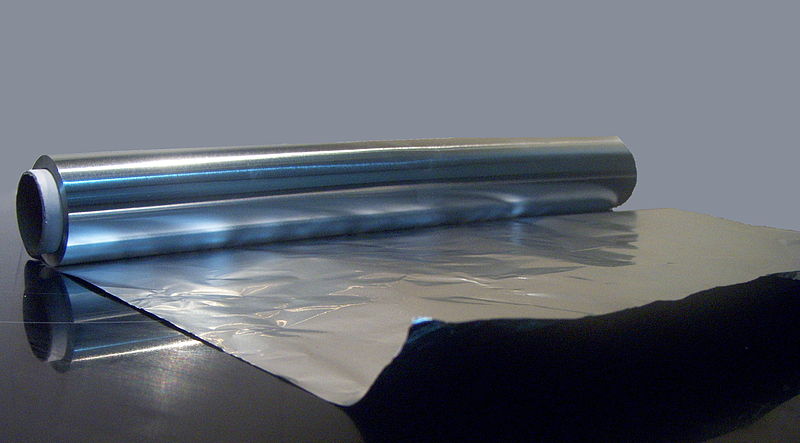
aluminium foil
thin, flexible sheets of aluminium, used for wrapping food, and other purposes

drypoint technique
thumb|Woman in Cafe, drypoint with Burr (metal)|burr by [[Lesser Ury]]
thumb|Surlingham Ferry - looking towards Norwich, drypoint with very rich burr by Edward Thomas Daniell
Drypoint is a printmaking technique of the intaglio family, in which an image is incised into a plate (or "matrix") with a hard-pointed "needle" of sharp metal or diamond. In principle, the method is practically identical to engraving. The difference is in the use of tools, and that the raised ridge along the furrow is not scraped or filed away as in engraving. Traditionally the plate was copper, but now acetate, zinc, or
heat treatment
process of heating something to alter it

patina
thumb|Copper roof on the Minneapolis City Hall, coated with patina
thumb|upright|The Dresden Frauenkirche. The church was destroyed during the [[bombing of Dresden in 1945 and rebuilt from 1993 to 2005 with new material; the stones with the black patina are the parts that survived the firebombing from the original 18th-century church.]]
thumb|Pre-colonial copper coin formerly used in the Copper Belt ([[Democratic Republic of the Congo and Zambia). The external layer has been weathered by moisture and rain, leading to the oxidation of copper.]]

gilding
thumb|right|Gilded frame ready for burnishing (metal)|burnishing with an [[agate stone tool]]
thumb|right|Application of gold leaf to a reproduction of a 15th-century panel painting
Gilding is a decorative technique for applying a very thin coating of gold over solid surfaces such as metal (most common), wood, porcelain, or stone. A gilded object is also described as "gilt". Where metal is gilded, the metal below was traditionally silver in the West, to make silver-gilt (or vermeil) objects, but gilt-bronze is commonly used in China, and also called ormolu if it is Western. Methods of gilding

sintering
thumb|Heat and compaction fuse small particles into a dense bulk
thumb|clinker (cement)|Clinker nodules produced by sintering
powder metallurgy
process of sintering metal powders
steel wool
bundle of very fine and flexible sharp-edged steel filaments
tool steel
types of carbon steel and alloy steel used in tool making

inlay
280px|thumb|Example of Boulle work inlay using [[tortoiseshell in mottled red, brass and pewter]]
280px|thumb|Boulle work showing the use of [[pewter (center) and the 'depth' given by tortoiseshell in the background. Brass inlay is on the right and left.]]
Inlay covers a range of techniques in sculpture and the decorative arts for inserting pieces of contrasting, often colored materials into depressions in a base object to form ornament or pictures that normally are flush with the matrix. A great range of materials have been used both for the base or matrix and for the inlays inserted into it
.jpg)
niello
thumb|right|300px|Diptych with Nativity and Adoration, silver and niello, [[gilt-bronze frame, Paris, , The Cloisters]]
thumb|Byzantine gold ring with niello inscription: "Lord help Leontius, Patrician and Count of imperial Obsikion guarded by God",
Niello is a black mixture, usually of sulphur, copper, silver, and lead, used as an inlay on engraved or etched metal, especially silver. It is added as a powder or paste, then fired until it melts or at least softens, and flows or is pushed into engraved lines in the metal. It hardens and blackens when cool, and the niello on the flat surface is
G-code
G-code (abbreviation for geometric code; also called RS-274, standardized today in ISO 6983-1) is the most widely used computer numerical control (CNC) and 3D printing programming language. It is used mainly in computer-aided manufacturing to control automated machine tools, as well as for 3D-printer slicer applications. G-code has many variants.
foil
very thin sheet metal, usually made by hammering or rolling
work hardening
strengthening of a metal by plastic deformation
milling
machining process by rotation ot the tool
cupola furnace
variety of small blast furnace used for melting pig iron or scrap for foundry purposes

damascening
thumb|upright=1.2|Some examples of damascened work in Toledo
thumb|upright=1.2|An array of damascened pistols
cutting fluid
type of coolant and lubricant designed specifically for metalworking processes, such as machining and stamping

ajour
thumb|Openwork basket, English Bow porcelain, c. 1754–1755
right|thumb|alt=A gold bracelet with a pattern and writing created by making holes in the bracelet|Ancient Roman gold bracelet from the Hoxne Hoard. JULIANE is spelled out in [[opus interrasile openwork.]]
thumb|Intricate jalis from the [[Sidi Saiyyed mosque in Ahmedabad, India. From the inside]]
industrial etching
manufacturing process using baths of etching chemicals to remove material
primer
preparatory coating put on materials before painting
hydrogen embrittlement
reduction in ductility of a metal exposed to hydrogen
pickling
metal surface treatment

foundry
thumb|300px|The Iron Foundry, Burmeister & Wain, by [[Peder Severin Krøyer, 1885]]
thumbnail|A Foundryman, pictured by Daniel A. Wehrschmidt in 1899
A foundry is a factory that produces metal castings. Metals are cast into shapes by melting them into a liquid, pouring the metal into a mold, and removing the mold material after the metal has solidified as it cools. The most common metals processed are aluminium and cast iron. However, other metals, such as bronze, brass, steel, magnesium, and zinc, are also used to produce castings in foundries. In this process, parts of desired shapes and size
selective laser sintering
additive manufacturing technique used for the low volume production of prototype models and functional components
metal fume fever
illness caused by exposure to metal oxide fumes when heating e.g. zinc or aluminum.

electropolishing
thumb|Electropolishing principle: 1. Electrolyte 2. Cathode 3. Workpiece to polish (Anode) 4. Particle moving from the work-piece to the cathode 5. Surface before polishing 6. Surface after polishing
cladding
bonding together of dissimilar metals
finery forge
Forge for making wrought iron from pig iron
rotten stone
Rotten stone, sometimes spelled as rottenstone, also known as tripoli, is fine powdered porous rock used as a polishing abrasive for metalsmithing and in woodworking.
miter joint
woodworking joint

Mokume-gane
thumb| with a hawk and a sparrow, made by Hamano Masanobu, using the technique
is a Japanese metalworking procedure which produces a mixed-metal laminate with distinctive layered patterns; the term is also used to refer to the resulting laminate itself. The term translates closely to 'wood grain metal' or 'wood eye metal' and describes the way metal takes on the appearance of natural wood grain. fuses several layers of differently coloured precious metals together to form a sandwich of alloys called a "billet." The billet is then manipulated in such a way that a pattern resembling wood grain

metal injection molding
metalworking process using injection molding
shot tower
tower for the production of shot pellets

knife making
process of manufacturing a knife
hot isostatic pressing
heat and pressure treatment applied to metals and alloys
blowpipe
tool used to direct stream of gas
burnishing
deformation of a metal surface due to friction
metal clay
craft material of metal particles and a plastic binder
peening
In metallurgy, peening is the process of working a metal's surface to improve its material properties, usually by mechanical means, such as hammer blows, by blasting with shot (shot peening), focusing light (laser peening), or in recent years, with water column impacts (water jet peening) and cavitation jets (cavitation peening). With the notable exception of laser peening, peening is normally a cold work process tending to expand the surface of the cold metal, thus inducing compressive stresses or relieving tensile stresses already present. It can also encourage strain hardening of the surfac
metal polishing
finishing processes for smoothing a workpiece's surface using an abrasive and a work wheel or a leather strop
paintless dent repair
technique used to remove minor dents and dings from the body of a vehicle without using traditional body repair methods like painting or filling
rust converter
type of useful chemical solution
tumble finishing
technique for smoothing and polishing a rough surface on relatively small parts
Autofrettage
Autofrettage is a work-hardening process in which a pressure vessel (thick walled) is subjected to enormous pressure, causing internal portions of the part to yield plastically, resulting in internal compressive residual stresses once the pressure is released. The goal of autofrettage is to increase the pressure-carrying capacity of the final product. Inducing residual compressive stresses into materials can also increase their resistance to stress corrosion cracking; that is, non-mechanically assisted cracking that occurs when a material is placed in a corrosive environment in the presence of
bearing ball
highly spherical and smooth ball used as a component of a ball bearing or other mechanical device
ironwork
thumb|Gate of the Winter Palace in [[St Petersburg.]]
Ironwork is any weapon, artwork, utensil, or architectural feature made of iron, especially one used for decoration. There are two main types of ironwork: wrought iron and cast iron. While the use of iron dates as far back as 4000 BC, it was the Hittites who first knew how to extract it (see iron ore) and develop weapons. Use of iron was mainly utilitarian until the Middle Ages; it became widely used for decoration in the period between the 16th and 19th century.