Category
page 1Microwave technology

radar
Radar is a system that uses radio waves to determine the distance (ranging), direction (azimuth and elevation angles), and radial velocity of objects relative to the site. It is a radiodetermination method used to detect and track aircraft, ships, spacecraft, guided missiles, motor vehicles, weather formations and terrain. The term RADAR was coined in 1940 by the United States Navy as an acronym for "radio detection and ranging". The term radar has since entered English and other languages as an anacronym, a common noun, losing all capitalization.
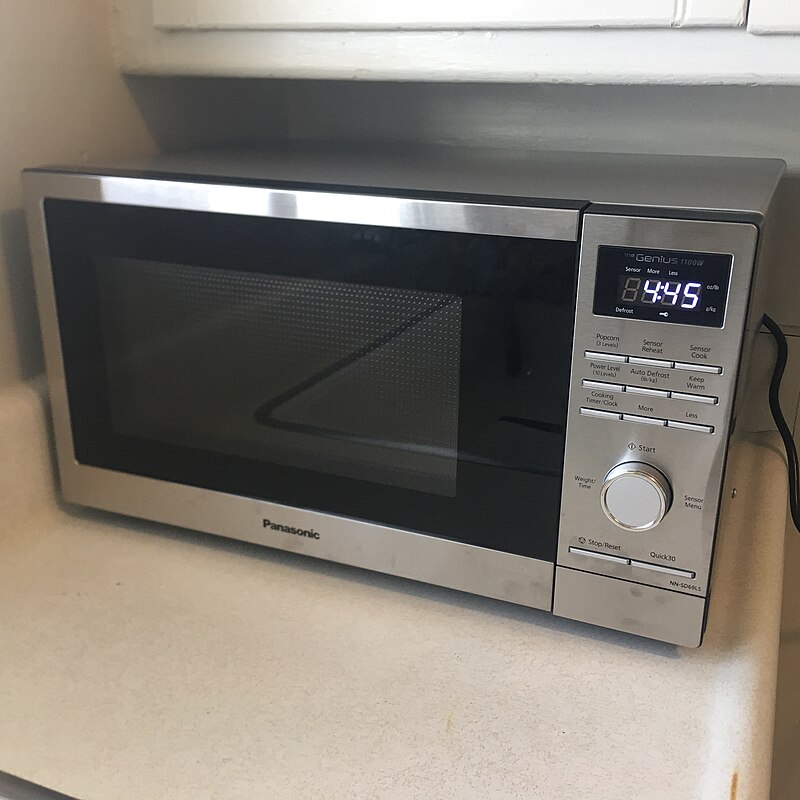
microwave oven
kitchen cooking appliance

microwave
thumb|A telecommunications tower with a variety of dish antennas for microwave relay links on [[Frazier Peak, Ventura County, California. The apertures of the dishes are covered by plastic sheets (radomes) to keep out moisture.]]

cavity magnetron
device for generating microwaves

maser
300px|thumb|upright=1.7 |The first prototype ammonia maser in front of its inventor [[Charles H. Townes. The ammonia nozzle is at left in the box, the four brass rods at center are the quadrupole state selector, and the resonant cavity is at right. The 24 GHz microwaves exit through the vertical waveguide Townes is adjusting. At bottom are the vacuum pumps.]]
thumb|right|260px|A hydrogen radio frequency discharge, the first element inside a #Hydrogen maser|hydrogen maser (see description below)

solar sail
type of spacecraft propulsion that takes advantage of solar radiation
electromagnetic waveguide
structure used to propagate electromagnetic waves

klystron
250px|thumb|right|400 kW klystron used for spacecraft communication at the Canberra Deep Space Communications Complex. This is a spare in storage.
thumb|upright=2|5 kW klystron tube used as power amplifier in UHF television transmitter, 1952. When installed, the tube projects through holes in the center of the cavity resonators, with the sides of the cavities making contact with the metal rings on the tube.
Gunn diode
form of diode
traveling-wave tube
device used to amplify radio frequency signals in the microwave spectrum
microwave transmission
technology of transmitting information or energy by the use of microwaves
PIN diode
a diode with a wide, undoped intrinsic semiconductor region between a p-type semiconductor and an n-type semiconductor region
negative resistance
the property that an increasing voltage results in a decreasing current

Gyrotron
thumb|High-power 140 GHz gyrotron for plasma heating in the Wendelstein 7-X fusion experiment, Germany.
A gyrotron is a class of high-power linear-beam vacuum tubes that generates millimeter-wave electromagnetic waves by the cyclotron resonance of electrons in a strong magnetic field. Output frequencies range from about 20 to 527 GHz, covering wavelengths from microwave to the edge of the terahertz gap. Typical output powers range from tens of kilowatts to 1–2 megawatts. Gyrotrons can be designed for pulsed or continuous operation. The gyrotron was invented by Soviet scientists at NIRFI, based
attenuator
electronic component which reduces a signal's amplitude
antenna array
set of multiple antennas which work together as a single antenna
high-electron-mobility transistor
field-effect transistor incorporating a heterojunction as the channel

microstrip
thumb|right|200px|Cross-section of microstrip geometry. Conductor A is separated from ground plane D by dielectric substrate C. Upper dielectric B is typically air.
Monolithic microwave integrated circuit
a type of integrated circuit (IC) device that operates at microwave frequencies

circulator

MESFET
thumb|upright=1.6|MESFET schematic
A MESFET (metal–semiconductor field-effect transistor) is a field-effect transistor semiconductor device similar to a JFET with a Schottky (metal–semiconductor) junction instead of a p–n junction for a gate.

Power dividers and directional couplers
radio technology devices
space charge
electric charge treated as continuously distributed in space
backward wave oscillator
vacuum tube used to generate microwaves
distributed element filter
type of electronic filter circuit
patch antenna
rectangular Microstrip Antenna is a radio antenna constructed from a single metal patch suspended over a ground plane
crossed-field amplifier
specialized vacuum tube used as a microwave amplifier
explosively pumped flux compression generator
non-nuclear weapon that creates an electromagnetic pulse
heterojunction bipolar transistor
type of bipolar junction transistor (BJT) which uses differing semiconductor materials for the emitter and base regions, creating a heterojunction
microwave radiometer
radiometer that measures energy in the one millimetre to meter wavelengths
Shorted monopole antenna
Antenna used in wireless communication
Microstrip antenna
antenna fabricated using photolithographic techniques
microwave isolator
two-port device that transmits microwave or radio frequency power in one direction only
Distributed element circuit
transmission line-based electrical circuit
magic tee
type of radio-frequency coupler
millimeter wave scanner
whole-body imaging device
microwave engineering
study and design of microwaves
waveguide filter
electronic filter that is constructed with waveguide technology
Phase shift module
microwave network module
pulse-Doppler radar
radar system
planar transmission line
transmission line with a flat, ribbon-shaped conductor
Tellurometer
thumb|Tellurometer model M/RA-1
thumb|Tellurometer model MRB2
vircator
A vircator (VIRtual CAthode oscillaTOR) is a microwave generator that is capable of generating brief pulses of tunable, narrow band microwaves at very high power levels. Its application is mainly in the area of electronic warfare, by way of interfering with electronic equipment such as radars or radio equipment.
YIG sphere
Magnetic device
rat-race coupler
type of radio-frequency coupler
Coplanar waveguide
type of planar transmission line
stripline
thumb|right|250px|Cross-section diagram of stripline geometry. Central Electrical conductor|conductor (A) is sandwiched between ground planes (B and D). Structure is supported by [[dielectric (C).]]
Inductive output tube
Television Broadcast Transmitter Power Amplifier
absorption wavemeter
electronic instrument used to measure the frequency of radio waves
reflex klystron
type of klystron for generating low intensity microwaves
Wilkinson
RF signal splitter with special properties
substrate integrated waveguide
synthetic rectangular electromagnetic waveguide
Goubau line
single wire transmission line used to conduct radio waves at UHF and microwave frequencies
Microwave thermotherapy
thermotherapy by microwaves for cancer
microwave cavity
resonator device that can hold a standing microwave