Category
page 1Middle Ordovician first appearances

Thelodonti
Thelodonti (from Greek: "nipple teeth") is a class of extinct Palaeozoic jawless fishes with distinctive scales instead of large plates of armor. These fish lived in both freshwater and marine environments, first appearing during the Late Ordovician, and perishing shortly after the Frasnian–Famennian extinction event in the Late Devonian.

Cystoids
Cystoidea was defined as a class of extinct paleozoic blastozoan echinoderms established to encompass stalked taxa that were neither crinoids nor blastoids. It was shown to be polyphyletic in the late 1960s but continues to be used even in recent (as of 2022) literature to discuss both rhombiferans and diploporitans.
Pectinida
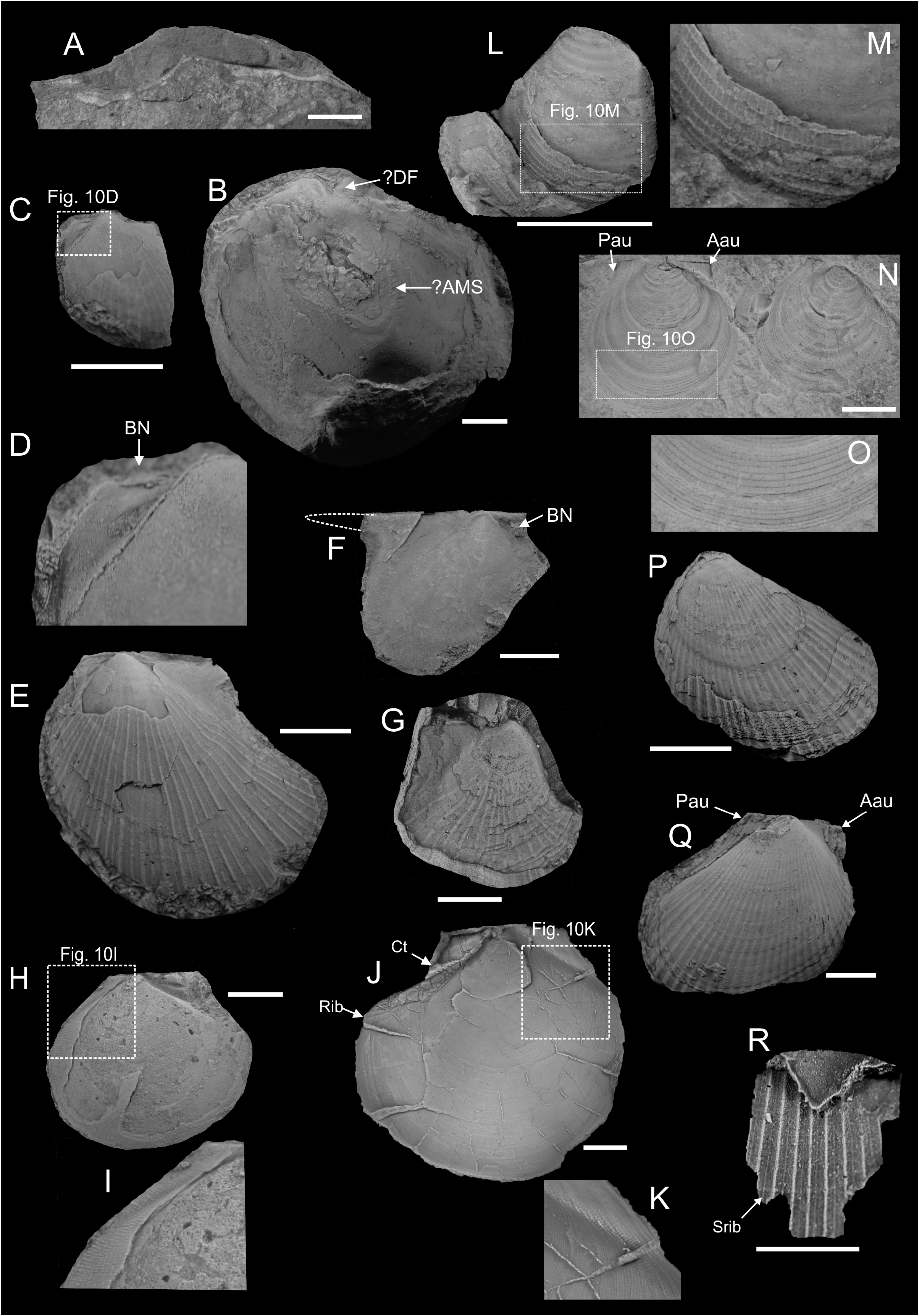
Pectinida is a taxonomic order of large and medium-sized saltwater clams, marine bivalve molluscs, commonly known as scallops and their allies. It is believed that they began evolutionarily in the late Middle Ordovician epoch; many species, of course, are still extant.

Endoceras
Endoceras, from Ancient Greek ἔνδον (éndon), meaning "inside", and κέρας (kéras), meaning "horn", is an extinct genus of large, straight-shelled cephalopods that gives its name to the Nautiloid order Endocerida. The genus lived during the middle and upper Ordovician 470 to 443 million years ago. The cross section in the mature portion is slightly wider than high, but is narrower laterally in the young. Sutures are straight and transverse. Endoceras has a large siphuncle, located close to the ventral margin, composed of concave segments, especially in the young but which may be tubular in the a
Perischoechinoidea
Perischoechinoidea is a subclass of primitive sea urchins that were abundant in the Palaeozoic seas. However, the great majority of species died out during the Mesozoic, as the more advanced euechinoid sea urchins became common. Today, only a single order, the Cidaroida, survives.
Fenestella
extinct genus of bryozoans
Atrypida
Atrypida is an extinct order of rhynchonelliform brachiopods. They first appeared in middle Ordovician and survived the Ordovician-Silurian extinction, becoming the dominant brachiopods of the Silurian alongside the order Pentamerida. They would survive into the Late Devonian before going extinct at the end of the Frasnian (Late Devonian).
Endoceratidae
Endoceratidae, from Ancient Greek ἔνδον (éndon), meaning "inside", and κέρας (kéras), meaning "horn", is a family of large to very large straight-shelled nautiloid cephalopods belonging to the order Endocerida that lived during the Middle and Late Ordovician. They include the largest known Paleozoic invertebrates, represented by Endoceras and Cameroceras.
Dekatriata
Dekatriata is a clade of planatergan chelicerates including the groups Arachnida, Chasmataspidida, Eurypterida and additionally two stem-genera Winneshiekia and Houia. Dekatriata is defined by an opisthosoma with 13 segments as groundplan (the number proposed to be secondarily reduced in most arachnid orders) and fused, plate-like appendages on the first opisthosomal segment (somite VII).
Encrinurus
Encrinurus is a long-lived genus of phacopid trilobites that lived in what are now Africa, Asia, Australia, Europe, North America, and South America from the middle Ordovician to the early Devonian from 472 to 412.3 mya, existing for approximately .
Prosomapoda
Prosomapoda is a clade of euchelicerates including the groups Xiphosura (horseshoe crabs) and Planaterga (a group comprising bunodids, pseudoniscids, chasmataspidids, eurypterids and arachnids), as well as several basal synziphosurid genera. The clade is defined by the lack of exopods (outer branches) of prosomal appendage II-V in the adult instar, where in contrast the exopods of appendage II-V are well-developed in the non-prosomapod euchelicerates Offacolus and Dibasterium.
Actinoceratidae
The Actinoceriatidae are a family of actinocerids named by Saemann in 1853 for those that grew to have large shells with blunt apices and large siphuncles with widely expanded segments and a generally arcuate endosiphucular canal system. Their range is from the upper Middle Ordovician to the Lower Silurian. Actinocerids are generally straight-shelled nautiloid cephalopods with a siphuncle composed of expanded segments, typically with thin connecting rings, in which the internal deposits are penetrated by a system of canals.
Rhenopteridae
The Rhenopteroidea is an extinct superfamily of eurypterids, an extinct group of chelicerate arthropods commonly known as "sea scorpions". The superfamily is one of four superfamilies classified as part of the suborder Stylonurina. Previously considered to consist only of the family Rhenopteridae, the superfamily was in 2025 divided into three families: Rhenopteridae, Brachyopteridae, and Brachyopterellidae.
Oncocerida
The Oncocerida comprise a diverse group of generally small nautiloid cephalopods known from the Middle Ordovician to the Mississippian (early Carboniferous; one possible member is known from the Early Permian), in which the connecting rings are thin and siphuncle segments are variably expanded (Flower, 1950). At present the order consists of some 16 families, a few of which, such as the Oncoceratidae, Brevicoceratidae, and Acleistoceratidae contain a fair number of genera each while others like the Trimeroceratidae and Archiacoceratidae are represented by only two or three (Sweet, 1964).
Astraspida
Astraspida, or astraspids, are a small group of extinct armored jawless vertebrates, which lived in the Late Ordovician (about 450 million years ago) in North America. They are placed among the Pteraspidomorphi because of the large dorsal and ventral shield of their head armor. They are represented by a single genus, Astraspis, including possibly two species, A. desiderata and A. splendens but their remains are fairly abundant in Ordovician sandstones of the USA (Colorado, Arizona, Oklahoma, Wyoming) and Canada (Quebec). The head armor of Astraspis is rather massive, with a series of ten gill
Ceraurus
Ceraurus is a genus of cheirurid trilobite of the middle and, much more rarely, the upper Ordovician. They are commonly found in strata of the lower Great Lakes region. These trilobites have eleven thoracic segments, a very small pygidium and long genal and pygidial spines.