Category
page 1Middle Platonists

Plutarch
Plutarch (; , Ploútarchos, ; before AD 50 – after 120) was a Greek and later Roman Middle Platonist philosopher, historian, biographer, essayist, and priest at the Temple of Apollo in Delphi. He is known primarily for his Parallel Lives, a series of biographies of illustrious Greeks and Romans, and Moralia, a collection of essays and speeches. Upon becoming a Roman citizen, he was possibly named Lucius Mestrius Plutarchus ().
%20-%20Veloso%20Salgado.png)
Galen
Aelius Galenus or Claudius Galenus (; September 129 – CE), often anglicized as Galen () or Galen of Pergamon, was a Roman and Greek physician, surgeon, and philosopher. Considered to be one of the most accomplished of all medical researchers of antiquity, Galen influenced the development of various scientific disciplines, including anatomy, physiology, pathology, pharmacology, and neurology, as well as philosophy and logic.

Apuleius
Apuleius ( ), also called Lucius Apuleius Madaurensis (c. 124 – after 170), was a Numidian Latin-language prose writer, Platonist philosopher and rhetorician. He was born in the Roman province of Numidia, in the Berber city of Madauros, modern-day M'Daourouch, Algeria. He studied Platonism in Athens, travelled to Italy, Asia Minor, and Egypt, and was an initiate in several cults or mysteries. The most famous incident in his life was when he was accused of using magic to gain the attentions (and fortune) of a wealthy widow. He declaimed his own defense before the proconsul and a court of magist

Origen
Origen of Alexandria (), also known as Origen Adamantius, was an early Christian scholar, ascetic, and theologian who was born and spent the first half of his career in Alexandria. He was a prolific writer who wrote roughly 2,000 treatises in multiple branches of theology, including textual criticism, biblical exegesis and hermeneutics, homiletics, and spirituality. He was one of the most influential and controversial figures in early Christian theology, apologetics, and asceticism. He has been described by John Anthony McGuckin as "the greatest genius the early church ever produced".
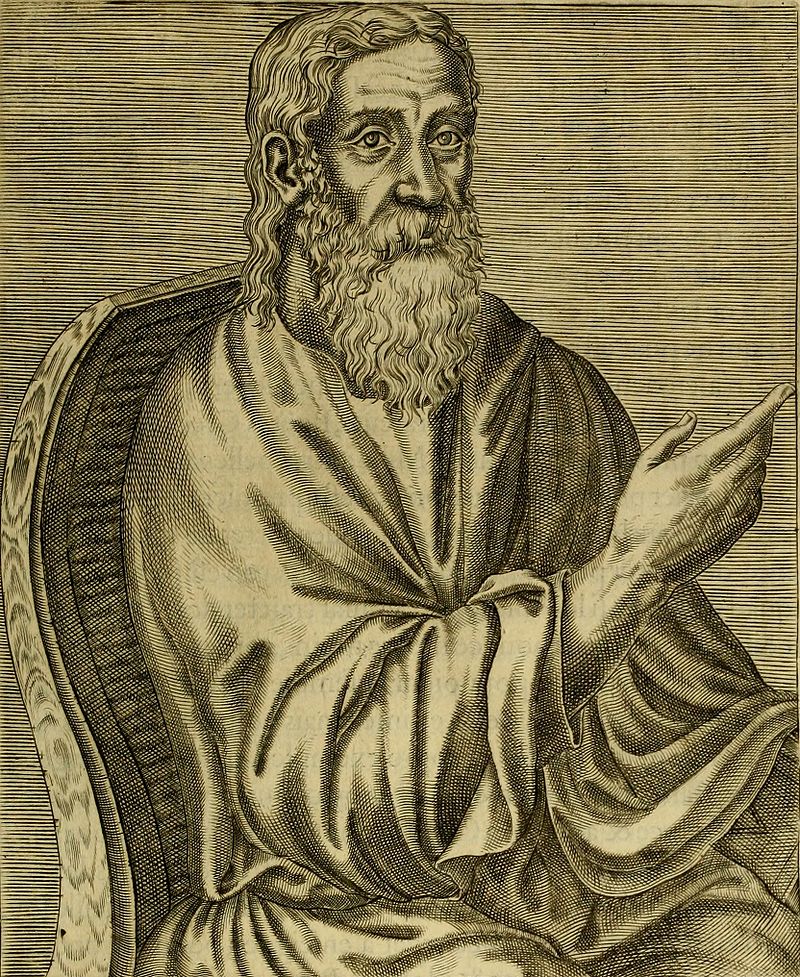
Clement of Alexandria
Christian theologian (c.150 – c.215)

Philo of Alexandria
Philo of Alexandria (; ; ; ), also called '''''', was a Hellenistic Jewish philosopher who lived in Alexandria, in the Roman province of Egypt.

Justin Martyr
2nd century CE Christian apologist and martyr

Hippolytus
Christian theologian and saint (c. 170 – c. 235)

Aulus Gellius
2nd century Roman author and grammarian
Ammonius Saccas
Hellenistic Platonist philosopher (175-242)

Athenagoras of Athens
Greek philosopher and Father of the Church (c.133–c.190)

Celsus
thumb|Origen, Contra Celsum ([[Cambridge, 1676 edition)]]

Nicomachus
Nicomachus of Gerasa (; ) was an Ancient Greek Neopythagorean philosopher from Gerasa, in the Arabia Petraea (now Jerash, Jordan). He is perhaps Hellenized of Arab origin from Jerash. Like many Pythagoreans, Nicomachus wrote about the mystical properties of numbers, best known for his works Introduction to Arithmetic and Manual of Harmonics, which are an important resource on Ancient Greek mathematics and Ancient Greek music in the Roman period. Nicomachus' work on arithmetic became a standard text for Neoplatonic education in Late antiquity, with philosophers such as Iamblichus and John Philo

Antiochus of Ascalon
ancient Greek philosopher
Cassius Longinus
Syrian/Egyptian Neoplatonist philosopher (c.213–273)
Numenius of Apamea
2nd century Greco-Roman philosopher
Maximus of Tyre
2nd century Greek rhetorician and philosopher
Theon of Smyrna
2nd century Greek mathematician and philosopher

Calcidius
right|thumb|Tenth-century manuscript of Calcidius' Timaeus translation and commentary now in the Vatican Library.
Calcidius (or Chalcidius) was a 4th-century philosopher who translated the first part (to 53c) of Plato's Timaeus from Greek into Latin around the year 321 and provided with it an extensive commentary. This was likely done for Bishop Hosius of Córdoba. Very little is otherwise known of him.
Albinus
ancient Greek philosopher
Pseudo-Plutarch
Pseudo-Plutarch is the conventional name given to the actual, but unknown, authors of a number of pseudepigrapha attributed to Plutarch but now known not to have been written by him. Some of these works were included in editions of Plutarch's Moralia.
Eudorus of Alexandria
1st century BC Greco-Egyptian philosopher
Alcinous
ancient Greek philosopher
Thrasyllus of Mendes
1st-century AD Egyptian Greek astrologer and philosopher
Onasander
Onasander or Onosander ( Onesandros or Ὀνόσανδρος Onosandros; fl. 1st century AD) was a Greek philosopher. He was the author of a commentary on the Republic of Plato, which is lost; as well as of the Strategikos () - a short but comprehensive work on the duties of a general, which was dedicated to Quintus Veranius. The Strategikos was the main source used for the military writings of emperors Maurice and Leo VI, as well as of Maurice of Saxony, who consulted it in a French translation and expressed a high opinion of it.
Origen the Pagan
3rd century Alexandrian Platonist philosopher
Atticus
2nd century Greek philosopher
Ammonius of Athens
1st century AD Greek philosopher
Moderatus of Gades
1st century AD Greek philosopher
Timaeus the Sophist
ancient Greek lexicographer
Harpocration of Argos
ancient Greek philosopher
Lucius Calbenus Taurus
2nd century Greek philosopher of the Middle Platonist school
Gaius the Platonist
ancient philosopher
Aristos of Ascalon
ancient Greek philosopher
Dercyllides
Dercyllides was an ancient Greek Platonist philosopher. There survive only quotations or paraphrases of his work in later writers, no complete works.