Category
page 1Mollicutes

Mollicutes
Mollicutes is a class of bacteria distinguished by the absence of a cell wall and its peptidoglycan. The word Mollicutes is derived from Latin '''' 'soft, pliable' and '''' 'skin'. Individuals are very small, typically only 0.2–0.3 μm (200–300 nm) in size and have a very small genome size. They vary in form, although most have sterols that make the cell membrane somewhat more rigid. Many move about by gliding, but members of the genus Spiroplasma are helical and move by twisting. The best-known genus in the Mollicutes is Mycoplasma, though it has been split in 2018 into several genera. Colonie
Phytoplasma
Phytoplasmas are obligate intracellular parasites of plant phloem tissue and of the insect vectors that are involved in their plant-to-plant transmission. Phytoplasmas were discovered in 1967 by Japanese scientists who termed them mycoplasma-like organisms. Since their discovery, phytoplasmas have resisted all attempts at in vitro culture in any cell-free medium; routine cultivation in an artificial medium thus remains a major challenge. Phytoplasmas are characterized by the lack of a cell wall, a pleiomorphic or filamentous shape, a diameter normally less than 1 μm, and a very small geno
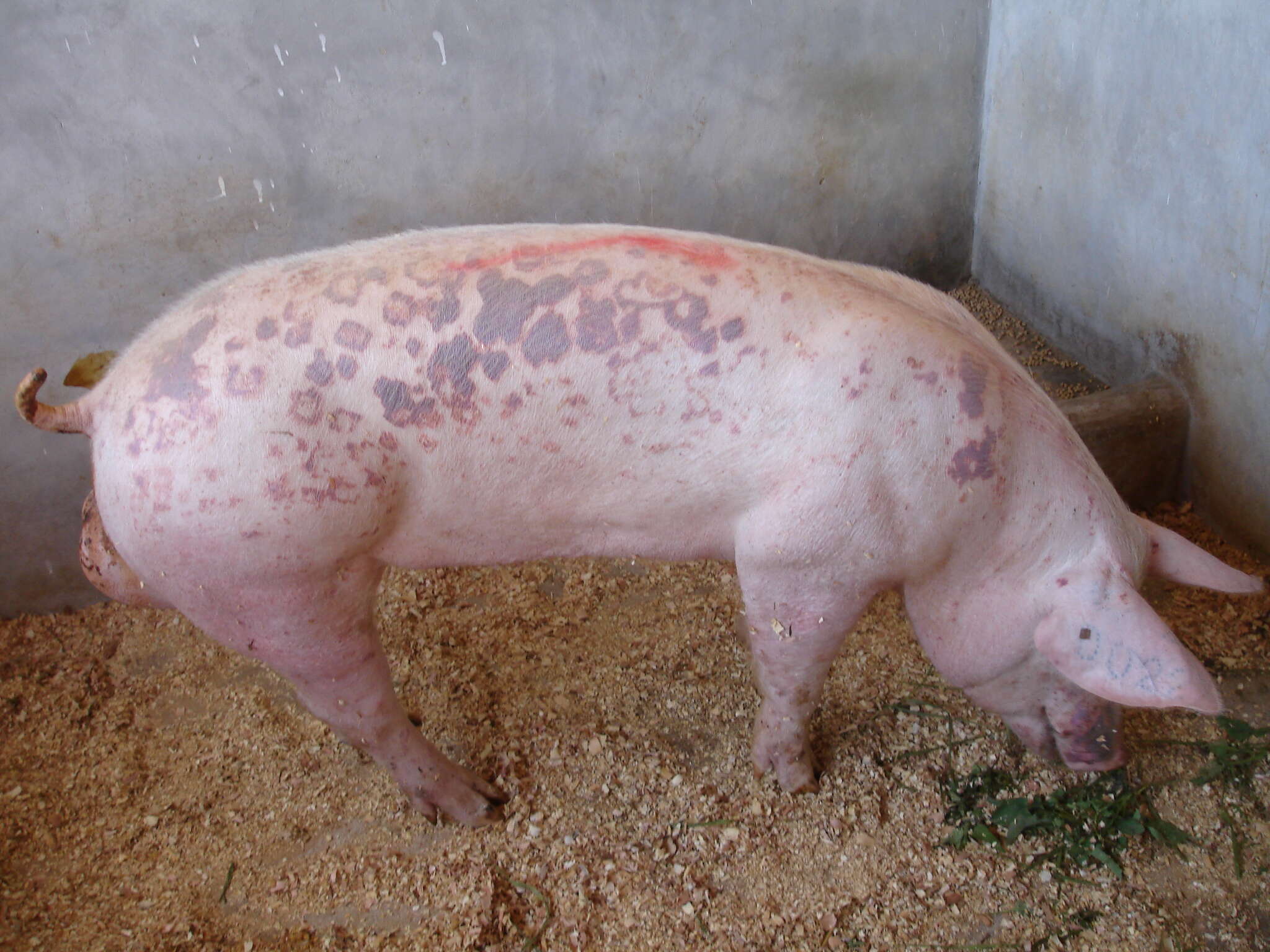
Erysipelothrix rhusiopathiae
species of bacterium
Mycoplasmataceae
Mycoplasmataceae is a family of bacteria in the order Mycoplasmatales. This family consists of Mycoplasma and four more genera.

Spiroplasma
Spiroplasma is a genus of Mollicutes, a group of small bacteria without cell walls. Spiroplasma shares the simple metabolism, parasitic lifestyle, fried-egg colony morphology and small genome of other Mollicutes, but has a distinctive helical morphology, unlike Mycoplasma. It has a spiral shape and moves in a corkscrew motion. Many Spiroplasma are found either in the gut or haemolymph of insects where they can act to manipulate host reproduction, or defend the host as endosymbionts. Spiroplasma are also disease-causing agents in the phloem of plants. Spiroplasmas are fastidious organisms, whic
Acholeplasmataceae
Acholeplasmataceae is a family of bacteria. It is the only family in the order Acholeplasmatales, placed in the class Mollicutes. The family comprises the genera Acholeplasma and Phytoplasma. Phytoplasma has the candidatus status, because members still could not be cultured.
Anaeroplasmatales
REDIRECT Anaeroplasmataceae
Erysipelothrix
Erysipelothrix is a genus of bacteria containing four described species: Erysipelothrix rhusiopathiae, Erysipelothrix tonsillarum, Erysipelothrix inopinata and Erysipelothrix larvae. Additional species have been proposed based on DNA-DNA hybridization studies. "The hallmark of Erysipelothrix is the presence of a type B cell wall, in which the peptide bridge is formed between amino acids at positions 2 and 4 of adjacent peptide side-chains and not, as in the vast majority of bacteria, between amino acids at positions 3 and 4."
Acholeplasma
Acholeplasma are wall-less bacteria in the Mollicutes class. They include saprotrophic or pathogenic species. There are 15 recognised species. The G+C content is low, ranging from 26 – 36% (mol%). The genomes of Acholeplasma species range in size from 1.5 to 1.65 Mbp. Cholesterol is not required for growth. The species are found on animals, and some plants and insects. The optimum growth temperature is 30 to 37 degrees Celsius.
Mycoplasmatales
Mycoplasmatales is an order of bacteria in the class Mollicutes. The order consists of the families Spiroplasmataceae and Mycoplasmataceae.
Spiroplasmataceae
REDIRECT Spiroplasma