Category
page 1Money

money
thumb|upright=1.5|Euro [[banknotes and coins]]

coin
A coin is a small object, usually round and flat, used primarily as a medium of exchange or legal tender. They are standardized in weight, and produced in large quantities at a mint in order to facilitate trade. They are most often issued by a government. Coins often have images, numerals, or text on them. The faces of coins or medals are sometimes called the obverse and the reverse, referring to the front and back sides, respectively. The obverse of a coin is commonly called heads, because it often depicts the head of a prominent person, and the reverse is known as tails.

microeconomics
thumb|right|300px|Microeconomics analyzes the market mechanisms that enable buyers and sellers to establish [[relative prices among goods and services. Shown is a marketplace in Delhi.]]

cash
thumb|Banknotes and coins of various currencies
Cash is money in the tangible form of currency, such as banknotes and coins.
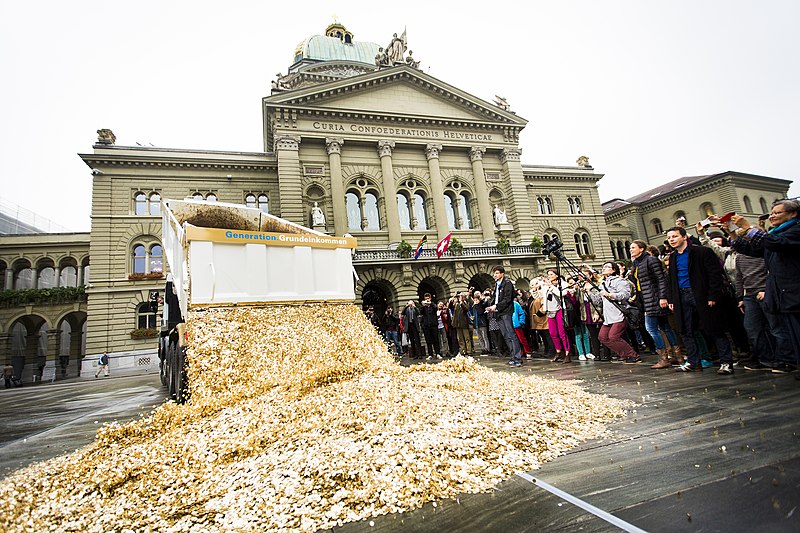
universal basic income
sociopolitical financial transfer proposal

Mammon
250px|thumb|1909 painting The Worship of Mammon by Evelyn De Morgan
Mammon (Aramaic: מָמוֹנָא, māmōnā) in the New Testament is commonly thought to mean money, material wealth, or any entity that promises wealth, and is associated with the greedy pursuit of gain. The Gospel of Matthew and the Gospel of Luke both quote Jesus using the word in a phrase often rendered in English as "You cannot serve both God and mammon."
tally stick
ancient memory aid device used to record and document quantities
commodity money
money with value derived from composition from a commodity (such as silver or gold coins)
time value of money
conjecture that there is greater benefit to receiving a sum of money now rather than later
Demurrage
cost associated with owning or holding currency over a given period
chocolate coins
gold foil covered chocolates in the shape of coins
monetization
Monetization (also spelled monetisation in the UK) is, broadly speaking, the process of converting something into money. The term has a broad range of uses. In banking, the term refers to the process of converting or establishing something into legal tender. While it usually refers to the coining of currency or the printing of banknotes by central banks, it may also take the form of a promissory currency. The term "monetization" may also be used informally to refer to exchanging possessions for cash or cash equivalents, including selling a security interest, charging fees for something that us
play money
currency used in games
token money
form of money that has little intrinsic value compared to its face value
gender pension gap
money services business
legal term used by financial regulators to describe businesses that transmit or convert money
regression theorem
economic price theory