Category
page 1Monotypic bryophyte genera

Lunularia cruciata
Lunularia is a genus of liverworts whose only species is Lunularia cruciata, the crescent-cup liverwort. Lunularia is either the only genus in the order Lunulariales, or may be placed in the order Marchantiales. The name, from Latin luna, moon, refers to the moon-shaped gemma cups.

Leiosporoceros dussii
Leiosporoceros dussii is the only species in the hornwort genus Leiosporoceros. The species is placed in a separate family, order, and class for being "genetically and morphologically distinct from all other hornwort lineages." Cladistic analysis of genetic data supports a position at the base of the hornwort clade. Physical characteristics that distinguish the group include unusually small spores that are monolete and unornamented. Additionally, there are unique strands of Nostoc (cyanobacteria) that grow inside the plant parallel with its direction of growth. Unlike other hornworts with symb

Blasia pusilla
Blasia pusilla is the only species in the liverwort genus Blasia. This species establishes a symbiosis with nitrogen-fixing cyanobacteria of the genus Nostoc, which are housed in special cavities, called auricles, occurring on the ventral (underside) surface of the thallus.

Makinoa crispata
Makinoa crispata is the only species of liverwort in the genus Makinoa and family Makinoaceae. The genus Verdoornia was formerly included in this family, but has been transferred to the family Aneuraceae on the basis of recent cladistic analysis of genetic sequences.
Allisonia cockaynei
Allisonia cockaynei is the only species of liverwort in the genus Allisonia and family Allisoniaceae. It is endemic to New Zealand.

Reboulia
Reboulia hemisphaerica, the hemisphaeric liverwort or small mushroom-headed liverwort, is the only species of liverwort in the genus Reboulia.

Mizutania riccardioides
Mizutania is a genus of liverworts restricted to tropical Asia, and contains a single species Mizutania riccardioides. It is classified in the order Jungermanniales and is a member of the family Calypogeiaceae within that order.
Neohodgsonia
Neohodgsonia is a genus of liverworts containing the single species Neohodgsonia mirabilis. Neohodgsonia is the only genus in the family Neohodgsoniaceae, which is the only family in the order Neohodgsoniales.

Gymnocolea
Gymnocolea is a genus of liverworts in the family Anastrophyllaceae.

Trichotemnoma corrugatum
Trichotemnoma is a genus of liverworts restricted to New Zealand and Tasmania, and contains a single species Trichotemnoma corrugatum. It is classified in the order Jungermanniales and is the only member of the family Trichotemnomataceae within that order. The generic name Trichotemnona was originally published in 1964, but that publication was invalid under the ICBN.
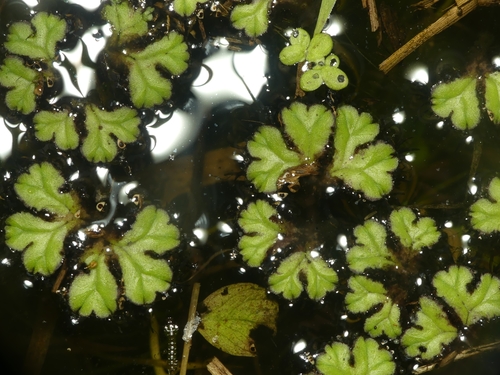
Ricciocarpos
Ricciocarpos natans (vernacular name: fringed heartwort) is the only species in the genus Ricciocarpos, a genus of liverworts in the family Ricciaceae. It was formerly listed in 1759 as a species of Riccia by Linnaeus, but then assigned to a new genus of its own in 1829 by August Carl Joseph Corda.

Hattoria yakushimensis
Hattoria yakushimensis is the only species of liverwort in the genus Hattoria, in the family Anastrophyllaceae. It is endemic to Japan. Its natural habitat is temperate forests. It is threatened by habitat loss.

Leptophyllopsis
Leptophyllopsis laxa is a species of liverwort in the family Lophocoleaceae. It is the only member of the genus Leptophyllopsis.
Monosolenium
Monosolenium tenerum, is a weedy species of liverwort found in east Asia. It is the only species in the genus Monosolenium and the family Monosoleniaceae. It is commonly confused with similar-looking plants in the aquarium trade like Pellia liverworts and Süsswassertang, a fern gametophyte.
Vandiemenia ratkowskiana
Vandiemenia ratkowskiana is the only species of liverwort in the genus Vandiemenia. It is endemic to Tasmania, Australia. Its natural habitat is subtropical or tropical dry forests.

Vetaforma dusenii
Vetaforma is a genus of liverworts found only in Argentina and Chile, and contains a single species Vetaforma dusenii. It is classified in the order Jungermanniales. It was placed as the only member of the family Vetaformaceae within that order, but this family has been merged into the family Lepicoleaceae based on morphological and genetic data. The genus name was originally published in 1960, but this publication was invalid under Article 36.1 of the International Code of Nomenclature for algae, fungi, and plants . The single species was first described in 1900 as Lepidozia dusenii and trans
Cavicularia
Cavicularia densa is the only species in the liverwort genus Cavicularia. The species was first described in 1897 by Franz Stephani, and is endemic to Japan, where it grows on fine moist soil.