Category
page 1Monotypic moss genera

Schistostega pennata
Schistostega pennata, also called goblin gold, '''Dragon's gold, luminous moss or luminescent moss, is a haplolepidous moss (Dicranidae) known for its glowing appearance in dark places. It is the only member of the family Schistostegaceae'''.

Oedipodium griffithianum
Oedipodium is the only genus of moss in the family Oedipodiaceae. It contains the single species Oedipodium griffithianum, the gouty-moss or '''Griffith's oedipodium moss'''. This species is distributed in cooler climates of Eurasia, as well as from Alaska, Washington state, British Columbia, Yukon, Greenland, Newfoundland, Tierra del Fuego and the Falkland Islands.

Andreaeobryum macrosporum
thumb|Andreaeobryum
Andreaeobryum is a genus of moss with a single species Andreaeobryum macrosporum, endemic to Alaska and western Canada. The genus is placed as a separate family, order and class among the mosses.

Discelium nudum
Discelium is the only genus of moss in the family Disceliaceae, containing a single species, Discelium nudum, known as flag-moss. This species is rare but is widely distributed across cool and temperate climates of the Northern Hemisphere.

Pseudoscleropodium
Pseudoscleropodium purum, or neat feather-moss, is a species of moss and the sole representative of the genus Pseudoscleropodium.

Pyramidula tetragona
Pyramidula is a genus of moss in the family Funariaceae. It contains the single species Pyramidula tetragona distributed in central North America as well as Europe and Africa. Pyramid moss is a common name.

Itatiella ulei
Itatiella ulei is a species of moss in the family Polytrichaceae. It is the only species in the genus Itatiella. The Polytrichaceae is a common family of mosses that does not have close living relatives. Its small size and the inflexed leaf apex characterize Itatiella ulei. When this species grows directly exposed to sun at high elevations, it presents a similar aspect but can be distinguished based on the distal lamella cells which are single and rhombic.

Aphanorrhegma serratum
Aphanorrhegma is a genus of moss in the family Funariaceae. It contains the single species Aphanorrhegma serratum distributed in eastern North America.
Eurhynchiastrum
Eurhynchiastrum pulchellum is a species of mosses belonging to the family Brachytheciaceae. It is the sole species of the genus Eurhynchiastrum.

Neomacounia nitida
__NOTOC__
Neomacounia nitida, or '''Macoun's shining moss, is an extinct moss that was found only in a small area of Ontario, and the sole species in the genus Neomacounia'''.
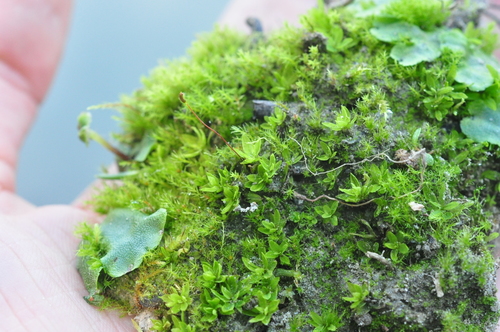
Bryobrittonia longipes
Bryobrittonia is a genus of moss in the family Encalyptaceae; it contains the single species Bryobrittonia longipes. This species grows on calcareous soil in cooler climates of North America, Europe, and central Asia.

Wardia hygrometrica
Wardia is a monotypic genus of mosses in the subclass Dicranidae; it contains only the species Wardia hygrometrica, "an aquatic moss endemic to the Western Cape province of South Africa." It is the only endemic moss family in South Africa. As it is an aquatic moss, it was first classified in the Fontinalaceae (and in the order of Isobryales), but molecular studies have shown that it is more closely related to the Dicranaceae.
Ambuchanania
Ambuchanania leucobryoides is the only species in the monotypic genus Ambuchanania. It is a Sphagnum-like moss endemic to Tasmania. Originally described as a species of Sphagnum, it is now a separate genus named after the original collector Alex M. Buchanan, (b.1944) an Australian botanist from the Tasmanian Herbarium in Hobart, (it was first collected in 1987). A. leucobryoides differs from the family Sphagnaceae in having elongate antheridia. It is entirely restricted to south-west Tasmania's Wilderness World Heritage Area where it occurs on white Precambrian quartzitic sand deposited by all

Eosphagnum inretortum
Eosphagnum inretortum is a species of moss, and the only species of the genus Eosphagnum. Originally described as a species of Sphagnum, it is now a separate genus on the basis of morphological and genetic differences.
Pseudoditrichum
Pseudoditrichum is a rare North American genus of haplolepideous moss (Dicranidae). It is the only known genus in its family (Pseudoditrichaceae), and there is only one species in the genus. Pseudoditrichum mirabile has been found only in a small area along the Sloan River near Great Bear Lake. This is in the Northwest Territory in northern Canada, only a few kilometers south of the Arctic Circle.

Mittenia plumula
Mittenia is a genus of haplolepideous mosses (Dicranidae) with a single species, Mittenia plumula, which is the sole representative of the family Mitteniaceae.
The family was previously placed in the order Pottiales, but is now placed in its own monotypic order, Mitteniales.
Ctenidiadelphus
Ctenidiadelphus is a monospecific genus of mosses in the family Hypnaceae described in 1923 by Max Fleischer. The only species it contains is Ctenidiadelphus plumularia.

Lorentziella imbricata
Lorentziella is a genus of moss in the family Gigaspermaceae. The genus contains a single species Lorentziella imbricata known from central Texas, Mexico, and South America (Argentina, Paraguay, & Uruguay). Imbricate lorentziella moss is a common name.
Crumia
Crumia latifolia is a species of moss belonging to the family Pottiaceae, and is the sole representative of the genus Crumia.

Catoscopium
Catoscopium is a genus of haplolepidous mosses (Dicranidae) in the monotypic family Catoscopiaceae and order Catoscopiales. It contains only a single species, Catoscopium nigritum.
Protosphagnum
Protosphagnum nervatum is the only known species of order Protosphagnales. It is only known from the Permian fossil record. In many ways, it resembles the living moss genus Sphagnum, though its leaf cells are not as strongly dimorphic as in Sphagnum.