Category
page 1Musical notation

note sign
sign used in musical notation to describe a pitched sound (frequency + duration)

Guido of Arezzo
11th century Italian monk, inventor of modern musical notation

sheet music
handwritten or printed form of musical notation that uses musical symbols to indicate the pitches, rhythms, or chords of a song or instrumental musical piece

clef
thumb|Diagram of treble, alto, and bass clefs with identical-sounding musical notes aligned vertically|alt=|440x440px
thumb|Middle C represented on (from left to right) treble, alto, tenor, and bass clefs|420px
thumb|200px|Three clefs aligned to middle C

figuring
to represent the information in digits or numbers in musical notation
sharp
musical sign (accidental) raising the pitch of a note by one chromatic semitone (factor 2^(1/12))
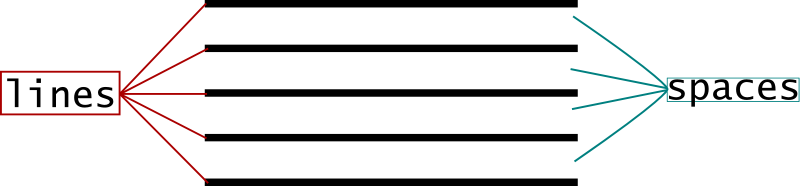
stave
musical notation of spaced lines used to indicate pitch of notes

measure
time unit in rhythmic musical notation
flat
musical sign (accidental) lowering the pitch of a note by one chromatic semitone (factor 2^(1/12))

solfège
In music, solfège ( or ; ) or solfeggio (; ), also called sol-fa, solfa, solfeo, among many names, is a mnemonic used in teaching aural skills, pitch and sight-reading of Western music. Solfège is a form of solmization, though the two terms are sometimes used interchangeably.
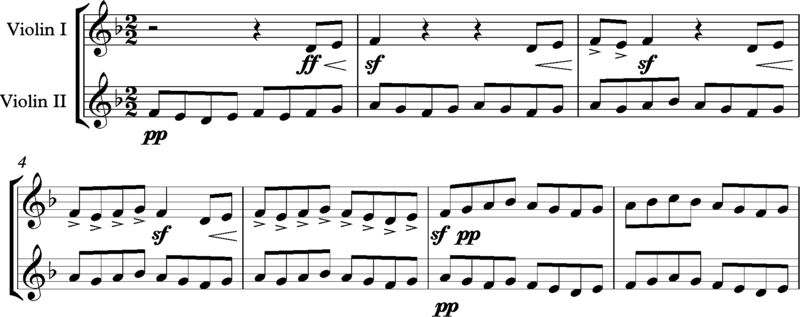
dynamics
aspect of musical expression related to sound intensity and its variation

tone
sound with a typical pitch; steady periodic sound; characterized by its duration, pitch, intensity (or loudness), and timbre (or quality)

staccato
Staccato (; Italian for "detached") is a form of musical articulation. In modern notation, it signifies a note of shortened duration, separated from the note that may follow by silence. It has been described by theorists and has appeared in music since at least 1676.

caesura
thumb|300px|An example of a caesura in modern western music notation
natural
musical sign (accidental) cancelling previous accidentals returning the frequency of the note to the natural/original value

glissando
In music, a glissando (; plural: glissandi, abbreviated gliss.) is a glide from one pitch to another (). It is an Italianized musical term derived from the French glisser, "to glide". In some contexts, it is equivalent to portamento, which is a continuous, seamless glide between notes. In other contexts, it refers to discrete, stepped glides across notes, such as on a piano. Some terms that are similar or equivalent in some contexts are slide, sweep bend, smear, rip (for a loud, violent glissando to the beginning of a note), lip (in jazz terminology, when executed by changing one's embouchure
coda
musical passage that leads on to the conclusion
accidental
sign that changes the pitch of the note

neumatic notation
frame|A sample of Kyrie|Kýrie Eléison XI (Orbis Factor) from the Liber Usualis. Listen to it interpreted.
A neume (; sometimes spelled neum) is the basic element of Western and some Eastern systems of musical notation prior to the invention of five-line staff notation.
rest
interval of silence in a piece of music, marked by a rest symbol indicating the length of the pause

pause
thumb|Urlinie in G with fermata on penultimate note. & (compare with penultimate note at )
key signature
musical notation indicating the key of diatonic music placed on the beginning of a line
time signature
specification of beats in a musical bar or measure

tablature
thumb|300px|right|Example of numeric vihuela tablature from the book "Orphenica Lyra" by [[Miguel de Fuenllana (1554). Red numerals (original) mark the vocal part.]]

tremolo
thumb|upright=1.2|Tremolo notation (denoting rapid repetition)
In music, tremolo (), or tremolando (), is a trembling effect. There are multiple types of tremolo. It is either the rapid repetition of a note, alternation between two different notes, or variation in volume.
%20of%20'Der%20Freisch%C3%BCtz'%20-%20NGO4p1116.jpg)
scoring
thumb|right|300px|A hand-written Sheet music|musical score for Act 2 of the [[opera Der Freischütz by Carl Maria von Weber, written in the 1820s. The score contains all the parts for the singers and the accompaniment parts and melodies for the orchestra.]]
Orchestration is the study or practice of writing music for an orchestra (or, more loosely, for any musical ensemble, such as a concert band) or of adapting music composed for another medium for an orchestra. Also called "instrumentation", orchestration is the assignment of different instruments to play the different parts (e.g., melody, bas

sight-singing
thumb|Caravaggio's Rest on the Flight into Egypt (1594–96)
In music, sight-reading, also called a prima vista (Italian meaning, "at first sight"), is the practice of reading and performing of a piece in a music notation that the performer has not seen or learned before. Sight-singing is used to describe a singer who is sight-reading. Both activities require the musician to play or sing the notated rhythms and pitches.
fingering
a set of signs that recommends how to use an instrument, which fingers to use and in what position
transposing instrument
instrument for which music is conventionally written transposed to a different pitch
da capo
indication that a composition or part should be performed
leger line
line used to notate pitches above or below the regular musical staff
figured bass
musical notation in which numerals/accidentals show chords to be played in relation to the bass note, used in Baroque music

tutti
thumb|The tutti piston seen over the organ pedalboard
Tutti is an Italian word literally meaning all or together and is used as a musical term, for the whole orchestra as opposed to the soloist. It is applied similarly to choral music, where the whole section or choir is called to sing. Music examination boards may instruct candidates to "play in tuttis", indicating that the candidate should play both the solo and the tutti sections.

solmization
thumb|175px|Guidonian hand, from 1274 [[Biblioteca Ambrosiana ]]
transcription
adaptation of a musical composition to a medium for which it wasn't initially written for
list of musical symbols
Wikimedia list article
alla breve
2/2 time signature in Western music notation
stem
vertical bar used for writing a musical note
Ut queant laxis
Latin hymn in honor of John the Baptist, written in Horatian Sapphic
slur
type of ligature indicating that the group of notes it comprises should be interpreted legato
dal Segno
musical symbol/term meaning return to the (segno) sign
music stand
device for holding sheets of music in position for reading
mensural notation
musical notation system used for European vocal polyphonic music
reduction
music term; arrangement or transcription of an existing score or composition in which complexity is lessened to make analysis, performance, or practice easier or clearer
graphic notation
representation of music through the use of visual symbols outside the realm of traditional music notation
Willi Apel
German-American musicologist

note head
right|150px|thumb|Parts of the note
thumb|Noteheads of quarter (and all further subdivisions), half, whole, and double whole notes
right|thumb|Left: breve in modern notation. Centre: breve in mensural notation used in some modern scores as well. Right: less common stylistic variant of the first form.
thumb|Regular, cross, square, and small noteheads
thumb|Ride pattern on a cymbal
thumb|Natural harmonics on the cello notated first as sounded (more common), then as fingered (easier to sightread).
tenth
musical interval
repeat sign
musical notation indicating repetition
Musical Symbols
Unicode block (U+1D100–1D1FF)
tonic sol-fa
music teaching method
chord symbol
system for naming chords
lead sheet / fake sheet
musical score describing the essential elements of a song
Swing
style of jazz performance
Braille music
Braille form of musical notation
music engraving
process of drawing music notation at high quality for reproduction

ossia
thumb|upright=1.5|Ossia example (2nd bar)
'''' () is a musical term for an alternative passage which may be played instead of the original passage. The word ossia comes from the Italian for "alternatively" and was originally spelled o sia'', meaning "or be it".
Guidonian hand
mnemonic
beam
thick line used to connect notes in musical notation

svara
Swara () or svara is an Indian classical music term that connotes simultaneously a breath, a vowel, a note, the sound of a musical note corresponding to its name, and the successive steps of the octave, or saptanka. More comprehensively, it is the ancient Indian concept of the complete dimension of musical pitch. At its most basic comparison to western music, a swara is, essentially, a "note" of a given scale. However, that is but a loose interpretation of the word, as a swara is identified as both a musical note and tone; a "tone" is a precise substitute for sur, relating to "tunefulness". Tr