Category
page 1Myadestes

Myadestes
Myadestes is a genus of solitaires, medium-sized mostly insectivorous birds in the thrush family, Turdidae.
%20-%20Kamao%20or%20Large%20Kauai%20Thrush%20-%20specimen%20-%20lateral%20view.jpeg)
Kāmaʻo
thumb
The kāmao or large Kauai thrush (Myadestes myadestinus) is an extinct species of small, dark solitaire that was endemic to Kauai in the Hawaiian Islands.

Slate-coloured Solitaire
species of bird

Brown-backed Solitaire
species of bird

Andean Solitaire
species of bird

Cuban Solitaire
species of bird

Townsend's Solitaire
species of bird

Olomaʻo
The olomao (Myadestes lanaiensis) is a small, dark solitaire endemic to Maui, Lānai and Molokai in the Hawaiian Islands. It is currently listed as Critically Endangered under the IUCN Red List of Threatened Species.

Black-faced Solitaire
species of bird

Rufous-throated Solitaire
species of bird

Myadestes obscurus
The ōmao (Myadestes obscurus), also called the Hawaiian thrush, is an endemic species of robin-like bird found only on the island of Hawaii. Ōmao are closely related to the other endemic thrushes of the Hawaiian Islands, the kāmao, the olomao, and the puaiohi. Ōmao are found primarily in rainforests in the eastern and southeastern regions of the Big Island. Population estimates approximate 170,000 birds, making it the most common of the Hawaiian thrushes. It appears to have a stable population, but because the entire population exists on a small range and is endemic to a single island, it is c
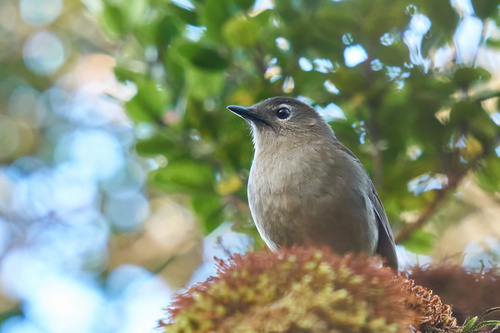
Puaiohi
The puaiohi (Myadestes palmeri) or small Kauai thrush is a rare species of songbird in the thrush family, Turdidae, that is endemic to the Hawaiian island of Kauai. It is closely related to the other three endemic Hawaiian thrushes, the kāmao, olomao, and ōmao. It was first collected by Henry Palmer in 1891 at Halemanu around the entrance to the Kōkee State Park.

Varied Solitaire
species of bird
ʻĀmaui
The ʻāmaui (Myadestes woahensis) or Oahu thrush is an extinct species of thrush in the family Turdidae that was endemic to the island of Oahu. It was the first member of its genus to become extinct, c. 1850. It has sometimes been considered a subspecies of the olomaʻo (Myadestes lanaiensis).