Category
page 1Mycobacteriales

Mycobacterium
Mycobacterium is a genus of over 190 species of Gram-positive bacteria in the phylum Actinomycetota, assigned its own family, Mycobacteriaceae. This genus includes pathogens known to cause serious diseases in mammals, including tuberculosis (M. tuberculosis) and leprosy (M. leprae) in humans. The Greek prefix myco- means 'fungus', alluding to this genus's mold-like colony surfaces. Since this genus has cell walls with a waxy lipid-rich outer layer containing high concentrations of mycolic acid, acid-fast staining is used to emphasize their resistance to acids, compared to other cell types.

Nocardia
thumb|Nocardia as found on a brain biopsy.
Nocardia is a genus of weakly staining Gram-positive, catalase-positive, rod-shaped bacteria. It forms partially acid-fast beaded branching filaments (appearing similar to fungi, but being truly bacteria). It contains a total of 85 species. Some species are nonpathogenic, while others are responsible for nocardiosis. Nocardia species are found worldwide in soil rich in organic matter. In addition, they are oral microflora found in healthy human gingiva, as well as periodontal pockets. Most Nocardia infections are acquired by inhalation of the bacteria

Rhodococcus
Rhodococcus is a genus of aerobic, nonsporulating, nonmotile Gram-positive bacteria closely related to Mycobacterium and Corynebacterium. While a few species are pathogenic, most are benign, and have been found to thrive in a broad range of environments, including soil, water, and eukaryotic cells. Some species have large genomes, including the 9.7 megabasepair genome (67% G/C) of Rhodococcus sp. RHA1.
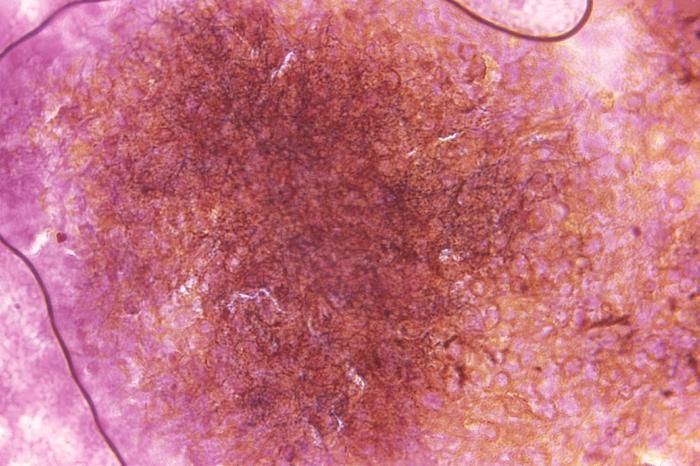
Nocardiaceae
The Nocardiaceae are a family of aerobic, non-fastidious, high G+C, Gram-positive actinomycetes that are commonly found in soil and water. Members of this family have been isolated from Antarctic soils. Nocardiaceae present coccobacilli, filamentous or, rarely, fragmented and palisading forms, and filamentous species grow in a branching morphological pattern similar to fungal hyphae.
Mycobacterium avium avium
species of bacterium
Nocardia asteroides
species of bacterium

Gordonia
genus of bacteria
Mycobacterium avium complex
nontuberculous bacteria in dust, water, soil; may infect lungs in immunocompromised people
Mycobacteriaceae
Mycobacteriaceae is a family of bacteria in the phylum Actinomycetota. Its name is derived from the Mycobacterium genus, which includes pathogens known to cause serious diseases in mammals, including tuberculosis (M. tuberculosis) and leprosy (M. leprae) in humans. The Greek prefix myco- means 'fungus', alluding to the mold-like appearance of these organisms on agar plates.
Rhodococcus equi
species of bacterium
Mycobacterium abscessus
species of bacterium
Nocardia brasiliensis
species of bacterium
Tsukamurella
thumb | right | A Tsukamurella pseudospumae disk
Tsukamurella is a Gram-positive, non-spore-forming, rod-shaped and obligate aerobic bacterial genus from the family of Tsukamurellaceae. Most of the strains of Tsukamurella degrade starch. Some Tsukamurella species can cause infections in humans.
Gordoniaceae
The Gordoniaceae are a family of bacteria in the order of Actinomycetales.
Rhodococcus fascians
species of bacterium