Category
page 1Mythological Cretans

Minotaur
In Greek mythology, the Minotaur (), also known as Asterion or Asterius, is a mythical creature portrayed during classical antiquity with the head and tail of a bull and the body of a man or, as described by Roman poet Ovid, a being "part man and part bull". He dwelt at the center of the Labyrinth, which was an elaborate maze-like construction designed by the architect Daedalus and his son Icarus, upon command of King Minos of Crete. According to tradition, every nine years the people of Athens were compelled by King Minos to choose fourteen young noble citizens (seven men and seven women) to

Minos
250 px|thumb|Gustave Doré's illustration of King Minos for [[Dante Alighieri's Inferno]]
thumb|Mural of Minos at the National and Kapodistrain University of Athens

Icarus

Ariadne
In Greek mythology, Ariadne (; ) was a Cretan princess, the daughter of King Minos of Crete. There are variations of Ariadne's myth, but she is known for helping Theseus escape from the Minotaur and being abandoned by him (or herself dying) on the island of Naxos. There, Dionysus saw Ariadne sleeping, fell in love with her, and later married her. Many versions of the myth recount Dionysus throwing Ariadne's jeweled crown into the sky to create a constellation, the Corona Borealis.
.jpg)
Rhadamanthus
thumb|315x315px|Depiction of Rhadamanthys in the Tomb of Judgement, Lefkadia, c.300–250 BC
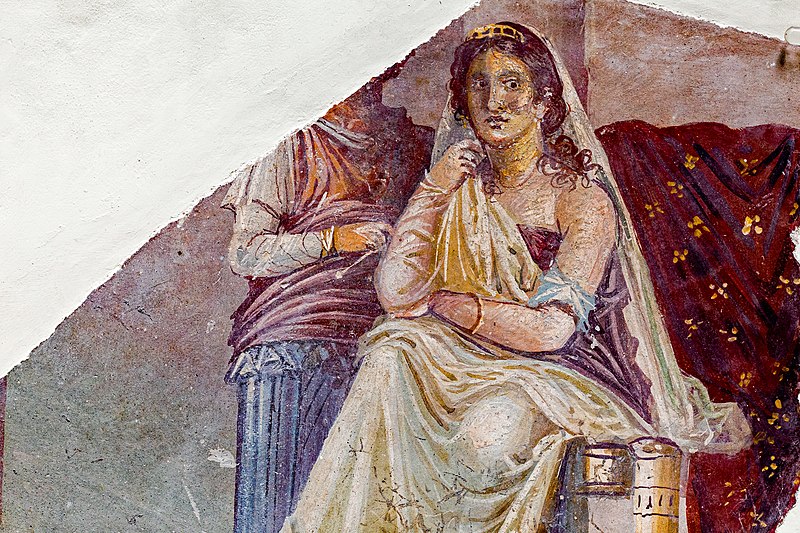
Phaedra
wife of Theseus in Greek mythology

Talos
thumb|Winged "" armed with a stone. Obverse of silver Ancient drachma|didrachma from [[Phaistos, Crete ( 300/280–270 BC) (Cabinet des Médailles, Paris)]]
In Greek mythology, Talos, also spelled Talus (; , Tálōs) or Talon (; , Tálōn), was a man of bronze who protected Crete from pirates and invaders. Despite the popular idea that he was a giant, no ancient source states this explicitly.
Aerope
In Greek mythology, Aerope (Ancient Greek: Ἀερόπη) was a Cretan princess as the daughter of Catreus, king of Crete. She was the sister of Clymene, Apemosyne and Althaemenes. After an oracle said he would be killed by one of his children, Catreus gave Aerope to Nauplius to be sold abroad. Nauplius spared her, and she became the wife of Atreus or Pleisthenes (or both). By most accounts, she is the mother of Agamemnon and Menelaus. While the wife of Atreus, she became the lover of his brother Thyestes, and gave Thyestes the golden lamb that allowed him to become king of Mycenae.
.jpg)
Britomartis
Britomartis (;) was a Greek goddess of mountains, nets, and hunting who was primarily worshipped on the island of Crete. She was sometimes described as a nymph, but she was more commonly conflated or syncretized with the goddesses Artemis, Athena, and Aphaea. She was also known as Dictynna, Dicte, Dictymna, or as a daughter of Dictynna (Δίκτυννα).
Idomeneus
Greek mythical character, King of Crete
%2004%20crop.jpg)
Korybantes
According to Greek mythology, the Korybantes (; ), also spelled Corybantes or Corybants, were the armed and crested dancers who worshipped the Phrygian goddess Cybele with drumming and dancing. They are also called the Kurbantes in Phrygia.
Dactyls
archaic mythical race of male beings associated with Rhea, the Great Mother
Androgeus
mythical son of Minos
Catreus
In Greek mythology, Catreus, also spelled Katreus (; , or , ), was the eldest son of Minos and Pasiphaë, and Minos's successor as king of Crete. Catreus had one son, Althaemenes, and three daughters, Apemosyne, Aerope and Clymene. Catreus was mistakenly killed by his son Althaemenes thereby fulfilling an oracle's prophecy.

Oenopion
thumb|Dionysus teaching the art of wine-drinking to his son Oenopion, on an Attica|Attic black-figured [[amphora from Vulci (ca. 540-530 BC) by Exekias]]
In Greek mythology, Oenopion (Ancient Greek: , Oinopíōn, English translation: "wine drinker", "wine-rich" or "wine face") was a legendary king of Chios, and was said to have brought winemaking to the island, which was assigned to him by Rhadamanthys.
Dictys Cretensis
companion of Idomeneus

Pandareus
thumb|270px|The daughters of Pandareus by Henry Fuseli, .
Acacallis
daughter of Minos in Greek mythology
Thoas
father of Hypsipyle in ancient Greek mythology, son of Dionysus
Meriones
mythical son of Molus of Crete

Althaemenes
thumb | right | Attavyros mountain, the place Althemenes fled to In Greek mythology, Althaemenes or Althemenes (Ancient Greek: Ἀλθαιμένης) was a Cretan prince as the only son of King Catreus of Crete. He was the brother of Apemosyne, Aerope and Clymene. Althaemenes mistakenly killed his father thereby fulfilling an oracle.
Deucalion of Crete
King of Crete in Greek mythology
Teucer, king of Troy
son of the river Scamander and of the nymph Idaea
Glaucus
son of Minos
Miletus
mythical founder of Miletus
Asterios
King of Crete and husband of Europa
Melissus of Crete
In Greek mythology, Melisseus (; , or ), was the father of the nymphs Adrasteia, Ida, Melissa, and Althaea who were nurses of the infant Zeus on Crete. His parentage differs from telling to telling, ranging from Gaia and Uranus, to Carystus the eponym of Karystos, and Socus and Combe.
Ida
Greek nymph, nurse of Zeus
Clymene
name of multiple figures in Greek mythology
Apemosyne
In Greek mythology, Apemosyne () was a Cretan princess as the daughter of King Catreus of Crete, the son of Minos. She had a brother Althaemenes, and two sisters, Aerope and Clymene.
Idaea
Idaea or Idaia () referring to either the Cretan Mount Ida, or the Phrygian Mount Ida in the Troad, is the name of several figures in Greek mythology:
Idaea, a nymph, who was the mother, by the river-god Scamander, of King Teucer.
Idaea, the daughter of the Scythian king Dardanus, and wife of Phineus, who falsely accused her stepsons, leading to their imprisonment and torture.
Idaea one of several epithets of Cybele, the great mother goddess of Anatolia, associated with Phrygian Mount Ida.
Idaea, a nymph who was said to be the mother, by the shepherd Theodorus, of Erythraean Sibyl Herophil
Carmanor
mythical hero of Crete
Staphylus
son of Dionysus in Greek mythology
Galatea
set of mythological Greek characters
Carme
nymph of the Greek mythology

Iapyx
thumb|right|300px|
Tectamus
Tectamus (Ancient Greek: Τέκταμος "craftsman", derived from tectainomai "to build", "plan", from tecton, "carpenter", "builder") was a king of Crete and hero of ancient Hellenic mythology. He was also called Tectaphus, Teutamus (), Tectauus () and Tectaeus ().

Iphis
thumb|Isis and Telethusa by Bernard Picart|Picart, 1732.
Leucippus
daughter of Lamprus and Galatea in Greek mythology
Adrasteia
In ancient Greek religion and mythology, Adrasteia (; , ), also spelled Adrastia, Adrastea, Adrestia, Adrestea, Adastreia or Adrasta, originally a Phrygian mountain goddess, probably associated with Cybele, was later a Cretan nymph, and daughter of Melisseus, who was charged by Rhea with nurturing the infant Zeus in secret, to protect him from his father Cronus. By at latest the fifth century BC, she became identified with Nemesis, the goddess of divine retribution.
Cleothera
thumb|320px|right|Detail of Camiro and Clytie in a reconstruction of the Nekyia by Polygnotus, 1892
Chrysothemis
mythical daughter of Carmanor of Crete
Alcaeus
set of mythological Greek characters
Chrysothemis
In Greek mythology, Chrysothemis or Khrysothemis (; , "golden law") is a name ascribed to several female characters in Greek mythology.
Euippe
Euippe or Evippe () is the name of eight women in Greek mythology:
Euippe, a daughter of Danaus and the naiad Polyxo. She married (and murdered) Imbrus, son of Aegyptus and Caliadne.
Euippe, another daughter of Danaus, this time by an Ethiopian woman. She married either Argius, son of Aegyptus and a Phoenician woman, or Agenor, son of Aegyptus.
Euippe, another name for Hippe, daughter of Chiron.
Euippe of Paionia, the mother, by Pierus, of the Pierides, nine sisters who challenged the Muses and, on their defeat, were turned into magpies.
Euippe (daughter of Tyrimmas). She bore Odysseus a
Atymnius
In Greek mythology, Atymnius (Ancient Greek: Ἀτύμνιος derived from atos and hymnos which means "insatiate of heroic praise") may refer to:
Crete
name of several figures in Greek mythology
Molus
mythical son of Deucalion or Minos
Cres
eponymous king of Crete in Greek mythology
Antimachus
set of Greek mythological characters
Orsilochus
In Greek mythology, Orsilochus (Ancient Greek: Ὀρσίλοχος), Ortilochus (Ὀρτίλοχος) or Orsilocus is a name that may refer to: