Category
page 1Nazi terminology

Anschluss
thumb|upright|Austrian citizens gather on the Heldenplatz to hear Hitler's declaration of annexation.
thumb|upright|right|Territory of the Nazi Germany|German Reich and Austria before the Anschluss

Führer
( , spelled Fuehrer when the umlaut is unavailable) is a German word meaning or . As a political title, it is strongly associated with Adolf Hitler, the dictator of Germany from 1933 to 1945. Hitler officially called himself der Führer und Reichskanzler () after the death of President Paul von Hindenburg in 1934, as well as the subsequent merging of the offices of Reichspräsident and Reichskanzler.
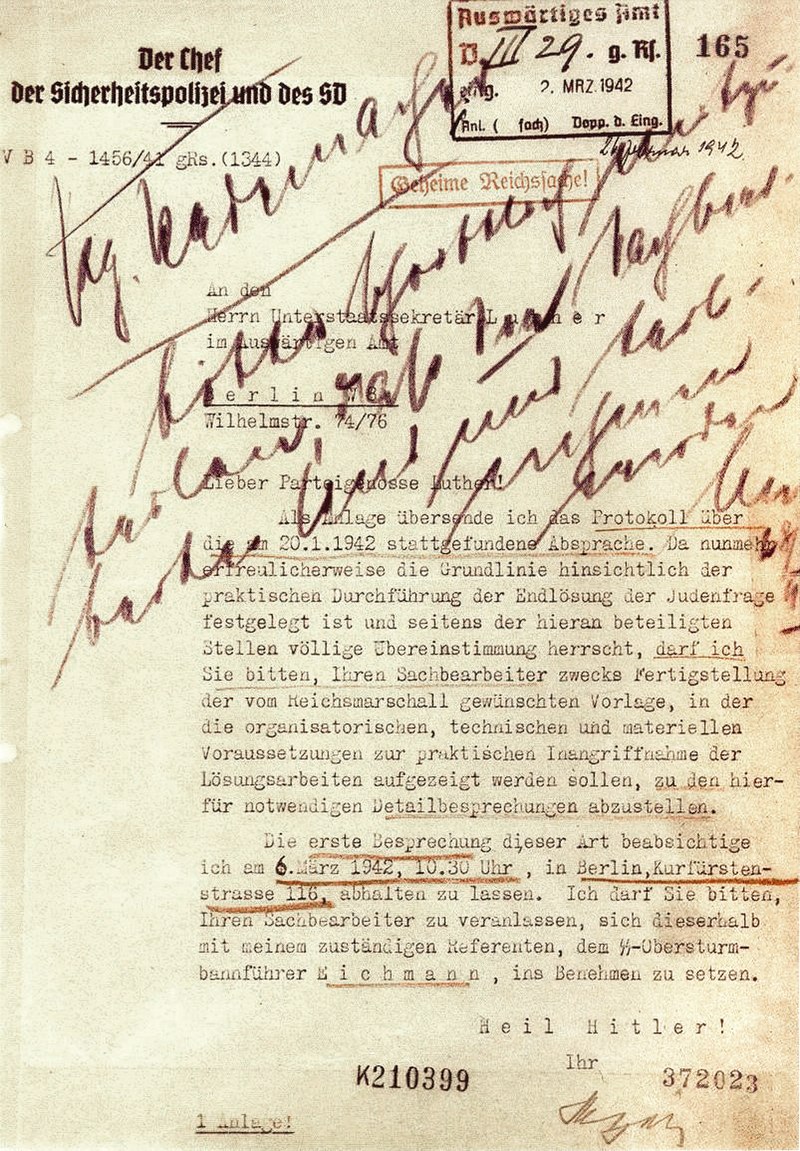
Final Solution
Nazi plan for the genocide or extermination of the Jews, resulted in the genocide known as 'Holocaust' or 'Shoah'

Lebensraum
thumb|Proposed supposed boundaries of the planned "Greater Germanic Reich," including planned post-war eastward expansions of Reichskommissariat|Reichskomissariats.

Aryan race
hypothetical racial grouping

degenerate art
term used by the German Nazi regime to describe modern art
League of German Girls
girls' wing of the Nazi Party youth movement, the Hitler Youth
.jpg)
Gleichschaltung
thumb|1938 Nuremberg rallies|Nuremberg Rally postcard, from the NSDAP Central Publishing House. A Nazi () towers over Germany and Austria.|upright=0.8
Drang nach Osten
German Eastward expansionism, later associated with Nazi Germany
Nuremberg Rally
annual rally of the Nazi Party in Nurenberg, Germany (1923-1938)
blood and soil
Nazi slogan

Kapo
A kapo was a type of prisoner functionary () at Nazi concentration and extermination camps. They were, whether voluntary or coerced, collaborators who worked under the Schutzstaffel (SS) to carry out administrative tasks or supervise the forced labour of inmates. Given authority over their fellow prisoners, they would often enjoy comparatively better conditions at the camps, such as increased food rations and less physical brutality from SS guards. Due to their privileged status and actions, kapos were highly resented and were frequently lynched by other prisoners when the camps were liberated
Gau
German term for a region within a country

Judenrat
thumb|Judenrat in the town of Szydłowiec in [[occupied Poland, where the Jewish population was in the majority before the Holocaust]]
Jewish Ghetto Police
Jewish auxiliary police units organized within the Nazi ghettos by local Judenrat

Führerprinzip
thumb|right|250px|Official poster from the Wochenspruch der NSDAP series, 16 February 1941. The inscription reads: "The Führer is always right".|alt=Blank poster with German-languge text.
People's Court
Instrument of judicial murder in Nazi Germany

Aryanization
thumb|"Herzmansky is purely Aryan again!" – The Herzmansky department store in Vienna was confiscated in March 1938 after the [[Anschluss, which also took place that month.]]
Aryanization () was the Nazi term for the seizure of property from Jews and its transfer to non-Jews, and the forced expulsion of Jews from economic life in Nazi Germany, Axis-aligned states, and their occupied territories. It entailed the transfer of Jewish property into "Aryan" or non-Jewish hands.
Heim ins Reich
slogan used to describe one of Adolf Hitler's foreign policies

Judenfrei
thumb|"Whoever wears this sign is an enemy of our people" – Parole der Woche, 1 July 1942 showing a [[yellow badge used by the Nazis to identify Jews]]
thumb|Synagogue in Occupation of Poland (1939–1945)|German-occupied [[Bydgoszcz, Poland, September 1939. The inscription in German reads: "This city is free of Jews!"]]
thumb|German map showing the number of Jewish executions carried out by Einsatzgruppe A in: [[Estonia (declared judenfrei), Latvia, Lithuania, Belarus, and Russia]]
thumb|Advertisement for a café in Tübingen, describing itself as judenfrei
Judenfrei (, "free of Jews") and
master race
Nazi idea of Aryan supremacy
racial hygiene
efforts to avoid miscegenation, analogous to an animal breeder seeking purebred animals
Deutsches Jungvolk
separate section for boys aged 10 to 13 of the Hitler Youth organisation in Nazi Germany
degenerate music
term adopted by the Nazis during the 1920s to condemn modern culture that, according to Hitler, manifested symptoms of national decline

Mischling
'''''' (; ; ) was a pejorative legal term which was used in Nazi Germany to denote persons of mixed "Aryan" and "non-Aryan", such as Jewish, ancestry as they were classified by the Nuremberg racial laws of 1935. In German, the word has the general connotation of “hybrid”, “mongrel”, or “half-breed”. Outside its use in official Nazi terminology, the term ('mixed children') was later used to refer to war babies born to non-white soldiers and German mothers in the aftermath of World War II.
Das Schwarze Korps
the official newspaper of the Schutzstaffel, published on Wednesdays and distributed free of charge
Life unworthy of life
Eugenic concept for the murder of humans declared "unworthy"
Holocaust train transport
railway use under the supervision of the German Nazis for the purpose of forcible deportation of the Jews, as well as other victims of the Holocaust to Nazi concentration camps
LTI – Lingua Tertii Imperii
essay by Victor Klemperer

Volksgemeinschaft
Volksgemeinschaft () is a German expression meaning "people's community", "folk community", "national community", or "racial community", depending on the translation of its component term Volk (cognate with the English word "folk"). This expression originally became popular during World War I as Germans rallied in support of the war, and many experienced "relief that at one fell swoop all social and political divisions could be solved in the great national equation". The idea of a Volksgemeinschaft was rooted in the notion of uniting people across class divides to achieve a national purpose, a
Defence of the Reich
1939 strategic defensive aerial campaign fought by the Luftwaffe over German-occupied Europe and Germany itself during World War II
Alter Kämpfer
Nazi party member who joined before 1930 election
Rhineland bastard
derogatory term for German children with a black father and a white mother
Gottbegnadeten list
list of artists considered crucial to nazi culture
Kinder, Küche, Kirche
Expression of traditional gender roles for women

Rassenschande
Rassenschande (, "racial shame") or Blutschande ( "blood disgrace") was an anti-miscegenation concept in Nazi German racial policy, pertaining to sexual relations between Aryans and non-Aryans. It was put into practice by policies like the Aryan certificate requirement, and later by anti-miscegenation laws such as the Nuremberg Laws, adopted unanimously by the Reichstag on 15 September 1935. Initially, these laws referred predominantly to relations between ethnic Germans (classified, together with most other western Europeans, as "Aryans") and non-Aryans, regardless of citizenship. In the earl

Poglavnik
thumb|Fausto Veranzio's 1595 Dictionarium quinque linguarum lists poglavnik as a "[[Dalmatian" word (column 4, item 5). It is equated to Latin princeps, German Fürst and Hungarian fejedelem.]]
'''''' () is a Croatian word meaning 'leader' or 'guide'.
Honorary Aryan
in Nazi Germany, someone who has been awarded an Aryan certificate despite not meeting the standards of the Nuremberg Laws

Endsieg
thumb|Billboard with Nazi slogans in Northern Transylvania, August 1944.
thumb|Memorial at the site of Völklingen Ironworks commemorating those who were made to perform "forced labour for the German Endsieg".
Endsieg (), German for "final victory", emerged prominently during World War II as a central concept within Nazi ideology.
Nur für Deutsche
German ethnocentric slogan
Action 14f13
campaign of the Third Reich to murder Nazi concentration camp prisoners
Aryan paragraph
Nazi discriminatory regulation
Final Solution of the Czech Question
Nazi plan for Germanification of Bohemia and Moravia

Sonderbehandlung
thumb|Himmler (front right, beside prisoner) while visiting the Dachau Concentration Camp in 1936
'''' (, "special treatment") is any sort of preferential treatment. However, the word Sonderbehandlung was used as a euphemism for mass murder by Nazi functionaries and the SS, who commonly used the abbreviation S.B.'' in documentation. It first came to prominence during Aktion T4, where SS doctors killed mentally ill and disabled patients between 1939 and 1941, and was one of a number of nonspecific words the Nazis used to document mass murder and genocide. Another notable example was .

Cultural Bolshevism
nazi slogan opposing modernist and progressive cultural movements
glossary of Nazi Germany
Wikimedia glossary list article
Sieg Heil
common salute in Nazi Germany
.jpg)
Wehrbauer
thumb|German Lebensraum|colonisation of Eastern European regions as envisaged in a Nazi-era propaganda map published in 1943
'''' (, ; ) is a German term for settlers living on the marches of a realm who were tasked with holding back foreign invaders until the arrival of proper military reinforcements. In turn, they were granted special liberties. Wehrbauern in their settlements, known as Wehrsiedlungen'' (-en being the plural suffix), were mainly used on the eastern fringes of the Holy Roman Empire and later Austria-Hungary to slow attacks by the Ottoman Empire. This historic term was resurre

Blockleiter
thumb|Blockleiter uniform (left)
thumb|Blockleiter armband
Blockleiter (Block Leader), where block refers to city block, was from 1933 the title of a lower Nazi Party political rank responsible for the political supervision of a neighborhood. Referred to in common parlance as Blockwart (Block Warden), the Block Warden's duty was to form the primary link between the Nazi authorities and the general population. The derogatory term Blockwart ("snoop") survives in German colloquial language.
Zellenleiter
thumb|Zellenleiter uniform (left)
thumb|Zellenleiter armband (1930–33)
Zellenleiter (; "Cell Leader") was a Nazi Party political title which existed between the years of 1930 and 1945. A Zellenleiter was higher in rank than a Blockleiter and was in charge of a "Nazi Cell", composed of eight to twelve city blocks.
Zivilarbeiter
thumb|ID card of a Zivilarbeiter from Nazi-occupied Soviet Union
right|thumb|200px|Arbeitsbuch für Ausländer (Workbook for Foreigner) identity document issued to a Polish Zivilarbeiter in 1942 together with a letter "P" patch Poles were required to wear attached to their clothing.
Zivilarbeiter () refers primarily to ethnic Polish residents from the General Government (Nazi-occupied central Poland), used during World War II as forced laborers in the Third Reich.
Sondergericht
thumb|right|Judge Roland Freisler (centre) at the People's Court|250px
A Sondergericht (plural: Sondergerichte) was a German "special court". After taking power in 1933, the Nazis quickly moved to remove internal opposition to the Nazi regime in Germany. The legal system became one of many tools for this aim and the Nazis gradually supplanted the normal justice system with political courts with wide-ranging powers. The function of the special courts was to intimidate the German public, but as they expanded their scope and took over roles previously done by ordinary courts such as Amtsgerichte
subcamp
thumb|The Außenkommando "Unter den Eichen" in Wiesbaden was the site of a subcamp of the SS-Sonderlager Hinzert in which 100 political prisoners performed forced labor.
Subcamps were outlying detention centres (Haftstätten) that came under the command of a main concentration camp run by the SS in Nazi Germany and German-occupied Europe. The Nazis distinguished between the main camps (or Stammlager) and the subcamps (Außenlager or Außenkommandos) subordinated to them. Survival conditions in the subcamps were, in many cases, poorer for the prisoners than those in the main camps.
Judenvermögensabgabe
The Judenvermögensabgabe ("Jewish Capital Levy") was an arbitrary special tax imposed on German Jews under the Nazi dictatorship. The tax was only a part of a larger series of actions taken by the Nazis to systematically plunder Jewish assets.
Wehrkraftzersetzung
right|thumb|Wehrkraftzersetzung death sentence issued by the Volksgerichtshof|People's Court on 8 September 1943 against Dr. Alois Geiger for [[defeatism]]
Geltungsjude
Geltungsjude was the term for people who were considered Jews by the first supplementary decree to the Nuremberg Laws from 14 November 1935. The term was not used officially, but was coined because the persons were deemed (gelten in German) Jews rather than exactly belonging to any of the categories of the previous Nuremberg Laws. There were three categories of Geltungsjuden: 1. offspring of an intermarriage who belonged to the Jewish community after 1935; 2. offspring of an intermarriage who was married to a Jew after 1935; 3. illegitimate child of a Geltungsjude, born after 1935.
Führerstadt
title of honor given to five German cities by Adolf Hitler
Negermusik
thumb|Poster of a 1938 exhibit in Düsseldorf, "Degenerate Music"

Volk ohne Raum
Nazi slogan that, due to the loss of German colonies (Treaty of Versailles), the Germans had become a people without Lebensraum
Postenpflicht
thumb|300px|A prisoner who was shot and killed at Mauthausen-Gusen concentration camp complex.
The Postenpflicht (German: "Duty of guards") was a general order issued to SS-Totenkopfverbände guards in Nazi concentration camps to summarily execute insubordinate prisoners. The order required guards to shoot prisoners who engaged in resistance or escape attempts, without warning; failing to do so would result in dismissal or arrest. The Postenpflicht was originally issued on October 1, 1933, for guards at Dachau concentration camp, but was later extended to other concentration camps.