Category
page 1Neolithic

Neolithic

Jericho
Jericho ( ; , ; Hebrew: יריחו) is a city in the West Bank, Palestine, and the capital of the Jericho Governorate. The city is located in the Jordan Valley, with the Jordan River to the east and Jerusalem to the west.
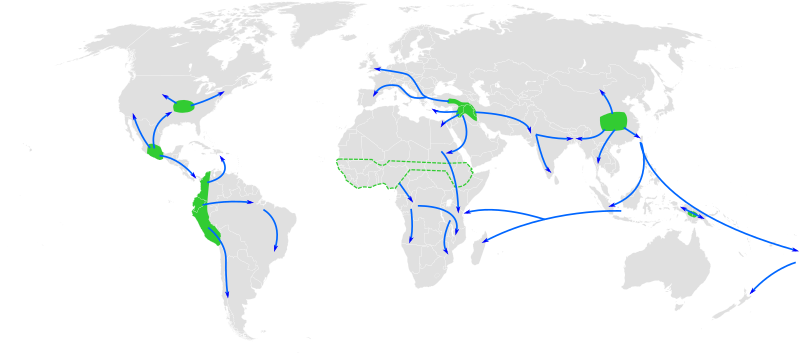
neolithic revolution
transition from hunter gatherer to settled peoples
Anatolian hypothesis
hypothesis
center of origin
geographical area where a group of organisms develop particular properties

proto-writing
thumb|right|The Kish tablet, bearing pictographic symbols. Some of the symbols are written in a “…seemingly archaic form…” according to the CDLI entry.
Nevalı Çori
Early Neolithic settlement and archaeological site
Tărtăria tablets
archaeological artifact
Tell es-Sultan
archaeological site in the West Bank
Neolithic architecture
structures dated about 10,000 to 2,000 BC
wattle and daub
building technique using woven wooden supports packed with clay or mud
Dispilio Tablet
wooden tablet bearing inscribed markings, discovered in Dispilio, Greece
Urfa Man
C. 9000 BCE statue from Turkey

Gavrinis
Gavrinis () is a small island in the Gulf of Morbihan in Brittany, France. It contains the Gavrinis tomb, a Neolithic passage tomb built around 4200–4000 BC, making it one of the world's oldest surviving buildings. Stones inside the passage and chamber are covered in megalithic art. It is likened to other Neolithic passage tombs such as Barnenez in Brittany and Newgrange in Ireland.
cup and ring mark
form of prehistoric art
Wadi al-Far'a
river in the West Bank

Anegundi
Anegundi, previously called Kishkindha, is a village in Gangavathi, Koppal district, in the Indian state of Karnataka. It is older than Hampi, situated on the northern bank of the Tungabhadra River. Nimvapuram, a nearby village, has a mount of ash believed to be the cremated remains of the king Vali.
grooves
grooves carved into rock

Hallan Çemi
archeological site in Turkey

Hamadia
Hamadia () is a kibbutz in the Beit She'an Valley, just north of Beit She'an in northern Israel. It belongs to the Valley of Springs Regional Council. In it had a population of .
Neolithic founder crops
The eight plant species that were domesticated in early human settlements.
hoe-farming
thumb|Use of the digging stick for tillage in the [[Nuba Mountains, Southern Sudan (2001 photograph)]]
Hoe-farming is a primitive form of agriculture defined by the absence of the plough. Tillage in hoe-farming cultures is done by simple manual tools such as digging sticks or hoes.
Hoe-farming is the earliest form of agriculture practiced in the Neolithic Revolution.
Early forms of the plough (ard) were introduced throughout the Near East (Naqada II) and Europe (Linear Pottery culture) by the 5th to 4th millennium BC.
The invention spread throughout Greater Persia and parts of Central Asia, r
Darra-e Kur
cave and archaeological site in Afghanistan

Plastered human skulls
prehistoric burial practice
Subneolithic
The Subneolithic is an archaeological period sometimes used to distinguish cultures that are transitional between the Mesolithic and the Neolithic. Subneolithic societies typically adopted some secondary elements of the Neolithic package (such as pottery), but retained economies based on hunting and gathering and fishing instead of agriculture. For the most part they were sedentary. The Subneolithic dates to the period 5000/4000–3200/2700 BCE in Scandinavia, north and north-eastern Europe.
history of sheep
aspect of history
Tievebulliagh
Tievebulliagh () is a mountain in the Glens of Antrim, Northern Ireland. It forms part of the watershed between Glenaan to the north and Glenballyemon to the south. It is situated about 4.4 km from Cushendall.
neolithic China
neolithic period in China
Carn Brea
civil parish in Cornwall, England, UK
aceramic
Aceramic is defined as "not producing pottery". In archaeology, the term means "without pottery". Aceramic societies usually used bark, basketry, gourds and leather for containers.
ground stone
prehistoric stone tool
Alunda moose
ceremonial axe in the Swedish History Museum
Tahunian
thumb|upright=1.7|Object said to be "the oldest sickle", flint and resin, Tahunian culture, c. 7000 BC, [[Nahal Hemar Cave. Israel Museum.]]
Pottery Neolithic
Later part of the Neolithic period in Southwest Asia
Asa Koma
Archaeological site in Djibouti
Furninha
Furninha, also known as '''Dominique's cave''', is a natural cave on the southern slope of the Peniche peninsula in Portugal. The cave is situated on the cliffs between the Peniche Fortress and the Cape Carvoeiro.
The cave is located furthest west of any Neanderthal site. Neanderthals became extinct over 40,000 years ago. The cave was also inhabited by modern humans during the Neolithic.
Dalma culture
prehistoric archaeological culture of north-western Iran
Rock art of the Djelfa region
Neolithic rock art in Algeria
Rock art of south Oran
neolithic period artistic rock carvings in Oran Province, Algeria
Monte Marmagna
mountain in Italy
Gesher
Archaeological site in Israel
Gürcütepe
Gürcütepe is a Neolithic site on the southeastern outskirts of Şanlıurfa in Turkey, consisting of four very shallow tells along Sirrin Stream that flows from Şanlıurfa. All four hills are now covered by modern buildings, so they are no longer recognizable. In the late 1990s a German archaeological team under the direction of Klaus Schmidt carried out soundings on all four hills and made extensive excavations on the second hill seen from the east.