Category
page 1Neuroanatomy

nerve
A nerve is an enclosed, cable-like bundle of nerve fibers (called axons). Nerves have historically been considered the basic units of the peripheral nervous system. A nerve provides a common pathway for the electrochemical nerve impulses called action potentials that are transmitted along each of the axons to peripheral organs or, in the case of sensory nerves, from the periphery back to the central nervous system. Each axon is an extension of an individual neuron, along with other supportive cells such as some Schwann cells that coat the axons in myelin.
grey matter
part of the brain
white matter
part of the brain

neuroanatomy
350px|thumbnail|right|Neuroanatomy is the study of the anatomy and organization of the [[nervous system. Pictured here is a cross-section showing the gross anatomy of the human brain.]]
Neuroanatomy is a branch of anatomy and neuroscience that studies the structure and organization of the nervous system. In contrast to animals with radial symmetry, whose nervous system consists of a distributed network of cells, animals with bilateral symmetry have segregated, defined nervous systems. Their neuroanatomy is therefore better understood. In vertebrates, the nervous system is segregated into the c
reward system
group of neural structures responsible for positive emotions

gyrus
thumb|300px|Gray's Anatomy|Gray's FIG. 726 – Lateral surface of left [[cerebral hemisphere, viewed from the side]]
thumb|300px|Gray's Anatomy|Gray's Fig. 727 – Medial surface of left cerebral hemisphere
motor cortex
region of the cerebral cortex
neural nucleus
brain structure consisting of a relatively compact cluster of neurons
rhinencephalon
In animal anatomy, the rhinencephalon (from the Greek, ῥίς, rhis = "nose", and ἐγκέφαλος, enkephalos = "brain"), also called the smell-brain or olfactory brain, is a part of the brain involved with smell (i.e. olfaction). It forms the paleocortex in the human brain.

neuropil
Neuropil (or "neuropile") is any area in the nervous system composed of mostly unmyelinated axons, dendrites and glial cell processes that forms a synaptically dense region containing a relatively low number of cell bodies. The most prevalent anatomical region of neuropil is the brain which, although not completely composed of neuropil, does have the largest and highest synaptically concentrated areas of neuropil in the body. For example, the neocortex and olfactory bulb both contain neuropil.
cytoarchitecture
thumb|The human cerebral cortex divided into Brodmann areas on the basis of cytoarchitecture.|page=145
Cytoarchitecture (from Greek κύτος 'cell' and ἀρχιτεκτονική 'architecture'), also known as cytoarchitectonics, is the study of the cellular composition of the central nervous system's tissues under the microscope. Cytoarchitectonics is one of the ways to parse the brain, by obtaining sections of the brain using a microtome and staining them with chemical agents which reveal where different neurons are located.
cerebral sulcus
depressions in cerebral cortex

nerve tract
bundle of nerve fibers (axons) connecting nuclei of the central nervous system
pallium
layers of nerve cells on the surface of cerebral hemispheres of chordate animals
temporoparietal junction
brain area
Bell–Magendie law
archicortex
The archicortex, or archipallium, is the phylogenetically second oldest region of the brain's cerebral cortex (the oldest is the paleocortex). In older species, such as fish, the archipallium makes up most of the cerebrum. Amphibians develop an archipallium and paleopallium.
Glossary of neuroanatomy
Wikimedia list article
NeuroNames
NeuroNames is an integrated nomenclature for structures in the brain and spinal cord of the four species most studied by neuroscientists: human, macaque, rat and mouse. It offers a standard, controlled vocabulary of common names for structures, which is suitable for unambiguous neuroanatomical indexing of information in digital databases. Terms in the standard vocabulary have been selected for ease of pronunciation, mnemonic value, and frequency of use in recent neuroscientific publications. Structures and their relations to each other are defined in terms of the standard vocabulary. Currently
cerebellopontine angle
structure at the margin of the cerebellum and pons
lamina terminalis
INAH 3
third interstitial nucleus of the anterior hypothalamus
Yakovlevian torque
type of physical brain asymmetry
nerve root
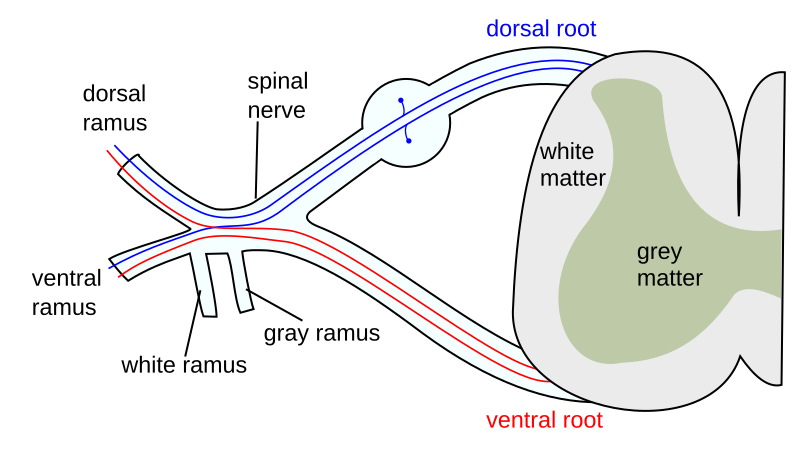
initial segment of a nerve leaving the central nervous system
medial forebrain bundle
complex group of fibers in the brain arising from the basal olfactory regions, the periamygdaloid region and the septal nuclei
Neuromorphology
Neuromorphology (from Greek νεῦρον, neuron, "nerve"; μορφή, morphé, "form"; -λογία, -logia, “study of”) is the study of nervous system form, shape, and structure. The study involves looking at a particular part of the nervous system from a molecular and cellular level and connecting it to a physiological and anatomical point of view. The field also explores the communications and interactions within and between each specialized section of the nervous system.
Morphology is distinct from morphogenesis. Morphology is the study of the shape and structure of biological organisms, while morphogenesi
Topographic map (neuroanatomy)
ordered projection of a sensory surface o one or more structures of the central nervous system
neural network
structure in nervous systems
olivocochlear system
component of the auditory system
funiculus
Erb's point
Aspect of human anatomy
behavioral medicine
the integration of biological, behavioral, psychological, and social sciences relevant to health and illness