Category
page 1Non-volatile memory

read-only memory
non-volatile memory used in computers and other electronic devices; class of storage medium used in computers and other electronic devices
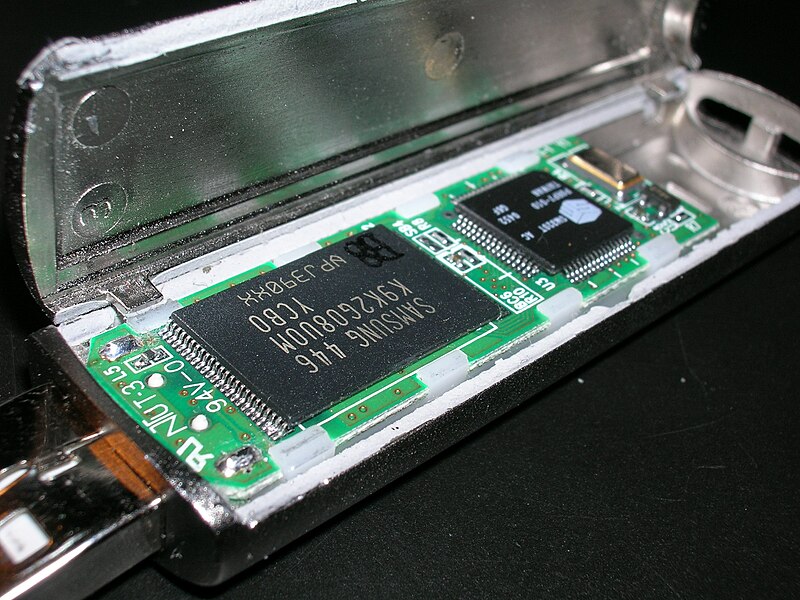
flash memory
electronic non-volatile computer storage device

solid-state drive
semiconductor-based data storage medium, often used for auxiliary memory to store data

EEPROM
thumb|A cross section of legacy EPROM structure.Upper insulator: Lower insulator: tunnel oxide
thumbnail|[[STMicroelectronics|STMicro M24C02 I²C serial type EEPROM]]
thumbnail|[[Atmel AT93C46A die]]
[[File:Atmel-avr-atusb162-HD.jpg|thumbnail| AT90USB162 MCU integrates 512 Byte EEPROM]]

programmable read-only memory
form of digital memory that can be written once by blowing fuses/antifuses to set bits
.jpg)
erasable programmable read-only memory
thumb|An EPROM: the Texas Instruments TMS27C040, a CMOS chip with 4 megabits of storage and 8-bit output (shown here in a 600-mil ceramic dual-in-line package). The TMS27C040 operates at 5 volts, but must be programmed at 13 volts.

spintronics
Spintronics (a portmanteau of spin transport electronics), also known as spin electronics, is the study of the intrinsic spin of the electron and its associated magnetic moment, in addition to its fundamental electronic charge, in solid-state devices. The field of spintronics concerns spin-charge coupling in metallic systems. The analogous effects in insulators fall into the field of multiferroics.
non-volatile memory
computer memory that can retain stored information even when not powered
magnetic-core memory
predominant form of random-access computer memory for 20 years between about 1955 and 1975
drum memory
magnetic data storage device
non-volatile random-access memory
random-access memory that retains its information when power is turned off (non-volatile),in contrast to dynamic random-access memory (DRAM) and static random-access memory (SRAM), which both maintain data only for as long as power is applied
bubble memory
type of non-volatile computer memory
magnetoresistive random-access memory
type of non-volatile random-access memory which stores data in magnetic domains
hybrid drive
logical or physical storage device containing both solid-state and hard disk storage
ferroelectric random-access memory
electronic device using the ferroelectric effect to produce low density random access memory
hardware programmer
device that configures programmable non-volatile integrated circuits
nonvolatile BIOS memory
small, battery-backed memory component for storing a computer's BIOS settings
racetrack memory
experimental memory device
Intel Turbo Memory
technology introduced by Intel
Superman memory crystal
Data storage format
millipede memory
non-volatile computer memory stored on nanoscopic pits burned into the surface of a thin polymer layer, read and written by a MEMS-based probe
multi-level cell
memory cell/element capable of storing more than a single bit of information
Wear leveling
operating principle for certain storage media
core rope memory
read-only memory in which ferrite cores in a rope act merely as transformers, and whether a word line wire couples or not to the core encodes bits; first used in the 1960s by NASA in Mariner probes and in the Apollo Guidance Computer
SONOS
SONOS, short for "silicon–oxide–nitride–oxide–silicon", more precisely, "polycrystalline silicon"—"silicon dioxide"—"silicon nitride"—"silicon dioxide"—"silicon",
is a cross sectional structure of MOSFET (metal–oxide–semiconductor field-effect transistor), realized by P.C.Y. Chen of Fairchild Camera and Instrument in 1977. This structure is often used for non-volatile memories, such as EEPROM and flash memories. It is sometimes used for TFT LCD displays.
Open NAND Flash Interface Working Group
association of electronic companies of NAND flash interface technologies sector
Plated wire memory
variant of core memory
programmable metallization cell
new memory technology that uses copper nanowires
Universal memory
proposed form of computer storage
charge trap flash
type of flash storage