Category
page 1Norse underworld
.jpg)
Odin
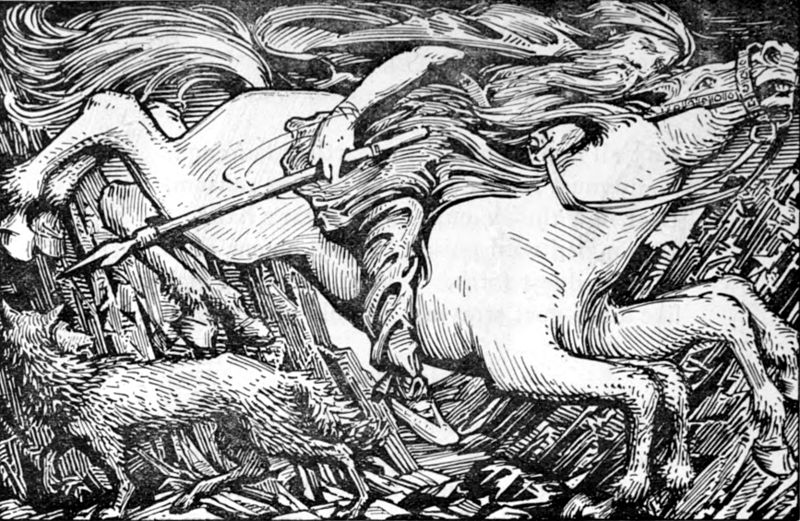
thumb|Odin, in his guise as a wanderer, as imagined by Georg von Rosen (1886)

Freyja
thumb|A depiction of Freyja. Within Norse paganism, Freyja was the deity primarily associated with .

valkyrie
thumb|The picture stone Lilbjärs III, showing a helmeted woman receiving a man with a horn of mead. On picture stones, the recurring motif of a woman receiving a man with a horn is generally interpreted as a dead man being received by a valkyrie at Valhalla.
thumb|The Valkyrie from Hårby|The "valkyrie from Hårby", silver-gilt figurine depicting a female figure with a sword and shield, often interpreted to be a valkyrie.
In Norse mythology, a valkyrie ( or ; from ) is one of a host of female figures who guide souls of the dead to the god Odin's hall Valhalla. There, the deceased warriors become
%20by%20Max%20Br%C3%BCckner.jpg)
Valhalla
250px|thumb|Walhalla (1896) by Max Brückner (artist)|Max Brückner in a scenic backdrop for [[Richard Wagner's Der Ring des Nibelungen]]

Hel
goddess of the underworld in Norse mythology
.jpg)
Sleipnir
thumb|upright=1.35|Depiction of Sleipnir in a detail on the Tjängvide image stone.
In Norse mythology, Sleipnir (Old Norse: "slippy" or "the slipper") is an eight-legged horse ridden by Odin. Sleipnir is attested in the Poetic Edda, compiled in the 13th century from earlier traditional sources, and the Prose Edda, written in the 13th century by Snorri Sturluson. In both sources, Sleipnir is Odin's steed, is the child of Loki and Svaðilfari, is described as the best of all horses, and is sometimes ridden to the location of Hel. The Prose Edda contains extended information regarding the circumst
%20The%20Cosmos%20in%20the%20Norse%20mythology.jpg)
Niflheim
In Norse cosmology, Niflheim or Niflheimr (Old Norse: ; "World of Mist", literally "Home of Mist") is a location which sometimes overlaps with the notions of Niflhel and Hel. The name Niflheimr appears only in two extant sources: Gylfaginning and the much-debated Hrafnagaldr Óðins.

norns
thumb|right|The Norns spin the threads of Destiny|fate at the foot of [[Yggdrasil, the tree of the world. Beneath them is the well Urðarbrunnr with the two swans that have engendered all the swans in the world.]]
thumb|right|The Norns (1889) by Johannes Gehrts
The Norns ( , plural: ) are a group of deities in Norse mythology responsible for shaping the course of human destinies.
The Norns are often represented as three goddesses known as Urðr, Verðandi, and Skuld, who weave the threads of fate and tend to the world tree, Yggdrasil, ensuring it stays alive at the center of the cosmos.
Hel
Norse mythical location
%20by%20Johannes%20Gehrts.jpg)
Garmr
thumb|right|"Hel" (1889) by Johannes Gehrts.
In Norse mythology, Garmr or Garm (Old Norse: ) is a wolf or dog associated with both Hel and Ragnarök, and described as a blood-stained guardian of Hel's gate.

Rán
thumb|right|Rán uses her net to pull a seafarer into the depths in an illustration by Johannes Gehrts, 1901
In Norse mythology, Rán (in Old Norse: ) is a goddess and personification of the sea. Rán and her husband Ægir, a jötunn who also personifies the sea, and together the two produced nine daughters who personify the sea waves, and Rán's son is Snær, who personifies the snow. Rán may also be the mother of the beautiful jötunn Gerðr, wife of the god Freyr. The goddess is frequently associated with a net, which she uses to capture sea-goers. According to the prose introduction to a poem in th

Gefjon
thumb|300px|Detail of the Gefion Fountain (1908) by [[Anders Bundgaard]]
In Norse mythology, Gefjon (Old Norse: ; alternatively spelled Gefion, or Gefjun , pronounced without secondary syllable stress) is a goddess associated with ploughing, the Danish island of Zealand, the legendary Swedish king Gylfi, the legendary Danish king Skjöldr, foreknowledge, her oxen children, and virginity. Gefjon is attested in the Poetic Edda, compiled in the 13th century from earlier traditional sources; the Prose Edda and Heimskringla, written in the 13th century by Snorri Sturluson; in the works of skalds; an

Fólkvangr
thumb|"Freya" (1882) by Carl Emil Doepler

Náströnd
thumb|333px|An illustration of Náströnd (1895) by Lorenz Frølich.
In Norse mythology, Náströnd ("Corpse Shore") is a place in Hel where Níðhöggr devours the dead souls of the dishonorable. It is the afterlife for those guilty of murder, and severe oath-breaking.
Gjöll
Gjöll (Old Norse: Gjǫll ) is the river that separates the living from the dead in Norse mythology. It is one of the eleven rivers traditionally associated with the Élivágar, rivers that existed in Ginnungagap at the beginning of the world.

Gjallarbrú
thumb | right | alt=Gjallarbrui. Illustration by Gerhard Munthe, 1904. | Gjallarbrui. Illustration by Gerhard Munthe, 1904.
In Norse mythology, Gjallarbrú (lit. "bridge of Gjöll") is a bridge that crosses the river Gjöll, serving as the passage to reach Hel.
Gnipahellir
Gnipahellir (Gnipa cave) is a cave in Norse mythology. Gnipahellir is the home of Garmr, the hellhound who guards the gates of Hel, the Norse realm of the dead. Garmr is often featured chained here until the onset of Ragnarök, at which time his bindings break and he runs free. Reference to Gnipahellir appears in Vǫluspá, Prophecy of the Völva, one of the poems of the Poetic Edda.
Móðguðr
In Norse mythology, Móðguðr (Old Norse: , "Furious Battler"; also Modgud) refers to the female guardian (tutelary deity) of the bridge over the river Gjöll ("Noisy"), Gjallarbrú. She allowed the newly dead to use the bridge to cross from one side of the river Gjöll to the other if the soul stated their name and business and possibly in turn prevented the dead beyond the river from crossing back over Gjöll into the lands of the living.
Éljúðnir
In Norse mythology, Éljúðnir (sometimes Anglicized to Eljudnir) is Hel's hall located in Niflheim as described in chapter 34 of Snorri Sturluson's Prose Edda in the book Gylfaginning. The name Éljúðnir is Old Norse and means "sprayed with snowstorms" or "damp with sleet or rain". The hall is only mentioned in this chapter.
Niðafjöll
In Norse mythology, Nidafjöll (, ; ) is a location in the northern underworld. Niðafjöll is the site from which the dragon Nidhogg comes. According to Snorri Sturluson, the good and virtuous people will live here in a golden palace after Ragnarök, despite its proximity to Hel.
Niflhel
Niflhel ("Misty Hel"; Nifel meaning fog) is a location in Norse mythology which appears in the eddic poems Vafþrúðnismál and Baldrs draumar, and also in Snorri Sturluson's Gylfaginning. According to Snorri Sturluson's work, Niflhel could be interpreted as the lowest level of Hel, but Niflhel and sometimes Hel are conflated with the concept of Niflheim, a term which originates with Sturluson.