Category
page 1Nostocaceae
%20Figure%202.jpg)
Nostoc
Nostoc, also known as star jelly, '''troll's butter, spit of moon, fallen star, witch's butter''' (not to be confused with the fungi commonly known as witches' butter), and '''witch's jelly,' is the most common genus of cyanobacteria found in a variety of both aquatic and terrestrial environments that may form colonies composed of filaments of moniliform cells in a gelatinous sheath of polysaccharides. It may also grow symbiotically within the tissues of plants, providing nitrogen to its host through the action of terminally differentiated cells known as heterocysts. Nostoc is a genus that inc
Anabaena
Anabaena is a genus of filamentous cyanobacteria that exist as plankton. They are known for nitrogen-fixing abilities, and they form symbiotic relationships with certain plants, such as the mosquito fern. They are one of four genera of cyanobacteria that produce neurotoxins, which are harmful to local wildlife, as well as farm animals and pets. Production of these neurotoxins is assumed to be an input into its symbiotic relationships, protecting the plant from grazing pressure.

Nostoc commune
species of Cyanobacteria

Nostocaceae
The Nostocaceae are a family of cyanobacteria that forms filament-shaped colonies enclosed in mucus or a gelatinous sheath. Some genera in this family are found primarily in fresh water (such as Nostoc), while others are found primarily in salt water (such as Nodularia). Other genera (e.g. Anabaena) may be found in both fresh and salt water. Most benthic algae of the order Nostocales belong to this family.

Nostoc flagelliforme
species of edible, terrestrial cyanobacterium
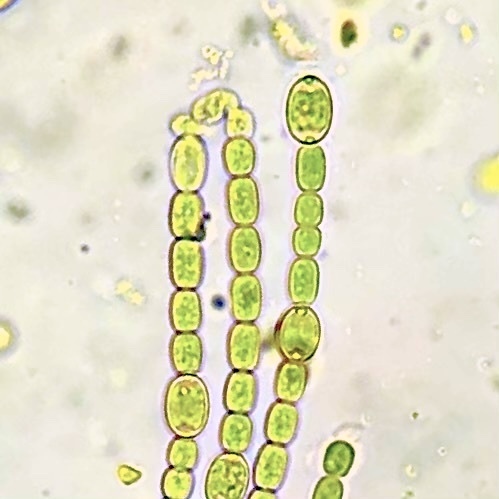
Anabaena azollae
species of Cyanobacteria

Nostoc pruniforme
species of Cyanobacteria

Cylindrospermum
thumb|upright=0.5|Illustration of "Cylindrospermum stagnale". h, heterocyst; sp, resting spore

Nostoc verrucosum
species of Cyanobacteria
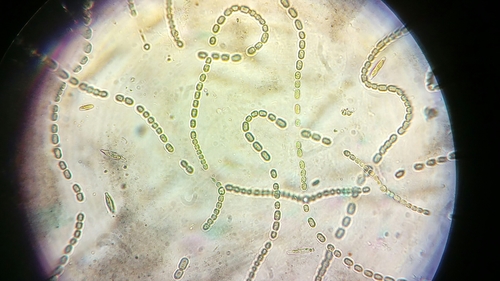
Nostoc punctiforme
species of Cyanobacteria

Dolichospermum
Dolichospermum is a genus of cyanobacteria belonging to the family Nostocaceae. It was created by splitting from Anabaena using molecular evidence. It is paraphyletic as the author intends: the genera Aphanizomenon and Cuspidothrix, though cladistically included, have "distinct and unique" morphological features that set them apart.