Category
page 1Nucleosynthesis

nucleosynthesis
thumb|alt=Diagram|Diagram illustrating the creation of new elements by the
Nucleosynthesis is the process that creates new atomic nuclei from nucleons (protonsand neutrons) and nuclei. According to current theories, the first nuclei were formed a fewminutes after the through nuclear reactions in a process called BigBang nucleosynthesis. After about 20minutes, the universe had expanded and cooled to a point at which these collisions among nucleons ended, so only the fastest and simplest reactions occurred, leaving our universe containing hydrogen and helium, traces of other elements, such as l
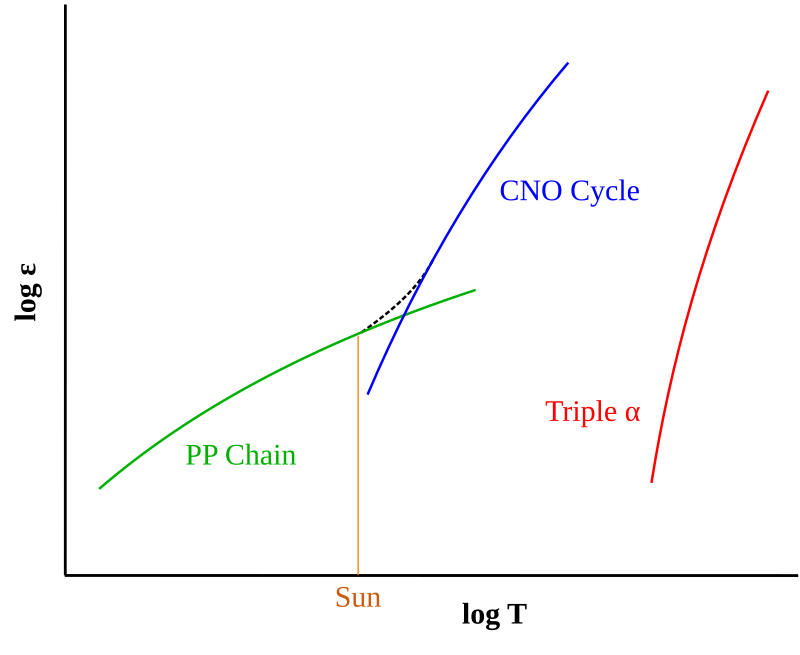
CNO cycle
set of fusion reactions by which stars convert hydrogen to helium: 4¹H+2e⁻→⁴He+2e⁺+2e⁻+2νₑ+3γ+24.7 MeV→⁴He+2νₑ+3γ+26.7 MeV
stellar nucleosynthesis
process by which the natural abundances of the chemical elements within stars change due to nuclear fusion reactions in the cores and their overlying mantles

triple-alpha process
nuclear fusion reaction chain converting helium to carbon
Big Bang nucleosynthesis
nucleosynthesis that occurred during the Big Bang (between ca. 10⁻² and 200 seconds after the Big Bang)
helium flash
brief thermal runaway nuclear fusion in the core of low mass stars
alpha process
nuclear fusion reaction

s-process
The slow neutron-capture process, or '''s-process', is a series of reactions in nuclear astrophysics that occur in stars, particularly asymptotic giant branch stars. The s''-process is responsible for the creation (nucleosynthesis) of approximately half the atomic nuclei heavier than iron.
r-process
In nuclear astrophysics, the rapid neutron-capture process, also known as the '''r-process', is a set of nuclear reactions that is responsible for the creation of approximately half of the atomic nuclei heavier than iron, the "heavy elements", with the other half produced largely by the s-process. The r-process synthesizes the more neutron-rich of the stable isotopes of even elements, and those separated from the beta-stable isotopes by those that are not often have very low s-process yields and are considered r-only nuclei; the heaviest isotopes of most even elements from zinc to mercury fall
carbon-burning process
nuclear fusion process in the cores of massive stars, combining carbon nuclei into heavier elements
neon-burning process
set of nuclear fusion reactions
oxygen-burning process
set of nuclear fusion reactions
silicon-burning process
nuclear fusion reaction sequence in stars of about 8–11 solar masses or more, starting with ²⁸Si+⁴He→³²S
photodisintegration
Photodisintegration (also called phototransmutation, or a photonuclear reaction) is a nuclear process in which an atomic nucleus absorbs a high-energy gamma ray, enters an excited state, and immediately decays by emitting a subatomic particle. The incoming gamma ray effectively knocks one or more neutrons, protons, or an alpha particle out of the nucleus. The reactions are called (γ,n), (γ,p), and (γ,α), respectively.
supernova nucleosynthesis
production of the elements in a supernova explosion
p-process
The term p-process (p for proton) is used in two ways in the scientific literature concerning the astrophysical origin of the elements (nucleosynthesis). Originally it referred to a proton capture process which was proposed to be the source of certain, naturally occurring, neutron-deficient isotopes of the elements from selenium to mercury. These nuclides are called p-nuclei and their origin is still not completely understood. Although it was shown that the originally suggested process cannot produce the p-nuclei, later on the term p-process was sometimes used to generally refer to any nucleos
X-ray burster
Class of X-ray binary stars
deuterium burning
nuclear fusion forming a helium-3 nucleus

rp-process
right|thumb|280px|Nucleosynthesis of proton-rich nuclei by rapid proton capture
The rp-process (rapid proton capture process) consists of consecutive proton captures onto seed nuclei to produce heavier elements. It is a nucleosynthesis process and, along with the s-process and the r-process, may be responsible for the generation of many of the heavy elements present in the universe. However, it is notably different from the other processes mentioned in that it occurs on the proton-rich side of stability as opposed to on the neutron-rich side of stability.
presolar grains
very old dust in space
B²FH paper
scientific article on the origin of the chemical elements
Cosmic ray spallation
Natural reactions causing nucleosynthesis
Lead star
Star with an overabundance of lead

beryllium-8
Beryllium-8 (8Be, Be-8) is a radionuclide with 4 neutrons and 4 protons. It is an unbound resonance of two alpha particles and nominally an isotope of beryllium. This has important ramifications in stellar nucleosynthesis as it creates a bottleneck in the creation of heavier chemical elements.
cosmological lithium problem
discrepancy between the observed abundance of lithium produced in Big Bang nucleosynthesis and the amount that should theoretically exist
photofission
Photofission is a process in which a nucleus, after absorbing a gamma ray, undergoes nuclear fission and splits into two or more fragments.
p-nuclei
p-nuclei (p stands for proton-rich) are certain neutron-deficient, naturally occurring isotopes of some elements between selenium and mercury inclusive which cannot be produced in either the s- or the r-process.
nuclear drip line
boundary on a table of nuclides demarcating where atomic nuclei decay by emitting protons or neutrons
Iron group
chemical series