Category
page 1Numeral systems

Roman numerals
numbers in the Roman numeral system

digit
numerical symbol used in combinations to represent numbers in various positional or additive numeral systems

numeral system
notation for expressing numbers

SI prefix
standardized prefix of the SI (Système International) for measurement units, indicating a multiple or fraction as a power of 10 or 1000

scientific notation
method of writing numbers, especially very large or small ones

counting
alt=A set of number blocks. The blocks 1, 2, and 3 are in the foreground; six other blocks can be seen in the background|thumb|Number blocks, which can be used for counting
Counting is the process of determining the number of elements of a finite set of objects; that is, determining the size of a set. The traditional way of counting consists of continually increasing a (mental or spoken) counter by a unit for every element of the set, in some order, while marking (or displacing) those elements to avoid visiting the same element more than once, until no unmarked elements are left; if the counte
radix
In a positional numeral system, the radix (radices) or base is the number of unique digits, including the digit zero, used to represent numbers. For example, for the decimal system (the most common system in use today) the radix is ten, because it uses the ten digits from 0 through 9.
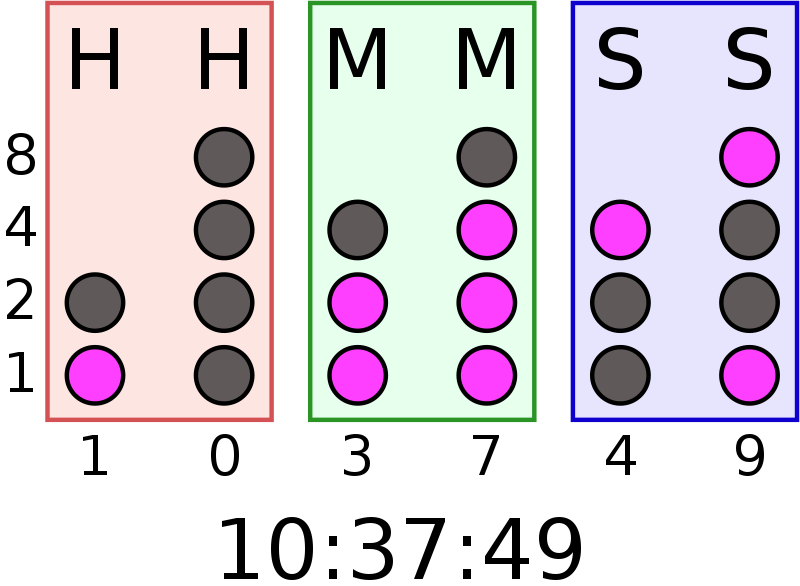
binary-coded decimal
class of binary encodings of decimal numbers where each decimal digit is represented by a fixed number of bits, usually four or eight. Special bit patterns are sometimes used for a sign or for other indications
list of notable numbers
Wikimedia list article
unary numeral system
the simplest numeral system, a non-positional numeral system
Maya numerals
numeral system
Egyptian numeral
numerals used in Ancient Eygpt
Gray code
ordering of binary strings such that subsequent strings differ only in one bit
binary prefix
symbol placed before units of digital information to indicate multiplication by a power of two
counter
device which stores the number of times a particular event or process has occurred
Hindu-Arabic numeral system
most common system for writing numbers
long and short scales
two of several different large-number naming systems for integer powers of ten
Babylonian numerals
numeral system used in ancient Babylonia
repeating decimal
decimal representation of a number whose digits are periodic
Suzhou numeral
numeral system used in China before the introduction of Arabic numerals

chronogram
thumb|upright=1.3|Chronogram on the Belfry of Thuin in Belgium: " reæDIfICor baptIstæ CherMan̄e soLertIa"
thumb|Portrait of Henry van Gameren, with Chronogram
A chronogram is a sentence or inscription in which specific letters, interpreted as numerals (such as Roman numerals), stand for a particular date when rearranged. The word, meaning "time writing", derives from the Greek words chronos (χρόνος "time") and gramma (γράμμα, "letter").
names of large numbers
Wikimedia list article
tally mark
numeral form used for counting
Indian numbering system
methods of naming large numbers
ones' complement
value obtained by inverting all the bits in the binary representation of the number
Jacques Pelletier du Mans
Humanist, Poet, Mathematician
numeral prefix
prefices derived from numerals or occasionally other numbers
Charles de Bovelles
French mathematician
Nicolas Chuquet
mathematician
Cistercian numerals
positional numeral system system developed by the Cistercian monastic order in the early 13th century with a single glyph indicating any integer from 1 to 9999
balanced ternary
numeral system that uses the digits −1, 0, and 1
Aegean numerals
numeral system used by the Minoan and Mycenaean civilizations; attested in Linear A and Linear B scripts
Goodstein's theorem
theorem
sign-value numeral system
class of non-positional numeral systems that aggregate (e.g. sum) the values of symbols
excess-3
Excess-3, 3-excess or 10-excess-3 binary code (often abbreviated as XS-3, 3XS or X3), shifted binary or Stibitz code (after George Stibitz, who built a relay-based adding machine in 1937) is a self-complementary binary-coded decimal (BCD) code and numeral system. It is a biased representation. Excess-3 code was used on some older computers as well as in cash registers and hand-held portable electronic calculators of the 1970s, among other uses.

radix character
symbol used to separate the integer part of a number from its fractional part

Algorism
right|thumb|250px|Calculating-Table by Gregor Reisch: Margarita Philosophica, 1503. The woodcut shows Arithmetica instructing an algorist and an abacist (inaccurately represented as [[Boethius and Pythagoras). There was keen competition between the two from the introduction of the Algebra into Europe in the 12th century until its triumph in the 16th.]]
Algorism is the technique of performing basic arithmetic by writing numbers in place value form and applying a set of memorized rules and facts to the digits. One who practices algorism is known as an algorist. This positional notation system ha
computer number format
internal representation of numeric values in a digital computer
leading zero
any 0 digit that comes before the first nonzero digit in a number string in positional notation
Elias gamma coding
universal encoding scheme for positive integers
Chuvash numerals
ancient Turkic numeral system
Midy's theorem
theorem
Offset binary
method for signed number representation
Aiken code
complementary binary-coded decimal which assigns a group of 4 bits to each decimal digit: 0→0000, 1→0001, 2→0010, 3→0011, 4→0100, 5→1011, 6→1100, 7→1101, 8→1110, 9→1111
Bi-quinary coded decimal
numeral encoding scheme
Elias delta coding
universal code encoding positive integers
engineering notation
version of scientific notation in which the exponent of ten reflects powers of a thousand
mathematics of the Incas
Mathematical knowledge possessed by the Incas
long hundred
120 (as in six score, rather than 100)
Mathieu Béroalde
French calvinist writer (1520-1576)
Elias omega coding
universal code encoding positive integers
exponential-Golomb coding
type of universal code, parameterized by a nonnegative integer
slashed zero
glyph variant of numeral 0 (zero) with slash
genealogical numbering system
data visualization for family trees
Joan Francés Fulcònis
French mathematician
Yan Tan Tethera
counting system
Muisca numerals
numeric notation and a vigesimal numerical system, based on multiples of twenty (Chibcha: gueta) used by the Muisca, one of the four advanced civilizations of the Americas before the Spanish conquest
list of numeral systems
Wikimedia list article
number sense in animals
ability of creatures to represent and discriminate quantities of relative sizes by number sense