Category
page 1Numerical analysis
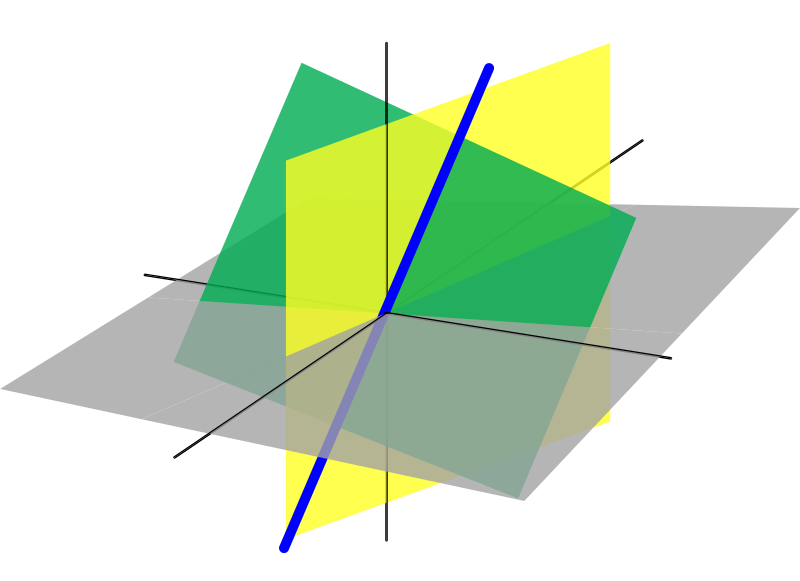
linear algebra
branch of mathematics that studies vector spaces and linear transformations

numerical analysis
study of algorithms that use numerical approximation for the problems of mathematical analysis

Monte Carlo method
broad class of computational algorithms using random sampling to obtain numerical results

approximation
An approximation is anything that is intentionally similar but not exactly equal to something else.
significant figure
any digit of a number within the measurement resolution of that number, as opposed to spurious digits

numerical integration
family of algorithms for finding the definite integral of a function
Runge–Kutta method
family of implicit and explicit iterative methods
Simpson's rule
numerical integration
Horner's method
algorithm for polynomial evaluation
approximation theory
theory of getting acceptably close inexact mathematical calculations
discrete Fourier transform
technique used in advanced mathematics
approximation error
also known as absolute error
finite difference
discrete analog of a derivative
iterative numerical method
numerical method in which the n-th approximation of the solution is obtained on the basis on the (n-1) previous approximations
Bernstein polynomial
type of polynomial used in Numerical Analysis
numerical stability
property of a numerical algorithm which describes how errors and approximations in the input data or intermediate values propagate through the algorithm without diverging its results
linear approximation
approximation of a function by its tangent line at a point
De Casteljau's algorithm
recursive method to evaluate polynomials in Bernstein form, used to work with Bézier curves
Padé approximant
'best' approximation of a function by a rational function of given order
well-posed problem
functional relationship F between some input x and output y such that y=g(x) and g is Lipschitz in a neighbourhood of every x
condition number
function K of the input x of a well-posed problem which describes how much its variation influences the variation of the output g(x)
curse of dimensionality
various phenomena that arise when analyzing and organizing data in high-dimensional spaces that do not occur in low-dimensional settings such as the three-dimensional physical space of everyday experience
truncation
In mathematics and computer science, truncation is limiting the number of digits right of the decimal point.

discretization
right|thumb|A solution to a discretized partial differential equation, obtained with the finite element method.
numerical differentiation
algorithms for estimating the derivative of mathematical functions

CORDIC
CORDIC, short for coordinate rotation digital computer, is a simple and efficient algorithm to calculate trigonometric functions, hyperbolic functions, square roots, multiplications, divisions, exponentials, and logarithms with arbitrary base, typically converging with one digit (or bit) per iteration. CORDIC is therefore an example of a digit-by-digit algorithm. The original system is sometimes referred to as '''Volder's algorithm'''.
rate of convergence
rate at which a convergent sequence approaches its limit
finite-volume method
method for representing and evaluating partial differential equations
Newton fractal
boundary set in the complex plane
interval arithmetic
method for bounding the errors of numerical computations
radial basis function
real-valued function whose value depends only on the distance between the input and some fixed point, which forms a basis for some function space
propagation of uncertainty
effect of variables' uncertainties (or errors, more specifically random errors) on the uncertainty of a function based on them
basis function
element of a basis for a function space
round-off error
difference between the result produced by an algorithm when using exact arithmetic and when using finite-precision, rounded arithmetic
truncation error
error from taking a finite sum of an infinite series
Galerkin method
class of methods for converting a continuous operator problem to a discrete problem
linear multistep method
effective tools for solving ordinary equations, whose working principle is as follows: first we choose a starting point, and then take a small step forward to find the next solution point.
trigonometric table
overview about trigonometric tables
false precision
presentation of numerical data in a manner that implies better precision than is justified
multiphysics simulation
simultaneous simulation of different aspects of a physical system or systems
computer-assisted proof
mathematical proof at least partially generated by computer
discrete wavelet transform
transform in numerical harmonic analysis
computational statistics
interface between statistics and computer science
Von Neumann stability analysis
numerical analysis procedure
Kempner series
harmonic series with all terms containing the digit '9' removed
predictor–corrector method
algorithms in numerical analysis
spectral method
class of methods used in numerical analysis, scientific computing to solve ODE/PDE
Digital Library of Mathematical Functions
online project meant to be a collection of special functions
Remez algorithm
algorithm to approximate functions
difference quotient
expression in calculus

Handbook of Mathematical Functions with Formulas, Graphs, and Mathematical Tables
mathematical reference work edited by M. Abramowitz and I. Stegun
Kahan summation algorithm
computation algorithm to sum a sequence of floating-point numbers
error analysis
study of kind and quantity of error, or uncertainty, that may be present in the solution to a problem
De Boor's algorithm
method of evaluating spline curves
Wilkinson's polynomial
expression whose zeros are the integers from 1 to 20
Bernstein's constant
mathematical constant
differential algebraic equation
system of equations that either contains differential equations and algebraic equations
stiffness matrix
matrix used in finite element analysis
Orders of approximation
expressions for approximation accuracy
surrogate model
engineering method used when an outcome of interest cannot be easily directly measured, so a model of the outcome is used instead