Category
page 1Obsolete fungus taxa

Zygomycota
Zygomycota, or zygote fungi, is a former division or phylum of the kingdom Fungi. The members are now part of two phyla: the Mucoromycota and Zoopagomycota. Approximately 1060 species are known. They are mostly terrestrial in habitat, living in soil or on decaying plant or animal material. Some are parasites of plants, insects, and small animals, while others form symbiotic relationships with plants. Zygomycete hyphae may be coenocytic, forming septa only where gametes are formed or to wall off dead hyphae. Zygomycota is no longer recognised as it was not believed to be truly monophyletic.

fungi imperfecti
also known as deuteromycetes

Phycomycetes
thumb|
Phycomycetes or algal fungi is an obsolete polyphyletic taxon for certain fungi with aseptate hyphae. It is used in the Engler system. Asexual reproduction takes place by zoospores (motile) or by Aplanospores (non-motile). These spores are endogenously produced in sporangium. A zygospore is formed by fusion of two gametes. These gametes are similar in morphology (isogamous) or dissimilar (anisogamous or oogamous).
Hymenomycetes
Hymenomycetes was formerly the largest taxonomic group of fungi within the division Basidiomycota, but the term is no longer taxonomically relevant. Many familiar fungi belong to this class, including bracket fungi and toadstools. This class contained the orders Agaricales, Boletales, and Russulales.
Hyphomycetes
Hyphomycetes are a form classification of fungi, part of what has often been referred to as fungi imperfecti, Deuteromycota, or anamorphic fungi. Hyphomycetes lack closed fruit bodies, and are often referred to as moulds (or molds). Most hyphomycetes are now mainly assigned to the Ascomycota, on the basis of genetic connections made by life-cycle studies or by phylogenetic analysis of DNA sequences; somemany remain unassigned phylogenetically. There are also some basidiomycete species, with aquatic presence noted in certain Corticiaceae and Urediniomycetes.
Discomycetes
thumb|Photograph of a discomycetes.
Discomycetes is a former taxonomic class of Ascomycete fungi which contains all of the cup, sponge and brain fungi, and some club-like fungi. It includes typical cup fungi like the scarlet elf cup and the orange peel fungus, and fungi with fruiting bodies of more unusual shape, such as morels, truffles and the swamp beacon. New taxonomic and molecular data fail to support the monophyly of the Discomycetes.
Exidiaceae
REDIRECT Auriculariaceae
Trichomycetes
Trichomycetes refers to a group of fungi in the division Zygomycota that grow in the guts of arthropods living in aquatic habitats. The name is obsolete, having not been validly published. Species formerly placed in the Trichomycetes are now placed in the orders Harpellales and Asellariales, both in the subdivision Kickxellomycotina, while Amoebidiales and Eccrinales are included in Opisthokonta.
Aphyllophorales
The Aphyllophorales is an obsolete order of fungi in the Basidiomycota. The order is entirely artificial, bringing together a miscellany of species now grouped among the clavarioid fungi, corticioid fungi, cyphelloid fungi, hydnoid fungi, and poroid fungi.
Monascaceae
Monascaceae is a former family of fungi in the subclass Eurotiomycetidae.
Gigasperma
Gigasperma is an inactive genus of fungi in the order Agaricales with a single species. It was treated either as the only genus in the monotypic family Gigaspermataceae, or part of the wider Cortinariaceae. Gigasperma was circumscribed by Austrian mycologist Egon Horak in 1971.
Setulipes
Setulipes was a proposed genus of fungi in the family Marasmiaceae. This group of mushrooms, described by the Czech mycologist Vladimír Antonín in 1987, has a widespread distribution in north temperate areas, and would contain about 25 species.
Nematoctonus
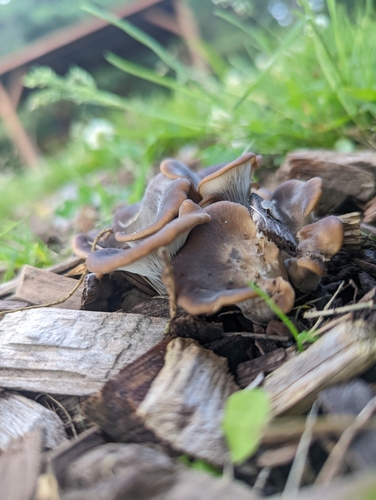
Nematoctonus (the name of which means 'nematode murderer') was a genus of fungi in the Pleurotaceae family, which is now considered a synonym of Hohenbuehelia. Originally the generic name —an anamorphic form of Hohenbuehelia—has a widespread distribution and contains 16 species. Under the one fungus - one name convention, the correct name for the group is Hohenbuehelia and species where the fruitbodies have not been discovered or that are older names for those described as fruitbodies have all been transferred to Hohenbuehelia.
Melanosporales
The Melanosporales is a former order of fungi within the class Sordariomycetes.
Coelomycetes
Coelomycetes are a form-class of fungi, part of what has often been referred to as fungi imperfecti, Deuteromycota, or anamorphic fungi.
Emericella
Emericella is a former genus of fungi.
Copelandia
Copelandia is a now deprecated genus of mushrooms consisting of at least 12 species. Many American mycologists previously placed members of Panaeolus which stain blue into Copelandia, whilst European mycologists generally used the name Panaeolus instead. Now all mushrooms previously categorised under Copelandia are universally classified in Panaeolus. The genus Copelandia was created as a subgenus of Panaeolus by Abbé Giacomo Bresadola (1847–1929) in honor of Edwin Bingham Copeland (1873–1964), an American who gathered fungi in the Philippines and sent some collections to Bresadola.
Tylophoropsis Sambo (1938) non N.E.Br. (1894)
later homonym, do not use
Lycoperdales
The Lycoperdales are a now outdated order of fungi. The order included some well-known types such as the giant puffball, the earthstars, and other tuberous fungi. They were defined as having epigeous basidiomes, a hymenium present, one to three layers in the peridium (outer wall), powdery gleba, and brown spores.