Category
page 1Old Prussians
Old Prussians
historical Baltic tribal group
Wulfstan of Hedeby
traveller and trader (fl. 9. century)

Skalvians
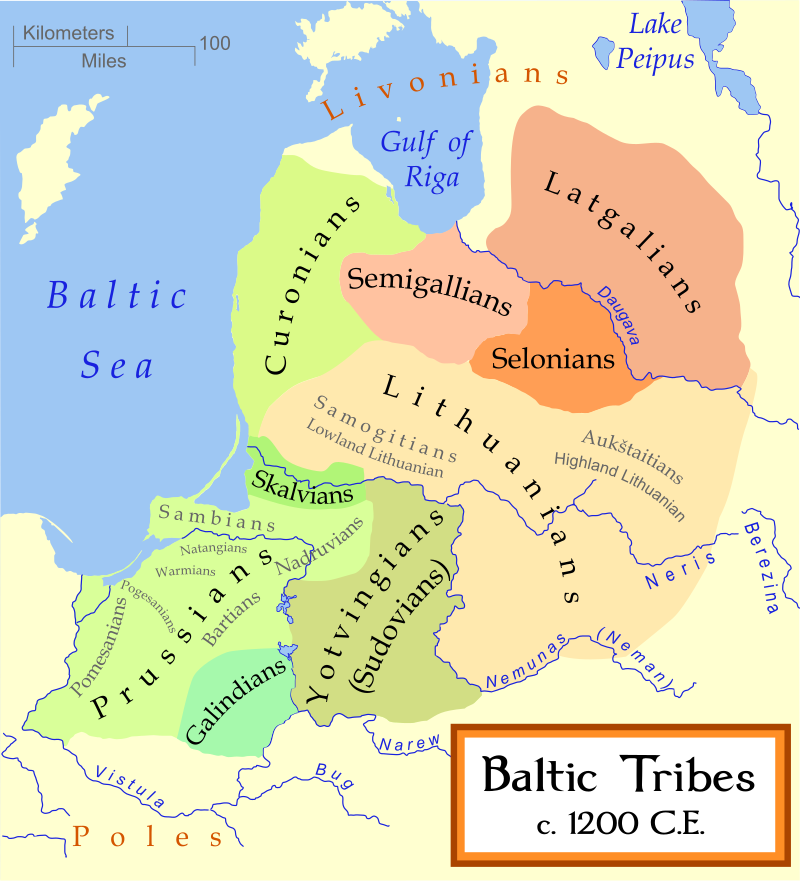
thumb|The Skalvians in the context of the other Baltic tribes, Common Era|CE. The Eastern Balts are shown in brown hues while the Western Balts are shown in green. The boundaries are approximate.
The Scalovians (; ), also known as the Skalvians, Schalwen and Schalmen, were a Baltic tribe related to the Prussians. According to the Chronicon terrae Prussiae of Peter of Dusburg, the now extinct Scalovians inhabited the land of Scalovia south of the Curonians and Samogitians, by the lower Neman River ca. 1240.
Chronicon terrae Prussiae
1326 chronicle of the Teutonic Order

Pogesania
Pogesanians were a Prussian tribe, which lived in the region of Pogesania (; ; ; ), a small territory stretched between the Elbląg and Pasłęka rivers, now located in the Warmian-Masurian Voivodeship, northern Poland. Pogesanians, as the rest of the Prussians, were conquered by the Teutonic Knights and became Germanized or Polonized. The old Prussian language became extinct sometime in the 17th century.

Nadruvians
The Nadruvians were a now-extinct Prussian tribe. They lived in Nadruvia (alternative spellings include: Nadruva, Nadrowite, Nadrovia, Nadrauen, Nadravia, Nadrow and Nadra), a large territory in northernmost Prussia. They bordered the Skalvians on the Neman (Nemunas) River just to the north, the Sudovians to the east, and other Prussian tribes to the south and west. Most information about the clan is provided in a chronicle by Peter von Dusburg.
Natangians
Natangians or Notangians (; ; ; ) was a Prussian clan, which lived in the region of Natangia, an area that is now mostly part of the Russian exclave Kaliningrad Oblast, whereas the southern portion lies in the Polish Warmian-Masurian Voivodeship.
Sambians
The Sambians were a Prussian tribe. They inhabited the Sambia Peninsula north of the city of Königsberg (now Kaliningrad). Sambians were located in a coastal territory rich in amber and engaged in trade early on (see Amber Road). Therefore, they established contacts with foreign nations before any other Prussians. However, as with all other Prussians, they were conquered by the Teutonic Knights, and, exposed to assimilation and Germanization, became extinct sometime in the 17th century.
Warmians
Warmians (also Warmi) were a Prussian tribe that lived in Warmia (, , , ), a territory which now mostly forms part of the Warmian-Masurian Voivodeship in Poland, with a small northern portion located in neighbouring Russia. It was situated between the Vistula Lagoon, Łyna and Pasłęka Rivers.
Bartians
The Bartians (also Barthi, Barthoni, Bartens, or Barti) were an Old Prussian tribe who were among the last natives following a pre-Christian religion before the Northern Crusades forced their conversion to Christianity at the cost of a high percentage of the native population. They lived in Bartia (also Bartenland or Barthonia), a territory that stretched from the middle and lower flow of Łyna river, by the Liwna river, and Lake Mamry, up to the Galindian woods. The territory is quite precisely known from description in Chronicon terrae Prussiae, dated 1326.
Pomesianians
Pomesanians were a Prussian clan. They lived in Pomesania (; ; ), a historical region in modern northern Poland, located between the Nogat and Vistula Rivers to the west and the Elbląg River to the east. It is located around the modern towns of Elbląg and Malbork. As the westernmost clan, the Pomesanians were the first of the Prussians to be conquered by the Teutonic Knights, a German military crusading order brought to the Chełmno Land to convert the pagans to Christianity. Due to Germanization and assimilation, Pomesanians became extinct some time in the 17th century.