Category
page 1Operating system distributions bootable from read-only media

Ubuntu
Ubuntu ( ) is a Linux distribution based on Debian and composed primarily of free and open-source software. Developed by the British company Canonical and a community of contributors under a meritocratic governance model, Ubuntu is released in multiple official editions: Desktop, Server, and Core for IoT and robotic devices.

Debian
Debian () is a Linux distribution developed by the Debian Project, established by Ian Murdock in August 1993.

Kubuntu
Kubuntu ( ) is an official flavor of Ubuntu, a Linux distribution that uses the KDE Plasma Desktop Environment instead of the GNOME desktop environment. As part of the Ubuntu project, Kubuntu uses the same underlying systems. Kubuntu shares the same repositories as Ubuntu and is released regularly on the same schedule as Ubuntu.

Knoppix
Knoppix, stylized KNOPPIX ( ), is an operating system based on Debian designed to be run directly from a CD or DVD (Live CD) or a USB flash drive (Live USB). It was first released in 2000 by German Linux consultant Klaus Knopper, and was one of the first popular live distributions. Knoppix is loaded from the removable medium and decompressed into a RAM drive. The decompression is transparent and on-the-fly.

Kali Linux
Debian-derived Linux distribution

MINIX
MINIX is a Unix-like operating system based on a microkernel architecture, first released in 1987 and written by American-Dutch computer scientist Andrew S. Tanenbaum. It was designed as a clone of the Unix operating system and one that could run on affordable, Intel 8086-based home computers; MINIX was targeted for use in classrooms by computer science students at universities.

Haiku
free/libre/open source operating system inspired by BeOS and compatible with its version 5

Lubuntu

Xubuntu

ReactOS
thumb|ReactOS 0.4.14 running the Firefox [[web browser]]
ReactOS is a free and open-source operating system for i586/amd64 personal computers that is intended to be binary-compatible with computer programs and device drivers developed for Windows Server 2003 and later versions of Microsoft Windows. ReactOS has been noted as a potential open-source drop-in replacement for Windows and has been of interest for its information on undocumented Windows APIs.

Manjaro
Manjaro ( ) is a free and open-source Linux distribution based on the Arch Linux operating system with a focus on user-friendliness, accessibility, and improved software testing and stability compared to its upstream sources. It uses a rolling release update model with Pacman-derived package managers. Manjaro is developed mainly in Austria, France and Germany.

FreeDOS
FreeDOS (formerly PD-DOS) is a free software operating system for IBM PC compatible computers. It intends to provide a complete MS-DOS-compatible environment for running legacy software and supporting embedded systems. FreeDOS can be booted from a floppy disk or USB flash drive and is designed to run well under virtualization or x86 emulation.

elementary OS
Linux distribution

Live CD
operating system distribution/image/copy bootable from CD, DVD and possibly other similar media

Puppy Linux
lightweight Linux distribution

Hurd
general-purpose kernel suitable for the GNU operating system

SliTaz
SliTaz GNU/Linux is a lightweight Linux distribution, community-based, suitable for use on older hardware and as a Live CD or Live USB. SliTaz stands for "Simple, Light, Incredible, Temporary Autonomous Zone" according to the boot screen.

OpenSolaris
OpenSolaris () is a discontinued open-source computer operating system for SPARC and x86 based systems, created by Sun Microsystems and based on Solaris. Its development began in the mid 2000s and ended in 2010.
DragonFly BSD
operating system
PCLinuxOS
PCLinuxOS, often shortened to PCLOS, is a rolling-release Linux distribution for x86-64 computers, with KDE Plasma, MATE, and XFCE as its default user interfaces. It is a primarily FOSS operating system for personal computers aimed at ease of use.
Slax
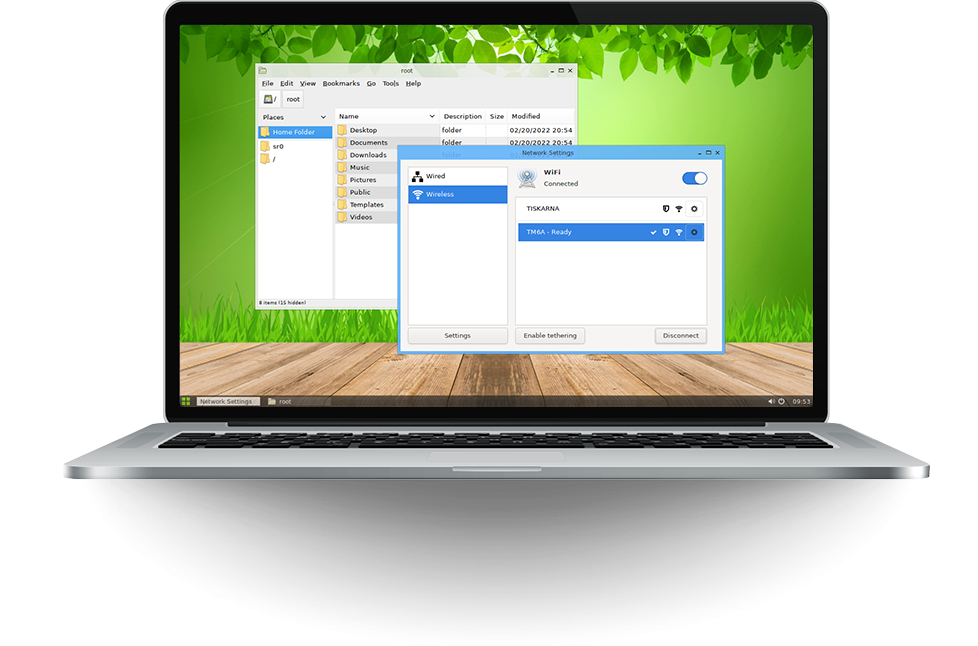
Slax is a LiveCD Linux distribution developed by Tomáš Matějíček and based on upstream customizable Linux distributions. Packages can be added by apt package manager or can be prepared as modules. The tagline for Slax refers to itself as "your pocket operating system".
BackTrack
BackTrack was a Linux distribution that focused on security, based on the Knoppix Linux distribution aimed at digital forensics and penetration testing use. In March 2013, the Offensive Security team rebuilt BackTrack around the Debian distribution and released it under the name Kali Linux.
Tails
Linux distribution for anonymity and privacy
Ubuntu MATE
Ubuntu flavor that comes with the MATE desktop
Sabayon Linux
Linux distribution
Plan 9
distributed operating system designed by Bell Labs as an UNIX's intended successor
Tiny Core Linux
lightweight Linux distribution

gNewSense
gNewSense was a Linux distribution, active from 2006 to 2016. It was based on Debian, and developed with sponsorship from the Free Software Foundation. Its goal was user-friendliness, but with all proprietary (e.g. binary blobs) and non-free software removed. The Free Software Foundation considered gNewSense to be composed entirely of free software.

MEPIS
MEPIS was a set of Linux distributions, distributed as Live CDs or DVDs that could be installed onto a hard disk drive. MEPIS was started by Warren Woodford and MEPIS LLC.
GParted
GParted is a GTK front-end to GNU Parted and an official GNOME partition-editing application (alongside Disks). GParted is used for creating, deleting, resizing, moving, checking, and copying disk partitions and their file systems. This is useful for creating space for new operating systems, reorganizing disk usage, copying data residing on hard disks, and mirroring one partition with another (disk imaging). It can also be used to format a USB drive.
pfSense
pfSense is a firewall/router computer software distribution based on FreeBSD. The open source pfSense Community Edition (CE) and pfSense Plus is installed on a physical computer or a virtual machine to make a dedicated firewall/router for a network. It can be configured and upgraded through a web-based interface, and requires no knowledge of the underlying FreeBSD system to manage.
Linux Lite
Lightweight Linux distribution based on Ubuntu LTS

Android-x86
thumb|right|Android x86 (ver. 4.0) on Asus Eee PC|EeePC 701 4G
Android-x86 is an unofficial port of the Android mobile operating system (developed by the Open Handset Alliance) for the Intel x86 platform. It is an open source project designed to make Android run on devices powered by x86 processors (such as PCs), rather than RISC-based ARM chips.
MX Linux
Linux distribution

MorphOS
MorphOS is an AmigaOS-like operating system designed for Power and PowerPC based computers. The core, based on the Quark microkernel, is proprietary; however, several libraries and other parts are open source, such as the Ambient desktop.
antiX
antiX () is a Linux distribution, originally based on MEPIS, which itself is based on the Debian Stable distribution. antiX initially replaced the MEPIS KDE desktop environment with the Fluxbox and IceWM window managers, making it suitable for older, less powerful x86-based systems. Unlike Debian, antiX does not use the systemd init system; instead, it provides an ISO image in which Runit is set as the default init system. The declared goal of the developers is to significantly extend the useful life of existing old & new computers by specifically selecting efficient software and operating sys

DR-DOS
DR-DOS is a disk operating system for IBM PC compatibles, originally developed by Gary A. Kildall's Digital Research, Inc. and derived from Concurrent PC DOS 6.0, which was an advanced successor of CP/M-86. Upon its introduction in 1988, it was the first DOS that attempted to be compatible with IBM PC DOS and MS-DOS.
Windows Preinstallation Environment
lightweight version of Microsoft Windows for deployment

Clonezilla
Clonezilla is an open-source suite of disk cloning, disk imaging and system deployment utilities. Clonezilla Server Edition uses multicast technologies to deploy a single image file to a group of computers on a local area network. Clonezilla was designed by Steven Shiau and developed by the NCHC Free Software Labs in Taiwan.

Antergos
Antergos is a discontinued Linux distribution based on Arch Linux. By default, it includes the GNOME desktop environment, but it also offers options for Cinnamon, MATE, KDE Plasma 5, Deepin, and Xfce desktops. Originally released in July 2012 as Cinnarch, it quickly gained popularity and was ranked among the top 40 most popular distributions on DistroWatch by June 2013. The name Antergos derived from the Galician word for ancestors, was chosen "to link the past with the present".

nUbuntu
__NOTOC__
Elive
Elive is a non-commercial Linux distribution based on Debian. It uses the Enlightenment desktop environment, offering a live DVD and a persistent USB image for 32- and 64-bit computers with Intel or AMD x86 processors.
Ubuntu GNOME
Linux distribution
Singularity
operating system
SparkyLinux
SparkyLinux is a desktop-oriented operating system based on the Debian operating system.
The project offers a ready-to-use operating system with various desktops to choose from. SparkyLinux is released 3-4 times per year to provide the latest versions of all applications.

Chakra Linux
Linux distribution
ArchBang
ArchBang Linux, also briefly known as GreenBANG, is a simple lightweight rolling release Linux distribution based on a minimal Arch Linux operating system with the i3 tiling window manager, previously using the Openbox stacking window manager. ArchBang is especially suitable for high performance on old or low-end hardware with limited resources. ArchBang's aim is to provide a simple out-of-the-box Arch-based Linux distribution with a pre-configured i3 desktop suite, adhering to Arch principles.
SystemRescue
SystemRescue (Previously known as "SystemRescueCD") is a Linux distribution for x86-64 and IA-32 computers. The primary purpose of SystemRescue is to repair unbootable or otherwise damaged computer systems after a system crash. SystemRescue is not intended to be used as a permanent operating system. It runs from a Live CD, a USB flash drive or any type of hard drive. It was designed by a team led by François Dupoux, and is based on Arch Linux since version 6.0. Starting with version 6.0, it has systemd as its init system.

Emmabuntüs
Emmabuntüs is a Linux distribution derived from Debian (previously Ubuntu) and designed to facilitate the restoration of computers donated to humanitarian organizations like the Emmaüs Communities.
MINIX 3
Unix-like operating system
Sabily
Sabily (, , My Way) is a discontinued Linux distribution based on Ubuntu, designed by and with the intent to be used by followers of Islam.
Originally named Ubuntu Muslim Edition (presented as UbuntuME), development for Sabily was active from 2007 to 2011.
Bharat Operating System Solutions
Linux distribution
Musix GNU/Linux
Linux distribution

Parted Magic
Linux distribution for disk partitioning

BartPE
BartPE ('''Bart's Preinstalled Environment) is a discontinued tool that customizes Windows XP or Windows Server 2003 into a lightweight environment, similar to Windows Preinstallation Environment, which could be run from a Live CD or Live USB drive. A BartPE system image is created using PE Builder''', a freeware program created by Bart Lagerweij.
Dynebolic
dyne:bolic GNU/Linux is a Live CD/DVD distribution based on the Linux kernel. It is shaped by the needs of media activists, artists and creators to be a practical tool with a focus on multimedia production, that delivers a large assortment of applications. It allows manipulation and broadcast of both sound and video with tools to record, edit, encode, and stream. In addition to multimedia specific programs, dyne:bolic also provides word processors and common desktop computing tools.

BackBox
BackBox is a penetration test and security assessment oriented Ubuntu-based Linux distribution providing a network and informatic systems analysis toolkit. It includes a complete set of tools required for ethical hacking and security testing.
Darik's Boot and Nuke
Linux distribution used for data erasure

Finnix
thumb|Finnix 102 default startup on an x86_64 system
Finnix is a Debian-based Live CD operating system, developed by Ryan Finnie and intended for system administrators for tasks such as filesystem recovery, network monitoring and OS installation. Finnix is a relatively small distribution, with an ISO download size of approximately 500 MiB, and is available for the X86-64 architecture. Finnix can be run off a bootable CD, a USB flash drive, a hard drive, or network boot (PXE).

Grml
Grml is a Linux distribution based on Debian. It is designed to run mainly from a live CD, but can be made to run from a USB flash drive. Grml aims to be well-suited to system administrators (sysadmin) and other users of text tools. It includes an X Window System server and a few minimalist window managers such as wmii, Fluxbox, and openbox to use the graphical programs like Mozilla Firefox which are included in the distribution.