Category
page 1Opisthokont orders
Cryptomycota
Cryptomycota ('hidden fungi'), Rozellida, or Rozellomycota are a clade of micro-organisms that are either fungi or a sister group to fungi. They differ from classical fungi in that they lack chitinous cell walls at any trophic stage in their lifecycle, as reported by Jones and colleagues in 2011. Despite their unconventional phagocytic feeding habits (typical fungi are osmotrophic), chitin has been observed in the inner layer of resting spores, and in immature resting spores for some species of Rozella, as indicated with calcofluor-white stain as well as the presence of a fungal-specific chiti
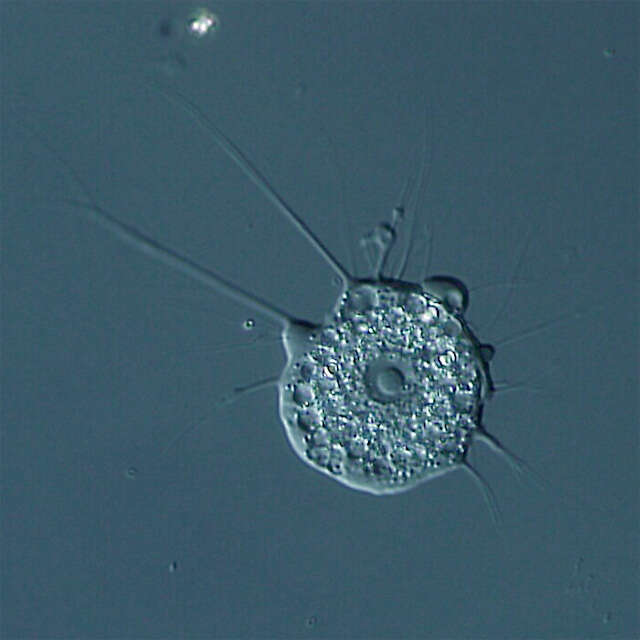
Nucleariida
REDIRECT Nucleariid
Dermocystida
Dermocystida is an order of parasitic eukaryotes.
Ichthyophonida
Eccrinida is an order of parasitic eukaryotes, especialized in parasiting animals.
Acanthoecida
Acanthoecida is an order of Choanoflagellates belonging to the class Choanoflagellatea. It is a type of heterotrophic nanoflagellate that feeds on suspended particles.
Craspedida
Craspedida is an order of choanoflagellate, with members with an exclusively organic covering. Crown group craspedids (and perhaps crown group choanoflagellates if Acanthoecida arose within Craspedida) appeared 422.78 million years ago. Although a previous study from 2017 recovered the divergence of the crown group choanoflagellates (craspedids) at 786.62 million years.
Eccrinales
Eccrinales are an order of eukaryotes, previously thought to be zygomycete fungi belonging to the class Trichomycetes, but now considered to be members of the opisthokont group Mesomycetozoea.