Category
page 1Orion (constellation)

Orion
constellation straddling the celestial equator
.png)
Betelgeuse
Betelgeuse is a red supergiant star in the equatorial constellation of Orion. It is usually the tenth-brightest star in the night sky and, after Rigel, the second brightest in its constellation. It is a distinctly reddish, semiregular variable star whose apparent magnitude, varying between +0.0 and +1.6, with a main period near 400 days, has the widest range displayed by any first-magnitude star. Betelgeuse is the brightest star in the night sky at near-infrared wavelengths. Its Bayer designation is ', Latinised to Alpha Orionis and abbreviated Alpha Ori or '.

Rigel
Rigel is a blue supergiant star in the equatorial constellation of Orion. It has the Bayer designation β Orionis, which is Latinized to Beta Orionis and abbreviated Beta Ori or β Ori. Rigel is the brightest and most massive componentand the eponymof a star system of at least four stars that appear as a single blue-white point of light to the naked eye. This system is located at a distance of approximately .

Orion Nebula
diffuse nebula

Orion's Belt
asterism

Messier 78
Reflection nebula in the constellation Orion

Bellatrix
Bellatrix is the third-brightest star in the constellation of Orion, positioned 5° west of the red supergiant Betelgeuse (Alpha Orionis). It has the Bayer designation γ Orionis, which is Latinized to Gamma Orionis. With a slightly variable magnitude of around 1.6, it is typically the 25th-brightest star in the night sky. It is the closest major star in Orion at only 244.6 light-years from the Solar System.

Messier 43
Nebula and H II region in the constellation Orion

Horsehead Nebula
dark nebula in the constellation Orion

Alnitak
Alnitak is a triple star system in the constellation of Orion. It has the designations ζ Orionis, which is Latinised to Zeta Orionis and abbreviated Zeta Ori or ζ Ori, and 50 Orionis, abbreviated 50 Ori. The system is located at a distance of several hundred parsecs from the Sun and is one of the three main stars of Orion's Belt along with Alnilam and Mintaka.

Alnilam
Alnilam is the central star of Orion's Belt in the equatorial constellation of Orion. It has the Bayer designation ε Orionis, which is Latinised to Epsilon Orionis and abbreviated Epsilon Ori or ε Ori. This is a massive, blue supergiant star some 1,250 light-years distant. It is estimated to be 270,000 times as luminous as the Sun, and 28 times as massive.

Flame Nebula
emission nebula in the constellation Orion

Mintaka
Mintaka , designation Delta Orionis (δ Orionis, abbreviated Delta Ori, δ Ori) and 34 Orionis (34 Ori), is a quintuple star system some 1,200 light-years from the Sun in the constellation of Orion. Together with Alnitak (Zeta Orionis) and Alnilam (Epsilon Orionis), the three stars form Orion's Belt, known by many names among ancient cultures. The star is located very close to the celestial equator. When Orion is near the meridian, Mintaka is the rightmost of the Belt's stars when viewed from the Northern Hemisphere facing south.

IC 2118
reflection nebula in the constellation Eridanus

NGC 1999
reflection nebula in the constellation Orion

Saiph
Saiph , designation Kappa Orionis (κ Orionis, abbreviated Kappa Ori, κ Ori) and 53 Orionis (53 Ori), is a blue supergiant star and the sixth-brightest star in the constellation of Orion. Of the four bright stars that compose Orion's main quadrangle, it is the star at the south-eastern corner. A northern-hemisphere observer facing south would see it at the lower left of Orion, and a southern-hemisphere observer facing north would see it at the upper right. Parallax measurements yield an estimated distance of from the Sun. It is smaller, less luminous but hotter at its surface than Rigel with an
NGC 2169
Open cluster in the constellation Orion
Iota Orionis
star in the constellation Orion
NGC 2174
H II emission nebula in the constellation Orion
NGC 2022
planetary nebula in the constellation Orion
NGC 1981
open cluster in Orion
NGC 1924
galaxy
NGC 2023
reflection nebula in the constellation Orion
NGC 1980
Open cluster in the constellation Orion
NGC 2119
galaxy
NGC 2071
reflection nebula

Meissa
Meissa , designated Lambda Orionis (λ Orionis, abbreviated Lambda Ori, λ Ori) is a star in the constellation of Orion. It is a multiple star approximately away with a combined apparent magnitude of 3.33. The main components are an O9 giant star and a B-class main sequence star, separated by about 4″. Despite Meissa being more luminous and only slightly further away than Rigel, it appears 3 magnitudes dimmer at visual wavelengths, with much of its radiation emitted in the ultraviolet due to its high temperature.
NGC 1788
reflection nebula
NGC 2175
open cluster in the constellation Orion
NGC 2110
galaxy
NGC 1990
galaxy
NGC 1762
galaxy
NGC 1819
galaxy
NGC 1683
galaxy
NGC 1719
galaxy
NGC 2194
open cluster
NGC 1807
asterism in the constellations Orion and Taurus
NGC 2202
open cluster in the constellation Orion
NGC 1662
open cluster in Orion
NGC 2064
reflection nebula
NGC 2067
reflection nebula
list of stars in Orion
Wikimedia list article
Trapezium Cluster
open cluster of star
Orion Molecular Cloud Complex
large group of bright nebulae, dark clouds, and young stars
GRB 970228
first gamma-ray burst for which an afterglow was observed
Pi3 Orionis
star in the constellation Orion
Sigma Orionis
five-star system in the constellation Orion
Chi1 Orionis
star in the constellation Orion
IC 434
emission nebula in the constellation Orion
S Orionis
variable star in the constellation Orion
Upsilon Orionis
star in the constellation Orion
Eta Orionis
variable star in the constellation Orion
Mrigashīrsha
Mṛgaśirā (also spelled Mr̥gaśīrṣa; Devanagari: मृगशीर्ष) is the 5th nakṣatra or lunar mansion as used in Hindu astronomy and astrology, in the constellation Orion. It corresponds to the stars λ, φ1, and φ2 Orionis. Its position is described in the Surya Siddhānta.
Pi4 Orionis
spectroscopic binary star system in the constellation Orion
Orion's Sword
asterism in the constellation Orion
GJ 3379
nearest star in the constellation Orion
15 Orionis
star system in the constellation Orion,
Mu Orionis
quadruple star system in the constellation Orion
U Orionis
variable star in the constellation Orion
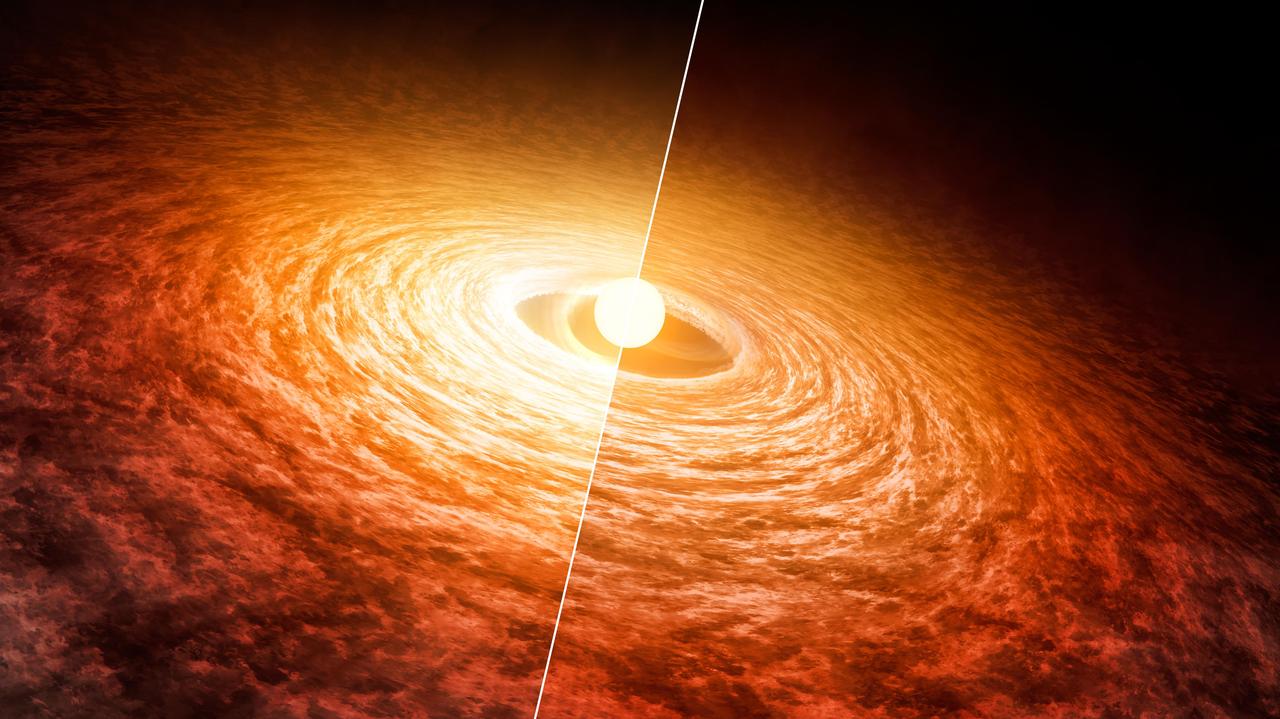
FU Orionis
variable star in the constellation Orion