Category
page 1Oscillators
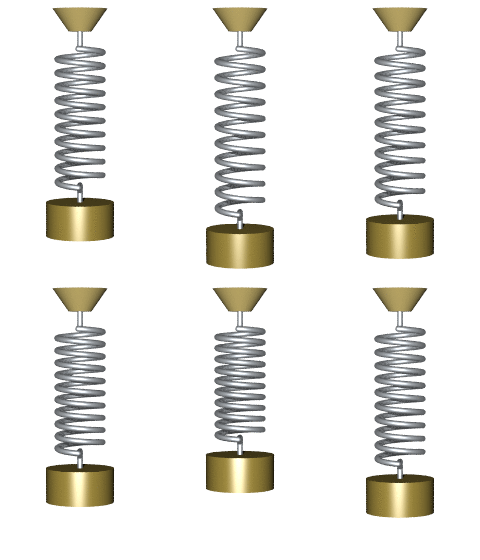
harmonic oscillator
physical system that responds to a restoring force inversely proportional to displacement
pendulum clock
timekeeping device
quantum harmonic oscillator
quantum mechanical model of a particle in a harmonic potential well
phase noise
frequency domain representation of rapid, short-term, random fluctuations in the phase of a waveform, caused by time domain instabilities

self-exciting oscillation
thumb|300px|Schematic representation of a self-oscillation as a positive feedback loop. The oscillator V produces a feedback signal B. The controller at R uses this signal to modulate the external power S that acts on the oscillator. If the power is modulated in phase with the oscillator's velocity, a negative damping is established and the oscillation grows until limited by nonlinearities.
Brusselator
thumb|right|350px|Top: The Brusselator in the unstable regime (A=1, B=3): The system approaches a limit cycle Bottom: The Brusselator in a stable regime with A=1 and B=1.7: For B2 the system is stable and approaches a fixed point.
Oregonator
thumb|alt=Limit cycle oscillation of Oregonator|Limit cycle oscillation of Oregonator
The Oregonator is a theoretical model for a type of autocatalytic reaction.
The Oregonator is the simplest realistic model of the chemical dynamics of the oscillatory Belousov–Zhabotinsky reaction.
It was created by Richard Field and Richard M. Noyes at the University of Oregon. It is a portmanteau of Oregon and oscillator.