Category
page 1Otters

Eurasian otter
species of otter
otter
Otters are carnivorous mammals in the subfamily Lutrinae. The 14 extant otter species are all semiaquatic, both freshwater and marine. Lutrinae is a branch of the Mustelidae family, which includes weasels, badgers, mink, and wolverines, among other animals.

sea otter
species of marine mammal

giant otter
species of mammal

oriental small-clawed otter
species of mammal

Lutra
Lutra is a genus of otters, one of seven in the subfamily Lutrinae.

smooth-coated otter
species of mammal

Hairy-nosed otter
species of mammal

African clawless otter
species of mammal

Lontra
Lontra is a genus of otters from the Americas.

spotted-necked otter
otter native to sub-Saharan Africa

Aonyx
Aonyx is a genus of otters, containing three species, the African clawless otter, the Congo clawless otter, and the Asian small-clawed otter.
The word aonyx means "clawless", derived from the prefix a- ("without") and onyx ("claw/hoof").

Japanese otter
species of mammal

Aonyx congicus
species of mammal
Lutrogale
Lutrogale was proposed as generic name by John Edward Gray in 1865 for otters with a convex forehead and nose, using the smooth-coated otter L. perspicillata as type species.

Enhydra
Enhydra is a genus of mustelid that contains the sea otter and two extinct relatives. It is the only extant genus of the bunodont otters group, referring to otters with non-blade carnassials with rounded cusps.

Enhydriodon
Enhydriodon is an extinct genus of otters known from Africa and South Asia that lived from the late Miocene to the early Pleistocene. It contains nine confirmed species, two debated species, and at least a few other undescribed species from Africa. The genus name means "otter tooth" in Ancient Greek and is a reference to its dentition rather than to the Enhydra genus, which includes the modern sea otter and its two prehistoric relatives. Enhydriodon belongs to the tribe Enhydriodontini (which also contains Sivaonyx and Vishnuonyx) in the otter subfamily Lutrinae.
otter fishing
using trained otters to fish
Megalenhydris barbaricina
Megalenhydris barbaricina is an extinct species of giant otter from the Late Pleistocene of Sardinia. It is known from a single partial skeleton, discovered in the Grotta di Ispinigoli near Dorgali, and was described in 1987. It was larger than any living otter, exceeding the size of South American giant otters (Pteronura), which can reach two meters in length. The species is one of four extinct otter species from Sardinia and Corsica. The others are Algarolutra majori, Lutra castiglionis and Sardolutra ichnusae. It is suggested to have ultimately originated from the much smaller European main
Siamogale melilutra
species of mammal
Sardolutra
Sardolutra ichnusae is an extinct species of otter from the Late Pleistocene of Sardinia. It was originally described as Nesolutra ichnusae. It was a rather small species of otter, probably living in the sea. Among its characteristics is a relatively very large baculum, larger than in any living otter.
The species probably evolved from a species of Lutra, maybe L. castiglionis.
Siamogale
Siamogale is an extinct genus of giant otter from the Late Miocene to Early Pliocene of eastern Asia. Three species are currently known, S. thailandica and S. bounosa from Thailand and S. melilutra from China.
Satherium
Satherium is an extinct genus of otters that lived in North America during the Pliocene and Pleistocene. Two species are known, Satherium piscinarium and Satherium ingens.
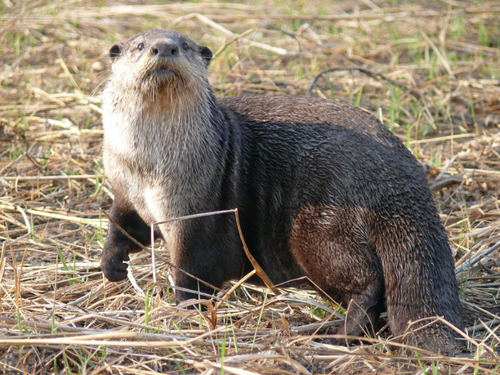
Aonyx capensis capensis
subspecies of mammal