Category
page 1Outdoor sculptures

sundial
thumb|right|SSW facing, vertical declining sundial on the Moot Hall in Aldeburgh, Suffolk, England. The gnomon is a rod that is very narrow, so it functions as the style. The Latin motto loosely translates as "I only count the sunny hours."
[[File:Melbourne sundial at Flagstaff Gardens.JPG|thumb|right|A horizontal dial commissioned in 1862, the gnomon is the triangular blade. The style is its inclined edge.

fountain
thumb|right|300px|(Center) Jet d'eau, (Geneva, Switzerland)
Clockwise from top right (1) Fontana di Trevi (Rome) (2) Place de la Concorde (Paris) (3) Fountain in the Garden of Versailles (Versailles) (4) The Hundred Fountains, Villa d'Este (Tivoli, Italy) (5) Fuente de los Leones, (The Alhambra, Granada) (6) Fountain in St. Peter's Square (Rome) (7) Samson and the Lion fountain (Peterhof, St. Petersburg, Russia) (8) Dubai Fountain (Dubai)

moai
thumb|330px|Moai facing inland at Ahu Tongariki, restored by Chilean archaeologist Claudio Cristino in the 1990s
.jpg)
obelisk
thumb|One of the two Luxor Obelisks, on the [[Place de la Concorde in Paris; a red granite monolithic column, high, including the base, which weighs over .]]
thumb|Lateran Obelisk in Piazza San Giovanni in Laterano, [[Rome. With its height of (with the base and the cross it reaches 45.70 m) it is the largest standing ancient monolithic obelisk in the world.]]

gargoyle
thumb|Gargoyles of Notre-Dame de Paris
thumb|Dragon-headed gargoyle of the Tallinn Town Hall, [[Estonia]]
thumb|Gargoyle of the Vasa Chapel at Wawel in [[Kraków, Poland]]

natural monument
natural or natural/cultural feature of outstanding or unique value

monolith
thumb|Niapiskau island, limestone monoliths, Gulf of St. Lawrence, [[Mingan Archipelago National Park Reserve, Canada]]
thumb|Uluru, [[Northern Territory, Australia, is often referred to as the biggest monolith. While the surrounding rocks were eroded, the rock survived as sandstone strata making up the surviving Uluru 'monolith'.]]
thumb|Monolithos, Greece|Monolithos fortress on [[Rhodes, Greece]]
thumb|Landsat 7 image [[Brandberg Mountain, Namibia]]
thumb|Pedra da Gávea|Gavea Rock, a monolith next to the sea, near [[Rio de Janeiro, Brazil]]
A monolith is a geological feature consisting of a

United Buddy Bears
sculpture series
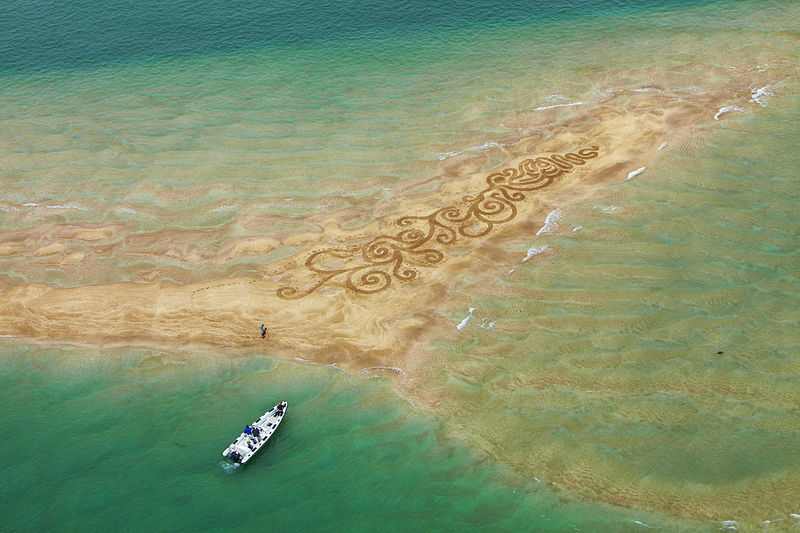
sand castle
building-like sculpture made with moist sand
Stone spheres of Costa Rica
Assortment of over three hundred precolumbian petrospheres in Costa Rica
Fallen Astronaut
sculpture of an astronaut on the moon
wind chime
percussion instrument
Laykyun Sekkya
Colossal statue of the Buddha in Myanmar
ice sculpture
sculpture that uses ice as the raw material
Kurgan stelae
anthropomorphic stone stelae within the perimeter of a tumulus

CowParade
thumb|right|Bronze casting commemorating Chicago's 1999 exhibition

Anakena
thumb|right|250px|Ahu Ature on Anakena Beach.
Anakena is a white coral sand beach in Rapa Nui National Park on Rapa Nui (Easter Island), a Chilean island in the Pacific Ocean. Anakena has two ahus; Ahu-Ature has a single moai and Ahu Nao-Nao has seven, two of which have deteriorated. It also has a palm grove and a car park.
Alyosha Monument
11-metre-tall ferroconcrete statue of a Soviet soldier on Bunarjik Hill in Plovdiv, Bulgaria
National Monument
monument in Malaysia

Jangseung
A ' () or village guardian' is a Korean totem pole usually made of wood. were traditionally placed at the edges of villages to mark village boundaries and frighten away demons. They were also worshipped as village tutelary deities.
The Hand
sculpture in Punta del Este
statue menhir
type of carved standing stone
El Panecillo
mountain in Quito, Ecuador
Latte stone
Historical building supports
snow sculpture
sculpture made of snow
replicas of the Statue of Liberty
list of replicas of the statue the Statue of Liberty
kugel fountain
sculpture made of a large sphere of hardstone as granite, which is carried by a very thin film of water in a concave fountain basin also of hard stone.
Bussa Emancipation Statue
monument to slave Bussa in Barbados
Monument to the sailors and fishermen perished in the sea
monument in Liepāja, Latvia
hydraulophone
A hydraulophone is a tonal acoustic musical instrument played by direct physical contact with water (sometimes other fluids) where sound is generated or affected hydraulically. The hydraulophone was described and named by Steve Mann in 2005, and patented in 2011. Typically, sound is produced by the same hydraulic fluid in contact with the player's fingers. It has been used as a sensory exploration device for low-vision individuals.
John the Baptist
sculpture series by Auguste Rodin
Kristu tal-Baħħara
Christ of the Mariners, underwater statue of Jesus Christ
Relocation of moai objects
Kissing Students
1998 sculpture by Mati Karmin in Tartu, Estonia
Keningau Oath Stone
monument in Sabah, Malaysia