Category
page 1Panhellenic Games
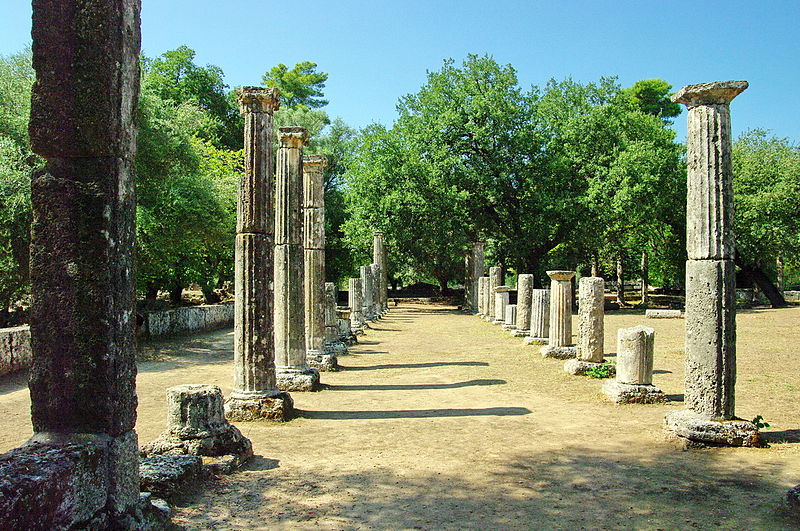
ancient Olympic Games
athletic competitions in ancient Greece
Pythian Games
ancient Panhellenic athletic festival held at Delphi in honor of Apollo
Isthmian Games
ancient panhellenic festival to Isthmian Poseidon in Greece
Nemean Games
One of the four Panhellenic Games, in honor of Nemean Zeus
Panhellenic Games
Four distinct Ancient Greek sports festivals
Heraean Games
ancient women's sports festival in Olympia

epinikion
thumb|150px|In addition to epinikia, a victorious athlete might be honored with a statue, as with this charioteer found at Delphi, probably a champion driver at the [[Pythian Games]]
The epinikion or epinicion (: epinikia or epinicia, Greek , from epi-, "on" and nikê, "victory") is a genre of occasional poetry also known in English as a victory ode. In ancient Greece, the epinikion most often took the form of a choral lyric, commissioned for and performed at the celebration of an athletic victory in the Panhellenic Games and sometimes in honor of a victory in war. Major poets in the genre are
agonothetes
In ancient Greece, an agonothetes (, plural ''''''''; ἀγωνοθέται) were the persons who decided the disputes and awarded the prizes in the Panhellenic Games. Alternative names for the same role included athlothĕtae'' (ἀθλοθέται), particularly in Athens.
Kallipateira of Rhodes
5th-century BC Greek athlete
theoros
The theoroi ( or ) in ancient Greece were sacred ambassadors, messengers sent out by the state which was about to organize a Panhellenic game or festival. Theoroi were both received and hosted by the theorodokoi. In the classical Greek world, theoroi meant something like "observers" and they were envoys sent by city-states to consult oracles, to give offerings at famous shrines or attend festivals.
Theorodokoi
The theorodokoi (Greek: , ) in ancient Greece were sacred envoy-receivers whose duty was to host and assist the theoroi (θεωροί, "viewers") before the Panhellenic games and festivals.