Category
page 1Patricii

Odoacer
Odoacer ( – 15 March 493 AD), also spelled Odovacer or Odovacar, was a barbarian soldier and statesman from the Middle Danube who was an officer of the Roman army and deposed the Western Roman child emperor Romulus Augustulus to become the ruler of Italy (476–493). Odoacer's overthrow of Romulus Augustulus is traditionally understood as marking the end of the Western Roman Empire.

Maurice
Byzantine Emperor (539-602)

Aëtius
Roman general and statesman ( c. 390 – 454)

Petronius Maximus
5th century western Roman emperor (396-455)

Constantius III
Western Roman Emperor (370-421)

Anthemius
Procopius Anthemius (; died 11 July 472) was the Western Roman emperor from 467 to 472. Born in the Eastern Roman Empire, Anthemius quickly worked his way up the ranks. He married into the Theodosian dynasty through Marcia Euphemia, daughter of Eastern emperor Marcian. He soon received a significant number of promotions to various posts, and was presumed to be Marcian's planned successor. However, Marcian's sudden death in 457, together with that of Western emperor Avitus, left the imperial succession in the hands of Aspar. He instead appointed Leo, a low-ranking officer, to the Eastern throne

Stilicho
Stilicho (; – 22 August 408) was a military commander in the Roman army who, for a time, became the most powerful man in the Western Roman Empire. He was partly of Vandal origins and married to Serena, the niece of emperor Theodosius I. He became guardian for the underage Honorius. After years of struggle against barbarian and Roman enemies, political and military disasters finally allowed his enemies in the court of Honorius to remove him from power. His fall culminated in his arrest and execution in 408.

Leontius
Leontius (; died 15 February 706) was Byzantine emperor under the regnal name Leo from 695 to 698. Little is known of his early life, other than that he was born in Isauria in Asia Minor. He was given the title of patrikios, and made strategos of the Anatolic Theme under Emperor Constantine IV. He led forces against the Umayyads during the early years of Justinian II's reign, securing victory and forcing the Umayyad caliph, Abd al-Malik ibn Marwan, to sue for peace.
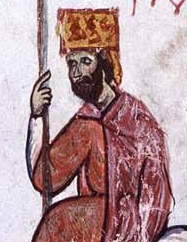
Romanos III Argyros
Byzantine emperor

Ricimer
Ricimer ( , ; – 19 August 472) was a Romanized Germanic general, who ruled the remaining territory of the Western Roman Empire from 456 after defeating Avitus, until his death in 472, with a brief interlude in which he contested power with Procopius Anthemius. Deriving his power from his position as magister militum of the Western Empire, Ricimer exercised political control through a series of puppet emperors. Ricimer's death led to unrest across Italy and the establishment of a Germanic kingdom on the Italian Peninsula.

Kubrat
Kubrat (; ) was the ruler of the Onogur–Bulgars, credited with establishing the confederation of Old Great Bulgaria in 632. His name derived from the Turkic words qobrat — "to gather", or qurt, i.e. "wolf".
Gundobad
Gundobad (; ; 452 – 516) was King of the Burgundians (473–516), succeeding his father Gundioc of Burgundy. Previous to this, he had been a patrician of the moribund Western Roman Empire in 472–473, three years before its collapse, succeeding his uncle Ricimer. He is perhaps best known today as the probable issuer of the Lex Burgundionum legal codes, which synthesized Roman law with ancient Germanic customs. He was the husband of Caretene.
Julius Constantius
son of Roman Emperor Constantius Chlorus (died 337)

Bardas
Bardas (; died 21 April 866) was a Byzantine noble and high-ranking minister. As the brother of Empress Theodora, he rose to high office under Theophilos (. Although sidelined after Theophilos's death by Theodora and Theoktistos, in 855 he engineered Theoktistos's murder and became the de facto regent for his nephew, Michael III (). Rising to the rank of Caesar, he was the effective ruler of the Byzantine Empire for ten years, a period which saw military success, renewed diplomatic and missionary activity, and an intellectual revival that heralded the Macedonian Renaissance. He was assassinate

Bonifatius
thumb|300px|Coin of Bonifatius Comes Africae (422-431 AD).
Mezezius
Mizizios or Mezezius (; or ) was an Armenian noble who served as a general of Byzantium, later usurping the Byzantine throne in Sicily from 668 to 669.
Telerig of Bulgaria
Telerig () was the ruler of Bulgaria from 768 to 777.
Anthemius
Pretorian Prefect of the East

John the Cappadocian
Praetorian prefect of the East (490-548)
Gregory the Patrician
Usurper of the Byzantine Empire in Africa (died 647)

Sittas
Sittas (; died 538) was a Byzantine military commander during the reign of Emperor Justinian I (r. 527–565). During the Iberian War against the Sassanid Empire, Sittas was given command of forces in Armenia, similar to the status of Belisarius in Mesopotamia. He won a victory over the Sassanids at the battle of Satala.
Peter the Patrician
Byzantine historian
Vasilios Lekapenos
Byzantine official

Illus
Flavius Illus (; died 488) was a Roman general who played an important role in the reigns of the Eastern Emperors Zeno and Basiliscus.
Joseph Bringas
Byzantine admiral

Al-Harith ibn Jabalah
King of the Ghassanids from c.528 to 569
Juansher
Juansher was the Mihranid prince of Caucasian Albania, ruling the principality from 637 to 669. He was the son and successor of Varaz Grigor ().
Justinian
6th-century Byzantine military general
Bardanes Tourkos
Byzantine general
John Troglita
Byzantine general
Petronas
9th-century Byzantine military leader and aristocrat
Castinus
Flavius Castinus was an influential Roman general and politician at the court of Emperor's' Honorius and Valentinian III, and most likely for some time before. He played a role in several military campaigns in Gaul and Hispania. He held the position of patricius and also served as consul for the year 424.
Solomon
Byzantine general
Marcellinus
Roman general (5th c.)
Quintus Aurelius Memmius Symmachus
6th century Roman historian and politician
Philippicus
Byzantine general
Leo Tornikios
mid-11th century Byzantine general and noble
John Tornike
Georgian general and saint
Liberius
Roman aristocrat (465-554)
Elpidius
Byzantine general and politician
Grigorios Taronites
Armenian prince of Taron
Anicius Faustus Albinus Basilius
politician
Areobindus
Roman general (magister militum) and consul of 434
Cyrus of Panopolis
Egyptian politician (400-470)

Theophobos
Theophobos () or Theophobus, originally Nasir (), Nasr (), or Nusayr (), was a commander of the Khurramites who converted to Christianity and entered Byzantine service under Emperor Theophilos (). Raised to high rank and married into the imperial family, Theophobos was given command of his fellow Khurramites and served under Theophilos in his wars against the Abbasid Caliphate in 837–838. After the Byzantines' defeat at the Battle of Anzen, he was proclaimed emperor by his own men, but did not pursue this claim. Instead he peacefully submitted to Theophilos in the next year and was apparently
Basil Argyros
Byzantine nobleman
Pompeius
5th century Roman consul
Michael Lachanodrakon
Byzantine governor and general (died 792)
Konstantinos Dalassenos
Byzantine aristocrat and general
Bonus
Byzantine general and statesman
John Mystacon
Byzantine general
Paul
8th century Exarch of Ravenna
Staurakios
Byzantine court official (died 800)
Seneqerim-Hovhannes of Vaspurakan
king of Vaspurakan
Adarnase I of Iberia
Prince of Iberia from 627 to c, 640
Plato
Exarch of Ravenna (645-649)
Damianos Dalassenos
Byzantine general and aristocrat
Niketas Ooryphas
Byzantine admiral
Dagalaifus
Roman politician, consul 461
Michael Doukeianos
Byzantine catepan of Italy