Category
page 1Patterned grounds
.jpg)
permafrost
Permafrost () is soil or underwater sediment which continuously remains below for two years or more; the oldest permafrost has been continuously frozen for around 700,000 years. Whilst the shallowest permafrost has a vertical extent of below a meter (3 ft), the deepest is greater than . Similarly, the area of individual permafrost zones may be limited to narrow mountain summits or extend across vast Arctic regions. The ground beneath glaciers and ice sheets is not usually defined as permafrost, so on land, permafrost is generally located beneath a so-called active layer of soil which free
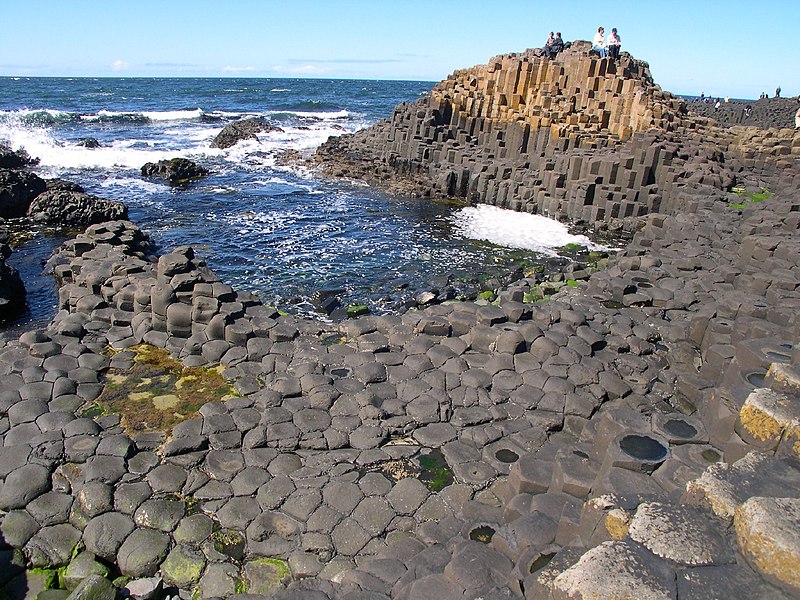
Giant's Causeway
rock formation on the Antrim coast of Northern Ireland

pingo
thumb|Ibyuk pingo near Tuktoyaktuk, northern Canada
thumb|View from top of a pingo towards another, within a partly drained lake, the Arctic Ocean in the background (near Tuktoyaktuk). July 20, 1975.

thermokarst
thumb|Permafrost thaw ponds in Hudson Bay, Canada, in 2008
Thermokarst is a type of terrain characterised by very irregular surfaces of marshy hollows and small hummocks formed when ice-rich permafrost thaws. The land surface type occurs in Arctic areas, and on a smaller scale in mountainous areas such as the Himalayas and the Swiss Alps.

desiccation
thumb|Mudcrack|Desiccation cracks in [[sludge]]
thumb|Centripetal desiccation cracks in the Lower Jurassic [[Moenave Formation at the St. George Dinosaur Discovery Site at Johnson Farm, southwestern Utah. A dinosaur footprint is at the center.]]
Batagaika crater
thermokarst depression in Russia
ripple marks
Sedimentary structures resulting from the interaction between sediment and bottom current

palsa
300px|thumb|upright=1.4|A group of well developed palsas as seen from above
Palsas are peat mounds with a permanently frozen peat and mineral soil core. They are a typical phenomenon in the polar and subpolar zone of discontinuous permafrost. One of their characteristics is having steep slopes that rise above the mire surface. This leads to the accumulation of large amounts of snow around them. The summits of the palsas are free of snow even in winter, because the wind carries the snow and deposits on the slopes and elsewhere on the flat mire surface. Palsas can be up to in diameter and can re
frost heaving
results from ice forming beneath the surface of soil during freezing conditions

vertisol
upright=1.6|thumb|Vertisols of the world
thumb|A more detailed map of the global distribution of Vertisols
fracture
geologic discontinuity feature, often a diaclase, or a fault
Patterned ground
Geometric land forms resulting from the freeze-thaw cycle

mudcrack
upright=1.25|thumb|Fresh mudcracks on the shore of The Wash, England
Mudcracks (also known as mud cracks, desiccation cracks or cracked mud) are sedimentary structures formed as muddy sediment dries and contracts. Crack formation also occurs in clay-bearing soils as a result of a reduction in water content.

ice wedge
crack in the ground formed by a narrow vertical block of ice
sedimentary structure
geologic structures formed during sediment deposition
Pingo Canadian Landmark
protected area