Category
page 1Peace goddesses

Athena

Venus
Roman goddess of love, sexuality, procreation and pleasure

Parvati
Parvati (, ), also known as Uma (, ) and Gauri (, ), is one of the principal goddesses in Hinduism, revered as the goddess of power, energy, nourishment, harmony, love, beauty, devotion, and motherhood. Along with Lakshmi and Sarasvati, she forms the trinity, known as the Tridevi.

Horae
thumb|upright=1.3|Dionysus leads the Horae. Dionysus carries his [[thyrsus, and the middle Hora hold ears of wheat. Neo-Attic Roman relief, c. 50–25 BC.]]
In Greek mythology, the Horae (), Horai () or Hours (, ) were the goddesses of the seasons and the natural portions of time.

Harmonia
thumb|250px|Statue of Harmonia in the Harmony Society gardens in Old Economy Village, Pennsylvania.
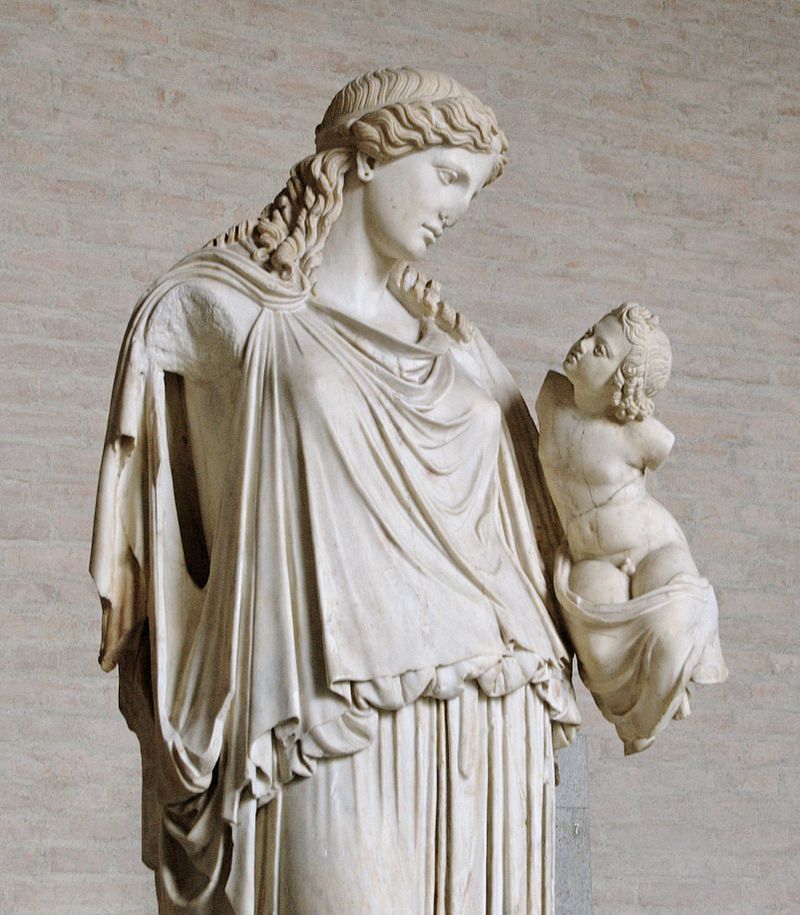
Eirene
ancient Greek goddess of peace
Concordia
goddess in ancient Roman religion
%20issued%20by%20Wm.%20S.%20Kimball%20%26%20Co.%20MET%20DPB871028.jpg)
Astraea
In ancient Greek religion and mythology, Astraea (; ), also spelled Astrea or Astria, is a daughter of Astraeus and Eos. She is the virgin goddess of justice, and is closely associated with another Greek justice goddess, Dike, the daughter of Zeus and Themis. Astraea is not to be confused with Asteria, the goddess of the stars and the daughter of Coeus and Phoebe.
Pax
Roman goddess of peace
María Lionza
Venezuelan female deity
Asase Ya
Goddess of fertility
Ekecheiria
In Greek mythology, Ekecheiria, Ekekheiria, or Ecechiria (; Ancient Greek: Ἐκεχειρία means 'armistice, truce') was the spirit and personification of truce, armistice, and cessation of hostilities. The term is also used to refer to the Olympic truce. The ancient Greeks hosted Olympiads for almost 600 years, and whenever the games were announced, Truce Heralds from Olympia went to all participating nations and city states to call for the laying down of arms. The truce was considered sacred, and only two violations are found in the records: Soldiers of Philip of Macedon were convicted of robbing
Tranquillitas
thumb|Tranquillitas depicted on a silver coin issued by Hadrian
In Roman mythology, Tranquillitas was one of the Imperial virtues and the personification of tranquility. She began to be portrayed as a deity in the 1st century CE alongside the goddesses Securitas, Tutela, and the pre-existing Salus. Together, these deities were responsible for the well-being and safety of Rome. She was likely the goddess of calm seas and associated with the food supply, maritime trade, and the security of the state.
Itonia
thumb|Ancient Greek coin with Athena Itonia on the reverse.
Itonia, Itonias or Itonis (Gr. ', or ') was an epithet of the Greek goddess Athena worshiped widely in Thessaly and elsewhere. The name was derived from the town of Iton in the south of Phthiotis.