Category
page 1Peltigerales genera

Peltigera
Peltigera is a genus of approximately 100 species of foliose lichens in the family Peltigeraceae. Commonly known as the dog or pelt lichens, species of Peltigera are often terricolous (growing on soil), but can also occur on moss, trees, rocks, and many other substrates in many parts of the world.

Collema
Collema (jelly lichen) is a genus of lichens in the family Collemataceae. The photobiont is the cyanobacterium genus Nostoc. Species in this genus typically grow on nutrient-rich bark or somewhat siliceous or calcareous rocks in humid environments.

Lobaria
Lobaria is a genus of foliose lichens, formerly classified in the family Lobariaceae, but now placed in the Peltigeraceae. They are commonly known as "lung wort" or "lungmoss" as their physical shape somewhat resembles a lung, and their ecological niche is similar to that of moss.

Nephroma
Nephroma is a genus of medium to large foliose lichens. The genus has a widespread distribution. They are sometimes called kidney lichens, named after the characteristic kidney-shaped apothecia that they produce on the lower surface of their lobe tips, which often curl upwards and thus are visible from above. Sterile specimens that do not have apothecia can look somewhat like Melanelia, Peltigera, Platismatia, or Asahinea. Most species grow either on mossy ground or rocks, or on trees.

Fuscopannaria
Fuscopannaria is a genus of lichen-forming fungi in the family Pannariaceae. It has about 50 species. The genus was established in 1994 by the Norwegian lichenologist Per Magnus Jørgensen to accommodate a group of squamulose and crustose lichens that are widespread across temperate and tropical regions. Members of the genus are typically found on tree bark in moist, shaded habitats, ranging from tropical rainforests to temperate woodlands, where they appear as small, greyish or dark crusty or scaly patches on trunks and branches.
.jpg)
Leptogium
Leptogium is a genus of lichen-forming fungi in the family Collemataceae. It has about 110 species. Species formerly classified under Leptogium have since been divided among the genera Leptogium, Pseudoleptogium, and Scytinium. Leptogium lichens are predominantly found on tree bark or soil, often among mosses, and sometimes on rocks in moist environments.
Solorina
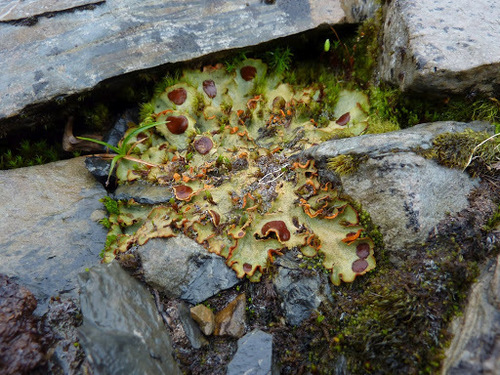
Solorina is a genus of 10 species of lichenized fungi in the family Peltigeraceae. The genus was first described by the Swedish botanist Erik Acharius in 1808. Members of the genus are commonly called socket lichens.
.jpg)
Pannaria
Pannaria is a genus of lichen-forming fungi in the family Pannariaceae. These lichens form leaf-like, scaly, or crusty patches that typically arrange themselves in loose rosettes on tree bark in humid forests. Most species partner with nitrogen-fixing cyanobacteria, though some contain green algae instead. The genus was established in 1828 and now includes about 80 recognized species found worldwide, particularly in tropical and subtropical regions.

Pseudocyphellaria
Pseudocyphellaria is a genus of large, leafy lichens that are sometimes referred to as "specklebelly" lichens. The genus has a widespread distribution, especially in south temperate regions, and contains about 170 species. They resemble Lobaria, except that most species of Pseudocyphellaria have conspicuous pseudocyphellae on their lower surface, a characteristic that was once considered unique to this genus. Some species contain pulvinic acid-related pigments; in these species the soredia and pseudocyphellae can be bright yellow.
Sticta
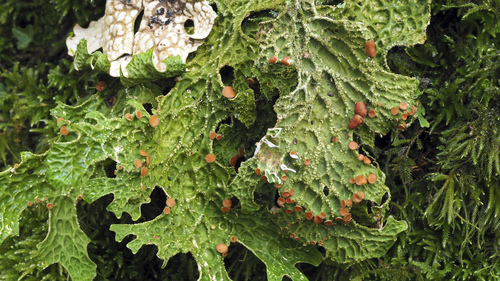
Sticta is a genus of lichens in the family Peltigeraceae. The genus has a widespread distribution, especially in tropical areas, and includes about 114 species. These lichens have a leafy appearance, and are colored brown or black. Sticta species with cyanobacteria as photobionts can fix nitrogen from the atmosphere, and due to their relative abundance and high turnover, they contribute appreciably to the rainforest ecosystem. They are commonly called spotted felt lichens.

Psoroma
Psoroma is a genus of lichen-forming fungi in the family Pannariaceae. The widespread genus contains about 30 species, most of which are found in south temperate regions.

Erioderma
Erioderma is a genus of lichen-forming fungi in the family Pannariaceae. They are commonly called mouse ears or felt lichens, and are small, pale brown to olive-brown foliose cyanolichens with a fuzzy upper surface that have the cyanobacteria Scytonema as their photobiont. Most species are found in the tropics of Central and South America, although three species are found in coastal regions of North America where they generally grow on mossy branches in humid sites. All North American species are rare. Species of Erioderma can resemble Pannaria, Leioderma, or small Peltigera, but their fuzzy u
Placynthium
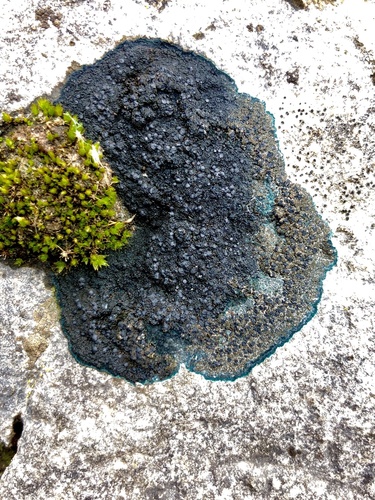
Placynthium is a genus of lichen-forming fungi in the family Placynthiaceae. Members of this genus are commonly called blackthread lichens.
Degelia
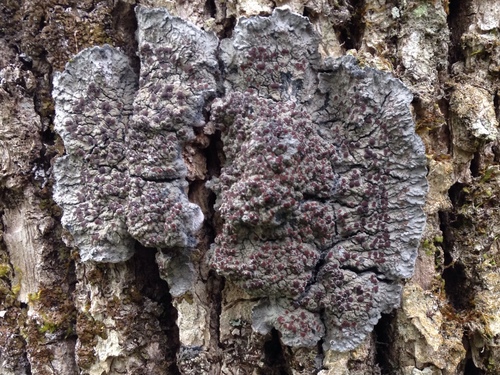
Degelia is a genus of lichen-forming fungi in the family Pannariaceae. The genus is named after Swedish lichenologist Gunnar Degelius.

Fuscoderma
Fuscoderma is a genus of lichenized fungi in the family Pannariaceae. It was originally circumscribed as a subgenus of the genus Leioderma by David Galloway and Per Magnus Jørgensen in 1987. The same authors promoted it to generic status a couple of years later in 1989. The New Guinean species F. papuanum was added to the genus in 2002.

Coccocarpia
Coccocarpia is a genus of lichen-forming fungi in the family Coccocarpiaceae. Recent genetic studies suggest the genus originated in the Australasia–Oceania region during the Late Cretaceous period, roughly 76–100 million years ago, and later spread to Asia and the Americas. Some South American lineages are thought to have reached the continent via warm rainforest corridors that crossed Antarctica during the Palaeogene period, around 50–60 million years ago.

Protopannaria
Protopannaria is a genus of seven species of lichen-forming fungi in the family Pannariaceae. The genus was elevated from a subgenus of Pannaria to full genus status in 2000. Protopannaria lichens typically grow as small, overlapping patches on mossy tree trunks and branches in humid, old-growth forests. The genus is primarily distributed in subantarctic and temperate regions of the Southern Hemisphere.

Parmeliella
Parmeliella is a genus of lichen-forming fungi in the family Pannariaceae. It occurs mainly in the tropics and subtropics, with species found in Africa, Asia, Australasia and South America. These lichens form small, leaf-like or crusty patches that are often anchored by blue-black fibres, and they partner with nitrogen-fixing cyanobacteria. The genus was established in 1862 by the Swiss lichenologist Johannes Müller Argoviensis, who distinguished it from related genera by the structure of its fruiting bodies.

Blennothallia
Blennothallia is a genus of jelly lichens in the family Collemataceae. It has four species, which collectively have a cosmopolitan distribution.

Physma
Physma is a genus of cyanolichens in the family Pannariaceae. It has five species. The genus was circumscribed by Italian lichenologist Abramo Bartolommeo Massalongo in 1854, with Physma boryanum assigned as the type species.

Polychidium
Polychidium is a genus of lichen-forming fungi in the family Massalongiaceae. These lichens form tiny, shrub-like tufts with branching filaments that create woolly cushions on moss-covered rocks and tree twigs. The genus was traditionally thought to include four similar-looking species, but molecular studies revealed that three of these actually belong to a different genus called Leptogidium. Today, Polychidium in the strict sense contains only P. muscicola and three closely related species, found from tropical to subarctic regions worldwide.
Hertella
Hertella is a lichenized genus of fungi within the Placynthiaceae family.

Spilonema
Spilonema is a genus of lichen-forming fungi in the family Coccocarpiaceae. These lichens form small, dark tufts of thread-like filaments that grow on rocks and are found in various regions from tropical to arctic climates. They partner with nitrogen-fixing cyanobacteria, which gives them their distinctive blue-green colouration and allows them to survive in nutrient-poor environments. The genus was established in 1856 by the French botanist Jean-Baptiste Édouard Bornet, who distinguished these species from similar-looking lichens based on their unique internal structure.

Koerberia
Koerberia is a genus of lichen-forming fungi in the family Koerberiaceae.
Rostania
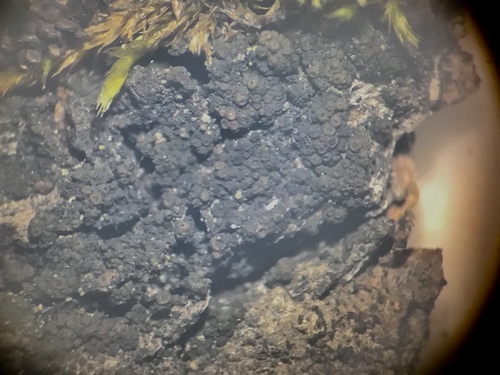
Rostania is a genus of lichen-forming fungi in the family Collemataceae. These lichens are primarily found on tree bark, occasionally on wood, with one species known to inhabit soil. The genus is characterized morphologically by having minute thalli made of hyphal tissue without a separate , and the more or less cuboid-shaped .
Austrella
Austrella is a small genus of lichen-forming fungi in the family Pannariaceae.
Leciophysma
Leciophysma is a genus of cyanolichens in the family Pannariaceae. It has four species. The genus was circumscribed by Theodor Magnus Fries in 1865, with Leciophysma finmarkicum assigned as the type species.
Lathagrium
Lathagrium is a genus of lichen-forming fungi in the family Collemataceae. It has 10 species of gelatinous lichens. Species in this genus typically grow on calcareous rocks, often amidst mosses, but can also be found on siliceous or serpentine rocks, mortar, or soil.

Scytinium
Scytinium is a genus of lichen-forming fungi in the family Collemataceae. It has 49 species. These lichens are typically found on basic rocks, soil, and trees, occasionally in association with mosses. In its revised sense, Scytinium includes crustose, squamulose or small foliose jelly-lichens with thalli (lichen bodies) usually only a few millimetres to a few centimetres across. Despite the morphological and ecological diversity within Scytinium, its species share similar ascospore features, such as shape and septation, as well as a small to medium-sized thallus with at least a partial .
Vahliellaceae
Vahliella is a genus of nine species of lichen-forming fungi in the order Peltigerales. It is the only member of Vahliellaceae, a family circumscribed in 2010 to contain this genus. Vahliella was formerly placed in the family Pannariaceae until molecular phylogenetics showed that it did not belong there. Vahliella species are found in the Northern Hemisphere – mainly in North America, but also in Europe and India.

Massalongia
genus of fungi

Enchylium
Enchylium is a genus of lichen-forming fungi in the family Collemataceae. The genus was originally established as a section of the related genus Collema in 1810, but molecular studies have since confirmed it forms a distinct evolutionary lineage. These lichens are characterised by their gelatinous, water-absorbing thalli that swell noticeably after rain and typically colonise bare soil or rock surfaces in well-lit environments. Most species are pioneers that help stabilise loose substrates before other plants and lichens become established.
Kroswia
Kroswia is a genus of lichens in the family Pannariaceae. It consists of four paleotropical species: K. epispora, K. gemmascens, K. polydactyla, and the type, K. crystallifera. Species in the genus are characterized by their gelatinous, homoiomerous (uniform in structure, without differentiation into distinct tissues), and ecorticate (without a cortex) thallus. The ascocarps contain terpenoids and fatty acids. The genus was circumscribed by Norwegian lichenologist Per Magnus Jørgensen in 2002.
Siphulastrum
Siphulastrum is a genus of lichen-forming fungi in the family Pannariaceae. It has five species. The genus was circumscribed by Johannes Müller Argoviensis in 1889, with S. triste assigned as the type species.