Category
page 1Persian literature

One Thousand and One Nights
collection of Middle Eastern folk stories

Nasreddin
thumb|A 17th-century miniature of Nasruddin, from the collection of the Topkapı Palace Museum|205x205px

ghazal
thumb|An illustrated headpiece from a mid-18th century collection of ghazals and Rubaʿi|rubāʻīyāt

Panchatantra
thumb|The first page of oldest surviving Panchatantra text in Sanskrit
thumb|An 18th-century Pancatantra manuscript page in Braj ("The Talkative Turtle")

Persian literature
oral compositions and written texts in the Persian language

Ruba'i
thumb|Calligraphic rendition of a ''ruba'i'' attributed to Omar Khayyam from
Bodleian MS. Ouseley 140 (one of the sources of FitzGerald's [[Rubaiyat of Omar Khayyam).]]
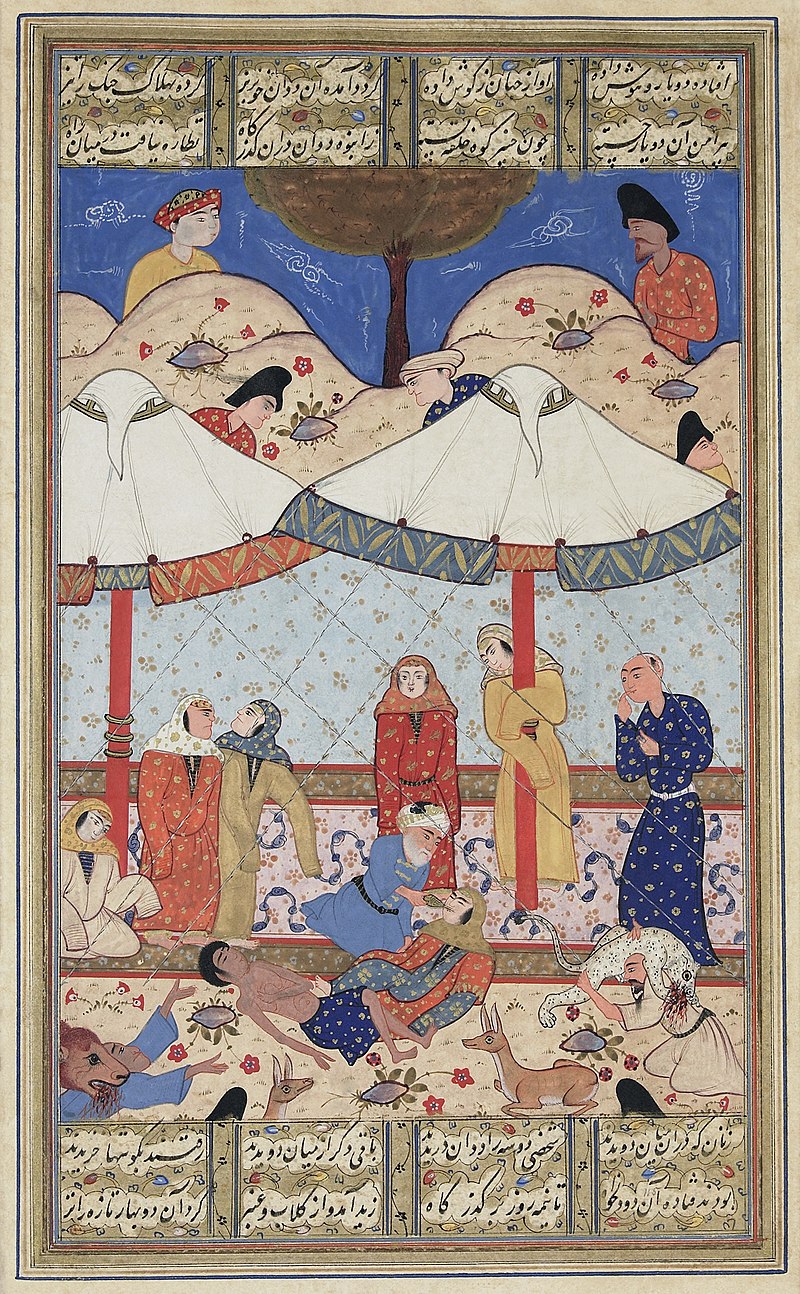
Layla and Majnun
story of Arab origin, about the 7th-century Arabic poet Qays ibn al-Mulawwah and his lover Layla bint Mahdi
Persepolis
2000–2003 French-language graphic novel series by Marjane Satrapi
Kalila and Demna
collection of fables
blind men and an elephant
parable from the ancient Indian subcontinent, in which several blind men feel and try to conceptualize an elephant
Academy of Persian Language and Literature
regulatory institution of the Persian language
Qabus nama
Nasihat Nama (), also known as Qabus Nama (), is a book in the Persian language from the 11th century. It was authored by Amir Keikavus. The book was completed in the year 475 AH. Qabus Nama is an advice book, and its contents are presented in the form of counsel and advice.

The Revival of the Religious Sciences
Islamic theological work written by Al-Ghazali between 1095 and 1105 in four parts of ten chapters each
Shu'ubiyya
'''''Shu'ubiyya''' () was a social, cultural, literary, and political movement within the Muslim world that sought to oppose the privileged status of Arabs and the Arabization of non-Arab civilizations amidst the early Muslim conquests, particularly under the Umayyad Caliphate. The vast majority of the Shu'ubis were Persian. It was first seriously studied by Hungarian scholar Ignaz Goldziher in the first volume of his work Muslim Studies''.

The Alchemy of Happiness
book by Al-Ghazali

Marsiya
A marsiya (; ) is an elegiac poem written to commemorate the martyrdom and valour of Hussain ibn Ali, his family, and his companions at the tragedy of Karbala. Marsiyas are essentially religious lamentations.

Rudaba
Rūdāba or Rudâbe ( ) is a Persian mythological female figure in Ferdowsi's epic Shahnameh. She is the princess of Kabul, daughter of Mehrab Kaboli and Sindukht, and later she becomes married to Zal, as they become lovers. They had two children, including Rostam, the main hero of the Shahnameh.
Iskandarnama
poetry by Persian poet Nizami Ganjavi
Chach Nama
Persian-language book about the history of Sindh

Tazkirat al-Awliya
Persian biographical book
list of Shahnameh characters
Wikimedia list article
ʿAjā'ib al-makhlūqāt wa gharā'ib al-mawjūdāt
important work of cosmography by Zakariya al-Qazwini
Tezkire
Tezkire (), from Arabic tadhkirah meaning "something that causes one to remember" or "memorandum", is a form of bibliographical dictionary or bibliographical compendium which flourished in the 16th-century Ottoman Empire. The most widely known are the tezkires of poets, but the books also focused on the works of government officials and artists in general. First seen in early Arab literature before the 10th century, they then made their way into Persian literature and later Ottoman literature.
Īhām
thumb|right|220px|The Divan of Hafez, a master of the art of īhām. [[National Museum of Iran, Tehran, Persia.]]
Cristoforo Armeno
Persian-Armenian writer and translator in Italian language.
Rudaki Institute of Language and Literature
regulatory institution of Tajiki Persian
Kashf al-ẓunūn ʻan asāmī al-Kutub wa-al-Funūn
book by Ḥājjī Khalīfah
Tahmina
use both this parameter and |birth_date to display the person's date of birth, date of death, and age at death) -->
| death_place = Kingdom of Samangan
| body_discovered =
| resting_place =
| resting_place_coordinates =
| burial_place =
| burial_coordinates =
| monuments =
| nationality =
| other_names =
| siglum =
| citizenship =
| education =
| alma_mater =
| occupation =
| years_active =
| era =
| employer =
| organization =
| agent =
| known_for = Rostam and Sohrab
| notable_works =
| style =
| net_worth =
| height =
| television =
| title =
| term =
| predecessor
Letter from Güyük Khan to Pope Innocent IV
1246 letter
Daneshnameh-ye Alai
The Daneshnameh-ye Alai ( is an 11th-century Early New Persian work by Avicenna.
Chicken with Plums
graphic novel by Marjane Satrapi

poetry of Afghanistan
form of poetry
Cypress of Kashmar
sacred tree in Zoroastrian legend
Zafar-Nameh
by the Persian epic poet Hamdollah Mostowfi
Falnama
thumb|right|upright|Adam and Eve being cast out from the Garden of Eden in the Dispersed Falnama
thumb|right|upright|Coffin of Ali|Imam 'Ali from the Dispersed Falnama|alt=Refer to caption
The Persian word Falnama () covers two forms of bibliomancy (fortune-telling using a book) used historically in Iran, Turkey, and India. Quranic Falnamas were sections at the end of Quran manuscripts used for fortune-telling based on a grid. In the 16th century, Falnama manuscripts were introduced that used a different system; individuals performed purification rituals, opened a random page in the book and i
Süleymanname
thumb|Suleiman marching with his army in Nakhchivan Autonomous Republic|Nakhichevan, summer 1554, during the Ottoman-Safavid War of 1532–1555. One of the scenes of the Süleymannâme.
Mojmal al-tawarikh
12th century chronicle of Persian Kings
Khorasani style (poetry)
movement in Persian poetry
Div-e-Sepid
mythical character
Safine-ye Solaymani
1685 Persian travel account
Zakhireye Khwarazmshahi
medical encyclopedia in Persian language
list of Iranian writers
Wikimedia list article
The Moderation in Belief
Book by Al-Ghazali
Asrar al-Tawhid
12th century Persian work about the Sufi mystic Abū-Sa'īd Abul-Khay
Safvat as-safa
hagiography of the Sufi shaykh Safi ad-din Ardabili
Darab Nama
The Darab-nama () (Book of Daaraab) is a Persian prose romance, written by the 12th-century writer Abu Tahir Tarsusi, in which the adventures of the Kayanid Iranian King Darab are recounted.
Bible translations into Persian
Shamshir-e Zomorrodnegar
Legendary Persian sword
Iranshenasi
Iran Shenasi also spelled as "Iranshinasi" () is an academic journal of Iranian studies. The founding editor-in-chief is Jalal Matini. The journal is published in Persian (with English abstracts) and covers Iranian history, Persian culture, and Persian literature. The majority of research libraries in the world that have a Middle Eastern or Iranian studies program are subscribers and it is considered one of the most authoritative journals on the culture of Iran and Persian literature.
The Beginning of Guidance
book by Al-Ghazali
Bazgasht-e adabi
18th-century Persian literary style
Farhad
mythical Iranian character
Jawami ul-Hikayat
Wikimedia list article
Tārikh-e Montazam-e Naseri
General history book dedicated to Nasser Al-Din Shah by Mohammad Hasan Khan E'temad os-Saltaneh
Encyclopædia Meysari
medical encyclopedia
Haftvād
thumb|A Persian miniature from a 15th-century manuscript of the [[Shahnameh depicting Ardashir killing Hafvād's worm.]]